For anyone who follows French Polynesian hospitality, the quiet plot at Pointe Raititi has always felt unfinished.
The former Hotel Bora Bora has been closed since 2008, yet its place in luxury travel history remains unusually large.
Now, fresh signs of movement around the site have revived a question Aman devotees have asked for years. Could the brand finally be preparing a return to Bora Bora?

At a glance
- The former Hotel Bora Bora site near Matira Beach appears to be moving toward long-discussed redevelopment after closing in 2008.
- The property opened in 1961 and introduced overwater bungalows in 1970 before becoming part of Aman in 1988.
- Aman has not confirmed a reopening date, and any future launch is likely several years away if construction advances.
Pointe Raititi and the bungalow that changed resort travel
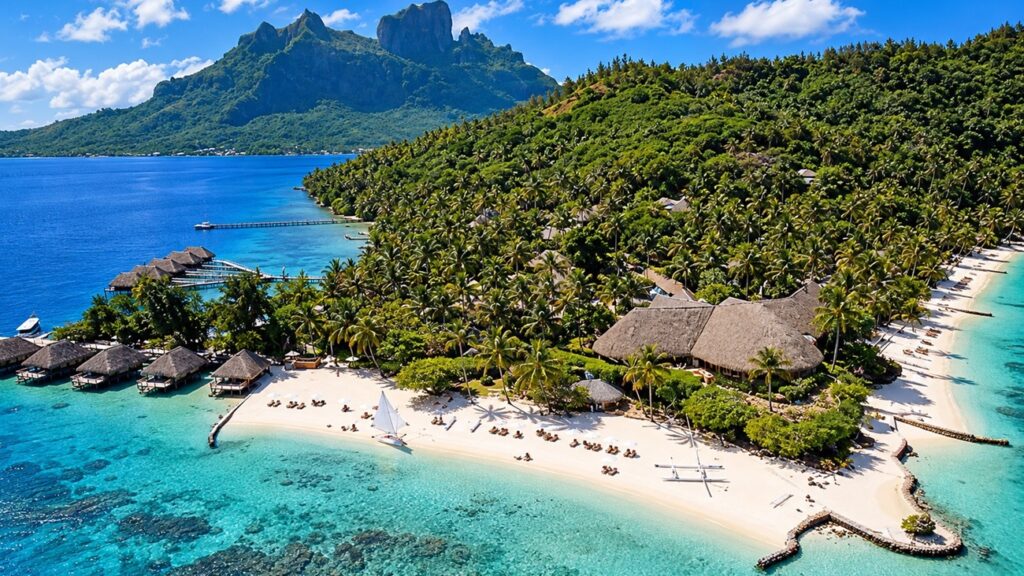
Hotel Bora Bora opened in 1961 as the island’s first major hotel, with a setting that still reads like a blueprint for tropical escapism.
Positioned on Pointe Raititi near Matira Beach, the property sat between Bora Bora’s luminous lagoon and its volcanic interior, with views toward Mount Otemanu and the surrounding islands.
It began modestly, with 18 thatched-roof huts, but its influence grew far beyond its original scale.

In 1970, the hotel introduced overwater bungalows, giving guests the now-familiar experience of sleeping directly above the lagoon.
That idea became inseparable from French Polynesia’s identity and later spread across the luxury resort world, from the Maldives to Southeast Asia.
Few hotel concepts have traveled as widely, and fewer still can be traced so clearly to a single South Pacific address.

Aman’s long pause in French Polynesia
The hotel joined Aman in 1988, the same year the hospitality group was founded.
At the time, Aman was beginning to define a quieter form of luxury, one built around privacy, careful design and a strong relationship with place rather than overt spectacle.
Hotel Bora Bora suited that philosophy almost instinctively.
It had history, landscape and a sense of retreat that could not be manufactured on demand.
The interruption came in October 2008, when the property closed for what was intended to be a complete reconstruction.
The ambition was to bring the resort back in time for its 50th anniversary in 2011, with a refreshed identity and a renewed future.
That reopening never happened.
Years passed, timelines slipped away, and one of Bora Bora’s most meaningful hotel sites remained dormant while the island’s luxury scene continued to expand elsewhere.
A cautious path toward a possible comeback
The latest indications are encouraging, but they need to be read with restraint.
A coordination meeting involving Bora Bora’s mayor and representatives connected to the project, including Aman representatives, has been linked to preparations for future construction.
The discussions are understood to have involved infrastructure, utilities and work tied to the surrounding road network.
Those details may sound less romantic than villas, pools and spa pavilions, but they’re often the real signs that a complex island redevelopment is moving beyond conversation.
A construction start target of 16 May 2026 has also circulated in connection with the project, though Aman has not publicly announced a formal timeline.
The redevelopment could take several years if it proceeds, which means travelers shouldn’t expect an imminent opening.
There is also no confirmed room count, accommodation plan, final resort name or booking window.
That uncertainty matters, particularly with a property carrying this much history and expectation.
How a new Aman could differ from Bora Bora’s motu resorts
If Aman does return, the site itself gives the project a distinct advantage.
Many of Bora Bora’s best-known luxury resorts occupy private motus, offering a highly controlled island-within-an-island experience.
Pointe Raititi is different.
Its proximity to Matira Beach and position on the main island could allow a revived resort to feel more connected to Bora Bora’s original hotel culture, rather than simply repeating the familiar overwater-villa formula.
The strongest version of the project would likely need to balance memory and modernity.
Guests would expect Aman’s restraint, privacy and service, but the property’s history asks for something more specific than a polished new-build resort.
It would need to acknowledge the landscape, the vegetation, the lagoon and the legacy of the hotel that helped shape how the world imagines a South Pacific escape.
For now, the sensible position is patience.
After nearly two decades of silence, even the possibility of serious movement at the former Hotel Bora Bora site is significant.
If Aman’s return eventually becomes official, it won’t just mark another high-end opening in French Polynesia. It would bring one of luxury travel’s most influential addresses back into the conversation.