The electric top-speed fight is moving into territory once reserved for the most extreme combustion hypercars.
BYD has confirmed that the Yangwang U9 Xtreme will attempt to pass 500 km/h this November, a figure that converts to roughly 310 mph.
It’s a bold next step for a car that has already clocked 496.22 km/h, or 308.33 mph, at Automotive Testing Papenburg in Germany.

At a glance
- Yangwang will attempt to push the U9 Xtreme beyond 500 km/h this November.
- The electric hypercar uses BYD’s quad-motor e4 platform with a claimed 2,977 hp.
- The run is expected to take place at Automotive Testing Papenburg, where the car previously reached 496.22 km/h.
A 500 km/h target for Yangwang
The announcement was made during the Goodwood Festival of Speed by BYD vice president Stella Li, putting a clear marker down for the brand’s most extreme performance project.
The target is simple, even if the engineering behind it is anything but.
Breaking the 500 km/h barrier would move the U9 Xtreme from near-miss territory into one of the most closely watched speed milestones in modern car culture.
The location matters too.
Automotive Testing Papenburg is a 12.3 km high-speed oval in Germany, giving manufacturers the kind of controlled environment needed for sustained maximum-velocity running.
The U9 Xtreme has already proven itself there, with its 496.22 km/h run making it one of the most significant electric performance cars yet.
The electric hardware behind the run
The U9 Xtreme is not simply a regular U9 with a bigger number attached to it.
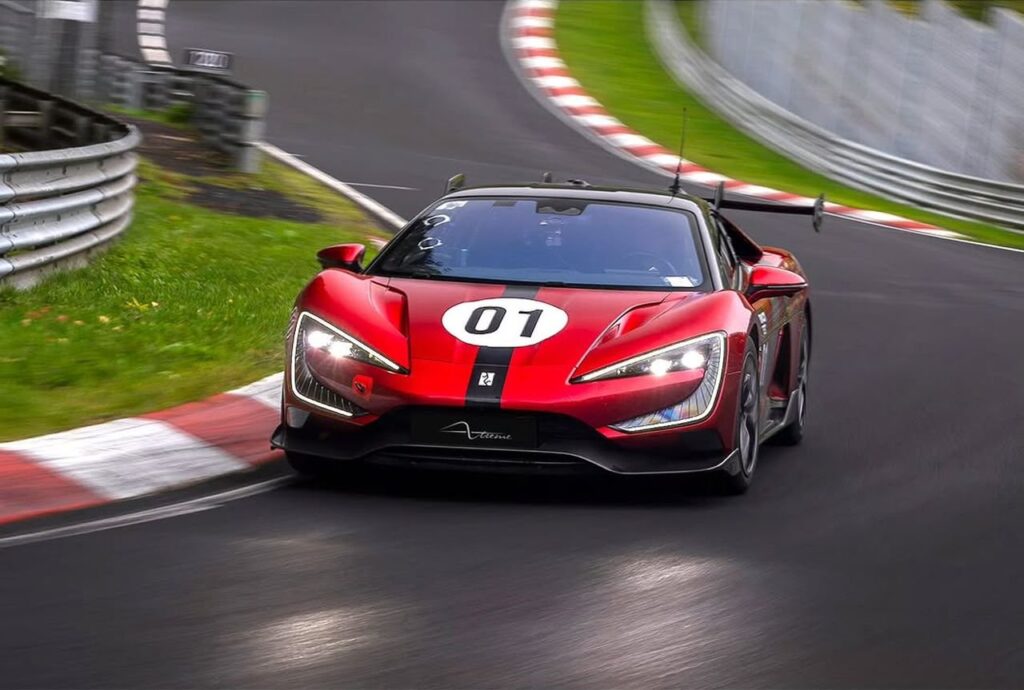
It’s a heavily reworked version of Yangwang’s electric supercar, built around BYD’s quad-motor e4 platform and tuned to produce a claimed 2,977 hp.
That output puts it well beyond the traditional hypercar conversation and into a small group of experimental-feeling production machines chasing the limits of tyre, aero and drivetrain control.
The visual changes tell the same story.
Yangwang has fitted the car with a towering swan-neck rear wing, a deep carbon front splitter and a race-influenced rear diffuser, all of which point to the stability demands of running at more than 300 mph.
At these speeds, the question isn’t only how much power a car can make.
It’s also how cleanly it can move through the air, how confidently it can stay planted and how repeatable the whole package is under enormous load.
Why this matters for BYD
BYD is already one of the defining names in the global electric car market, but the U9 Xtreme plays a different role from the company’s volume models.
This is brand-building through engineering spectacle.
For Yangwang, the performance sub-brand sitting at the more rarefied end of BYD’s portfolio, a 310 mph attempt is a way to show technical capability in a language enthusiasts understand instantly.
Top-speed records are rarely practical, but they’re culturally powerful.
They turn motor, battery, software, aero and chassis development into one number that can travel far beyond the engineering community.
The U9 Xtreme also arrives at a moment when electric performance cars are no longer judged solely by acceleration.
Sustained high-speed ability is becoming a more serious measure of thermal management, stability and total system durability.
Details & Specifications
| Brand | Yangwang |
|---|---|
| Parent company | BYD |
| Model | U9 Xtreme |
| Powertrain | Quad-motor electric e4 platform |
| Power | 2,977 hp |
| Previous top speed | 496.22 km/h, 308.33 mph |
| Target speed | Over 500 km/h, around 310 mph |
| Expected venue | Automotive Testing Papenburg, Germany |
| Track length | 12.3 km high-speed oval |
| Timing | November 2026 |
| Aerodynamics | Swan-neck rear wing, carbon splitter and race-inspired diffuser |
If Yangwang finds those final few kilometres per hour, the U9 Xtreme won’t just be an unusually powerful electric hypercar.
It will become a very public statement about how quickly China’s most ambitious EV makers are moving into the highest reaches of performance engineering.