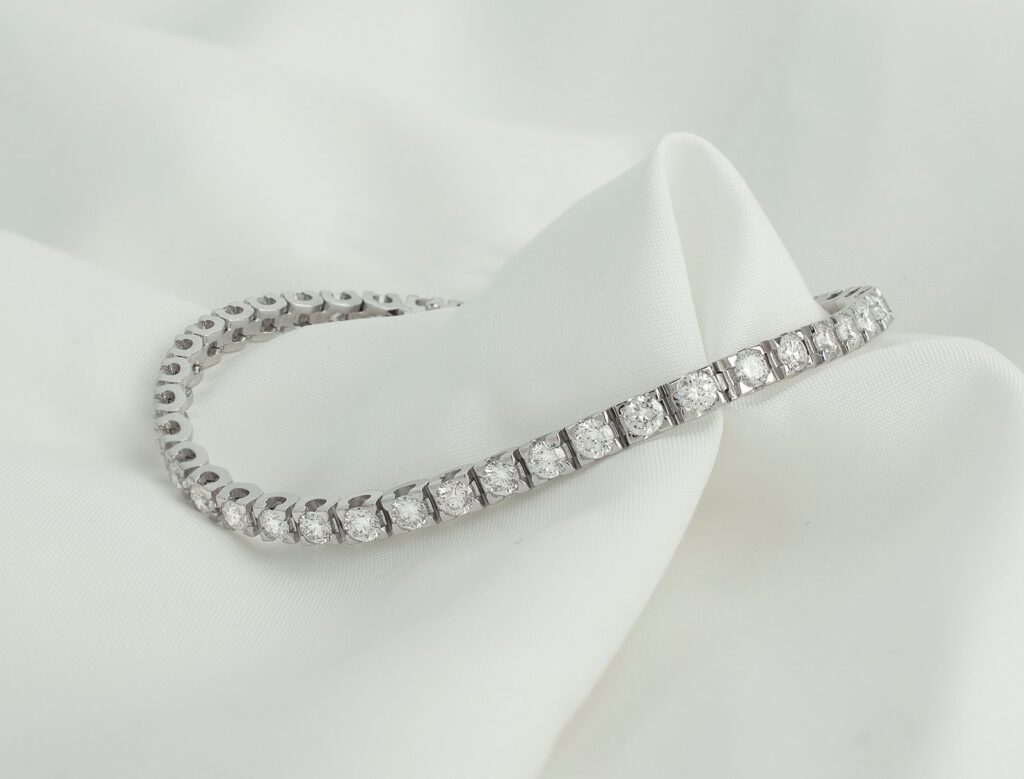
Diamond bracelets have always had a place in fine jewellery, but their appeal feels especially relevant now.
As modern luxury style becomes less rigid, the best diamond bracelets are no longer reserved for eveningwear or major occasions.
They can add quiet polish to tailoring, soften a minimal daytime look, or sit alongside other jewellery as part of a more personal wrist stack.

At a glance
- Diamond bracelets remain enduring luxury pieces because they balance elegance, versatility and personal significance.
- Tennis bracelets, bangles and station bracelets offer different ways to wear diamonds across casual, professional and formal settings.
- Buyers should consider diamond quality, setting style, metal choice, fit, origin disclosure and long-term care before purchasing.
The quiet power of a diamond bracelet
A diamond bracelet works because it doesn’t need to dominate an outfit.
A fine row of diamonds or a discreetly set chain can catch the light without turning the wrist into the entire story.
That balance is central to its staying power.
Diamonds set in gold, platinum or another precious metal have a visual language that survives fashion cycles, yet the way they’re worn continues to evolve.
For some, the attraction is the classic nature of the piece.
For others, it’s the ease with which a bracelet can move between a blazer, a white shirt, a knit, or a black evening dress.
Diamond bracelets also carry emotional weight.
They’re often chosen for anniversaries, birthdays, graduations and other milestones, giving them a role that extends beyond decoration.
The tennis bracelet’s lasting relevance
The tennis bracelet remains one of the most recognisable forms of diamond bracelet.
Its usual formula is simple and effective, with a continuous line of diamonds held in individual settings to create an even rhythm of sparkle around the wrist.
That symmetry gives it a clean, versatile presence.
A slim version can bring refinement to tailored clothing without feeling ornamental in the wrong way.
A more prominent setting or larger stones can suit evening dressing, especially when paired with a cocktail dress or formal outfit.
The same silhouette can also work casually when the proportions are lighter.
Worn with a simple shirt, knitwear or a pared-back dress, a delicate tennis bracelet adds a controlled point of brightness.
Layering is possible, too, though it’s worth being practical.
Bracelets worn together should be chosen carefully so they don’t rub excessively against one another, particularly when diamonds, metal links and polished surfaces are involved.
Beyond the classic line of diamonds
Modern diamond bracelets are not limited to the tennis bracelet.
Bangle designs offer a stronger outline and can work well as standalone pieces, especially for those who prefer structure over fluidity.
Station bracelets create a lighter impression.
With diamonds spaced along a fine chain, they can feel subtle and easy to wear while still introducing precious materials into the look.
Flexible constructions can also make a difference to comfort, allowing the bracelet to move more naturally with the wrist.
Diamond shape is another important visual choice.
Round, oval, emerald and other cuts can shift the mood of a bracelet, changing how formal, graphic or soft it appears.
Metal selection changes the character just as much.
Yellow gold gives warmth, white gold offers a cooler tone, rose gold brings a softer colour, and platinum is valued as a distinct precious-metal option.
The most successful combinations feel intentional rather than crowded.
A diamond bracelet can be part of a layered wrist, but it should still have enough space to be seen and worn comfortably.
What to consider before buying
A diamond bracelet should be judged on more than first impression.
Proportion, setting, material and construction all affect how the piece wears over time.
- Diamond quality Cut, colour, clarity and carat weight influence appearance and price.
- Setting style Prong settings allow more light to reach the stones, while bezel settings surround diamonds with metal for a different look.
- Fit A bracelet should move comfortably on the wrist without feeling too loose or too tight.
- Metal choice Existing jewellery, preferred colour and practical wear all matter.
- Diamond origin Natural and laboratory-grown diamonds have different origins and should be clearly described when sold.
Precious-metal markings are also worth understanding.
In the United States, the Federal Trade Commission provides guidance on buying platinum, gold and silver jewellery, including common quality marks and descriptions.
Disclosure rules can vary by country, so buyers should check the requirements that apply in their own location.
Care that keeps the sparkle wearable
Even durable jewellery benefits from careful habits.
Diamond bracelets should be removed before strenuous activity, swimming or household cleaning to reduce avoidable wear or damage.
Storage matters as well.
Keeping jewellery separate helps prevent scratches, tangling and contact damage from other pieces.
Cleaning should be gentle and appropriate for the bracelet’s materials.
Clasps and settings also deserve periodic checks, particularly on bracelets with multiple stones or delicate fastening systems.
For pieces worn often, professional inspection can be a sensible part of long-term care.
A diamond bracelet’s appeal lies in the way it can feel both considered and effortless.
Chosen well, it becomes less about occasion dressing and more about a personal signature that can stay in a wardrobe for years.