
At a certain point, wealth stops being simply a question of earning well and starts to become a matter of structure.
For UK residents with rising income, property, investments or business interests, understanding high net worth status can help clarify the level of planning their finances may now require.
The label isn’t just about prestige. It can shape how tax affairs are managed, how assets are organised and when specialist advice becomes prudent.
At a glance
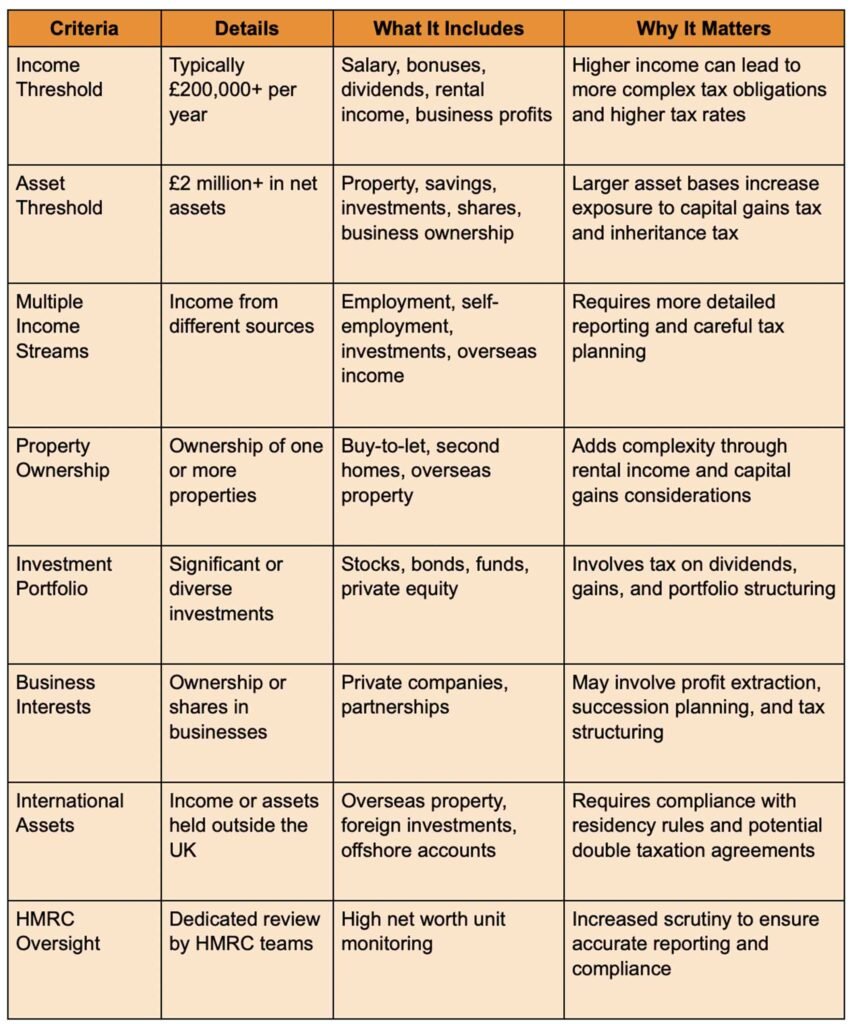
- In the UK, high net worth status is commonly linked to annual income of around £200,000 or more, or net assets of £2 million or above.
- Net assets typically include property, savings and investments, while ordinary personal possessions are usually excluded unless they have investment value.
- The category matters because higher wealth often brings more complex tax, reporting and long-term planning considerations.
How high net worth status is usually defined
There is no single public list that declares someone a high net worth individual in the UK.
In practical terms, the classification is often used by financial institutions and HM Revenue and Customs to identify people whose financial arrangements may be more complex than the average taxpayer’s.
A commonly used benchmark is annual income of approximately £200,000 or more, or net assets worth £2 million or above.
Those assets can include property, savings, investment portfolios and business interests, depending on the context.
Everyday personal items are not usually counted unless they carry a clear investment value, such as certain collectibles, jewellery or art held as part of a wider wealth strategy.
Why the label matters in practice
High net worth status is less about a title and more about the complexity that tends to follow wealth.
Someone with a single salary may have relatively straightforward tax affairs, even at a high income level.
Someone with company dividends, rental income, investment gains, overseas assets and estate planning concerns is in a very different position.
As wealth grows, the timing of income, asset sales, gifting and reinvestment can materially affect tax exposure.
That is why high net worth individuals often need more structured financial planning, not only to stay compliant but to make decisions with a clearer long-term view.
The UK taxes that need closer attention
High net worth individuals are taxed under the same UK tax system as everyone else, but the number of moving parts is often greater.
Income tax remains central, particularly for those earning above £100,000, where the personal allowance begins to taper.
For every £2 earned above that threshold, £1 of personal allowance is withdrawn, which can create a particularly high effective tax rate within that band.
The additional rate of income tax applies to income above £125,140, where earnings are taxed at 45%.
For those with salary, bonuses, rental income or business profits, each income stream needs to be reported accurately and considered in the context of the full tax year.
Capital gains tax is another major consideration, especially where shares, investment portfolios or additional properties are sold at a profit.
For higher-rate taxpayers, gains on most assets are commonly taxed at 20%, while gains on residential property can be taxed at 24%.
The annual capital gains tax exemption is currently £3,000, which means larger disposals can quickly create a taxable gain.
Dividend income also needs careful handling for investors and business owners.
After the current dividend allowance of £500, dividend income is taxed according to the individual’s tax band, with additional rate taxpayers facing rates of more than 39%.
Inheritance tax becomes increasingly important once property, investments and business assets push an estate beyond the standard nil-rate band of £325,000.
A residence nil-rate band may also apply in certain circumstances, but estates above the relevant thresholds can face inheritance tax at 40%.
Overseas assets and cross-border wealth
International elements can make high net worth finances significantly more complicated.
Overseas property, foreign income, offshore investments or business interests can all affect UK reporting obligations.
Residency status plays a central role in how worldwide income is treated for UK tax purposes.
Domicile can also be relevant in certain tax contexts, particularly where long-term wealth and estate planning are involved.
Double taxation agreements between the UK and other jurisdictions can help prevent the same income being taxed twice, but they do not remove the need for accurate reporting.
Currency movements, differing tax years and local rules can all influence the final position.
When to review your position
The moment to review your financial position is usually before complexity becomes difficult to manage.
A promotion, business sale, inheritance, property gain or successful investment period can all move someone into high net worth territory faster than expected.
Regular reviews can help identify whether allowances are being used efficiently, whether assets are structured sensibly and whether future liabilities are being managed in good time.
For many affluent individuals, the value of advice is not only in reducing tax exposure, but in avoiding mistakes that become expensive later.
High net worth status is ultimately a signal that personal wealth has reached a level where organisation matters as much as accumulation.
Understanding where you stand gives you a better chance of protecting what you’ve built, planning with intent and keeping your financial life proportionate to the scale of your assets.