Rolls-Royce has never treated Bespoke as a menu of options, and Ghost Savile Row makes that point with unusual precision.
This one-of-one Ghost Extended commission takes the visual language of British tailoring and translates it into paint, leather, wood, embroidery and the kind of hidden detail that rewards a closer look.
It’s a car shaped less by spectacle than by personal style, with Savile Row’s quiet discipline running through almost every surface.

At a glance
- Rolls-Royce has created Ghost Savile Row, a one-of-one Ghost Extended commission inspired by bespoke British tailoring.
- The car combines Midnight Sapphire over English White paint with a hand-painted Silver Featureline and a richly detailed Navy Blue and Arctic White interior.
- Its hidden rear-armrest embroidery uses 250,000 stitches and 1,830 metres of thread, making it a major showcase for Rolls-Royce Bespoke craftsmanship.
A Ghost Extended cut from a Savile Row cloth
The idea behind Ghost Savile Row is direct but carefully handled.
Rather than cover the car in obvious menswear references, Rolls-Royce has treated the Ghost Extended like a tailored suit, using proportion, contrast and restraint as the starting point.
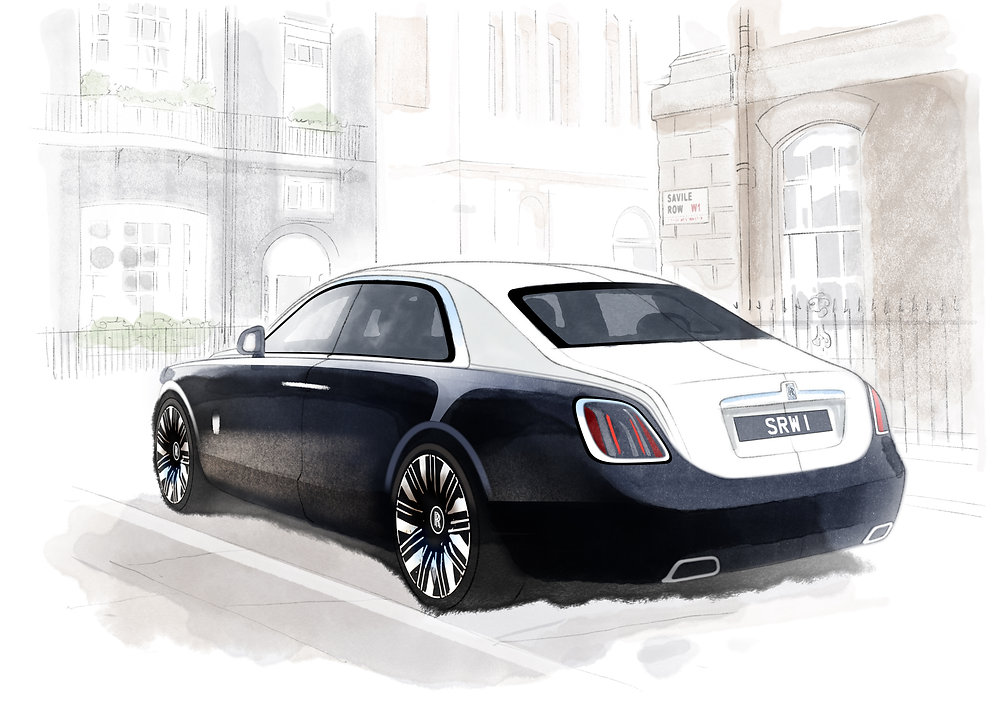
The exterior is finished in a two-tone combination of Midnight Sapphire over English White, a palette that recalls a navy suit worn with a crisp white shirt.
That pairing has deep roots in British dress, with understated dark tailoring and pale shirting becoming part of modern menswear’s vocabulary in the early 19th century.
In place of a conventional coachline, the car receives a hand-painted Silver Featureline.
It sits within the English White upper section rather than dividing the two colours, giving the car a small flash of brightness in the manner of cufflinks, a dress watch or a pocket detail against a white shirt.
The exterior is completed with 22-inch nine-spoke part-polished wheels, finished with body-coloured centres.
The Goodwood embroidery hidden behind the rear armrest
The most elaborate flourish in Ghost Savile Row is deliberately out of sight until the rear centre armrest is lowered.
Behind it sits a Bespoke embroidery inspired by the colourful lining of a tailored jacket, a private gesture rather than a public display.
The artwork shows a plan view of the square trees in the courtyard at the Home of Rolls-Royce at Goodwood, along with the shadows they cast.
Rolls-Royce developed a new stitch style for the commission, designed to resemble the interlocking threads of woven cloth laid into leather.
The result is described by the marque as its most demanding single-frame embroidery to date.
It uses seven colours, takes nine hours to create and comprises 250,000 stitches, with 1,830 metres of thread running through the composition.
It’s the kind of detail that neatly captures the car’s point of view.
The showmanship is there, but it’s reserved for the person who knows where to look.
Pinstripes, pocket-square cues and quiet cabin work
The cabin continues the tailoring theme with Navy Blue and Arctic White leather, Selby Grey detailing and a series of small decisions that feel closer to garment construction than automotive decoration.
The carpets, lambswool floor mats and seatbelts are finished in Navy Blue, while the seat and door piping, contrast stitching and embroidered RR monograms are picked out in Selby Grey.
Rolls-Royce has used a Bespoke vertical run-stitch on the seats, inspired by the pinstripe of a tailored suit.
This marks the first time the brand has applied a pinstripe stitch to its seats.
The stitch is aligned to the geometry of each seat, with the centre seam of each seat back meeting the vertical embroidery of the Arctic White insert above.
Set against the Navy Blue leather, those white inserts read like pressed pocket squares tucked into a jacket.
Each of the four inserts contains more than 16,600 stitches, worked tone-on-tone in two directions to suggest the warp and weft of woven fabric.
The fascia, steering-wheel spoke and door uppers use Tactile Open Pore White Wood veneer, while Black Wood appears on the centre console lids.
Smaller cabin details carry the same attitude, including a leather-wrapped indicator stalk with Arctic White stitching, an Arctic White leather-wrapped volume control and Navy Blue leather-wrapped climate controls.
Mayfair heritage translated into modern Bespoke work
The connection between Rolls-Royce and Savile Row isn’t simply thematic.
Rolls-Royce opened its first showroom in 1905 on Conduit Street in Mayfair, only a short walk from the tailoring houses that helped define the Row’s reputation.
The language of Bespoke also has a natural connection to tailoring, where cloth could be spoken for by an individual client long before the word became central to modern luxury.
Ghost Savile Row leans into that shared vocabulary without turning the car into a costume.
It reads as a highly personal commission, not a themed edition chasing attention.
Bespoke illuminated treadplates on all four door sills repeat the hidden embroidery motif, while the car’s stored umbrellas are finished with Navy Blue canopies, Selby Grey beading and Arctic White handles.
Even the umbrellas behave like finishing accessories, completing the commission with the same care given to a tailored overcoat or evening suit.
Details & Specifications
| Brand | Rolls-Royce |
|---|---|
| Model | Ghost Savile Row |
| Body style | Ghost Extended one-of-one commission |
| Exterior finish | Midnight Sapphire over English White two-tone |
| Exterior detail | Hand-painted Silver Featureline |
| Wheels | 22-inch nine-spoke part-polished wheels with body-coloured centres |
| Interior leather | Navy Blue and Arctic White |
| Interior accents | Selby Grey piping, contrast stitching and embroidered RR monograms |
| Veneer | Tactile Open Pore White Wood with Black Wood centre console lids |
| Embroidery | Hidden rear-armrest artwork with seven colours, 250,000 stitches and 1,830 metres of thread |
| Production | One-of-one Bespoke commission |
Ghost Savile Row works because it understands the difference between being dressed up and being well dressed.
Its references are specific, its craftsmanship is demanding and its most extravagant moment remains hidden until invited, which feels entirely appropriate for a Rolls-Royce shaped by the codes of Savile Row.