Monaco’s Exotic Garden is back, and its return feels bigger than a simple reopening.
After six years of renovation, the Jardin Exotique de Monaco reopened on March 30, 2026, restoring a cliffside landmark that has long offered one of the Principality’s most memorable meetings of botany, architecture and Mediterranean spectacle.
For visitors, the appeal is still the same at heart, with sculptural succulents, vertiginous paths and sweeping views over Monaco, now supported by a more secure and more contemporary visitor experience.

At a glance
- The Jardin Exotique de Monaco reopened on March 30, 2026 after six years of extensive renovation.
- The refreshed site adds safer pathways, reinforced walkways, panoramic viewing routes, a children’s play area and a redesigned entrance.
- The reopening restores one of Monaco’s signature visitor attractions, known for rare succulents, cliffside views and the Observatory Cave.
A cliffside landmark made easier to explore
The garden’s setting has always been part of its drama.
Built into steep terrain above the Mediterranean, it asks visitors to move through a vertical landscape where cacti, agaves and aloes frame views of Monaco’s dense urban fabric below.
The renovation focused heavily on safety and accessibility, with new pathways and reinforced walkways designed to make the site more comfortable without flattening its character.

That balance matters, because the Exotic Garden’s appeal has never been a manicured flatness, but the feeling of discovering an improbable botanical collection suspended above the sea.
New panoramic walkways now sharpen that experience, giving visitors fresh places to pause and take in the coastline, the harbour and the layered architecture of the Principality.
New spaces for a more contemporary visit
The upgrades go beyond the circulation routes.

The entrance area has been redesigned, creating a clearer and more polished arrival at a site that often serves as a first or last stop for travellers moving through Monaco.
A bar with a 40-square-meter terrace adds a natural pause point, giving the garden a more relaxed rhythm for visitors who want to linger rather than simply pass through.
There is also a dedicated children’s play area, along with a space intended for private celebrations such as birthdays.

These additions bring a practical layer to the garden without shifting its identity away from nature, geology and spectacle.
Royal attendance for a symbolic reopening
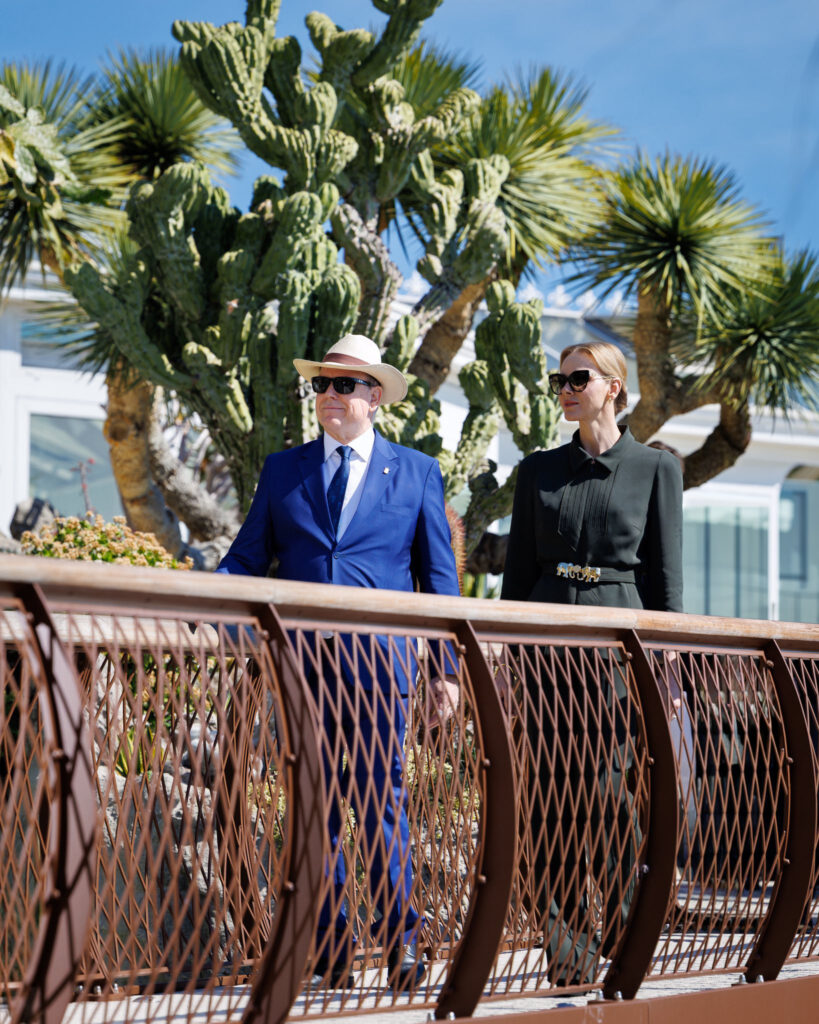
The reopening carried civic weight in Monaco, underscored by the presence of Prince Albert II and Princess Charlène.
Princess Caroline of Hanover also attended, alongside Minister of State Christophe Mirmand, Archbishop Dominique-Marie David, Monaco Mayor Georges Marsan and Diane Ortolani, Director of the Exotic Garden.

During the visit, the royal couple received an Aloe Caesia, a succulent species native to South Africa.
It was a fitting gesture for a garden whose identity has always been tied to plants that thrive in demanding climates and sculptural forms.
A garden shaped by plants, rock and time
The roots of the Jardin Exotique stretch back to the late 19th century, when Augustin Gastaud, head gardener of the Saint-Martin gardens near the Oceanographic Museum, cultivated a collection of succulents, many from Mexico.

Prince Albert I saw the potential for a dedicated garden, and a steep site above the Révoires district was eventually chosen for the project.
Work began in 1913 under engineer Louis Notari, with the difficult topography and the movement of mature plants making construction a long and complex undertaking.
The garden was inaugurated by Prince Louis II on February 13, 1933.

Its early nickname, the Hanging Gardens, captured the way the site appeared to cling to the rock before it became widely known as the Exotic Garden of Monaco in the 1940s.
The Observatory Cave adds another layer to the visit.
Discovered in 1916 during construction and opened to the public in 1950, the cave gives the site a geological counterpoint to its botanical collection.

Today, the garden’s plants come from arid regions across the world, including the southwestern United States, Mexico, Central and South America, Africa and the Arabian Peninsula.
Its flowering calendar is one of its quieter pleasures, with African species such as aloe and crassula typically blooming in winter, while many cacti flower in spring and summer.
For Monaco in 2026, the return of the Exotic Garden is more than a restored attraction.

It is the revival of a place where the Principality’s taste for refinement meets something older and less predictable, with stone, sea air and resilient plants doing most of the talking.