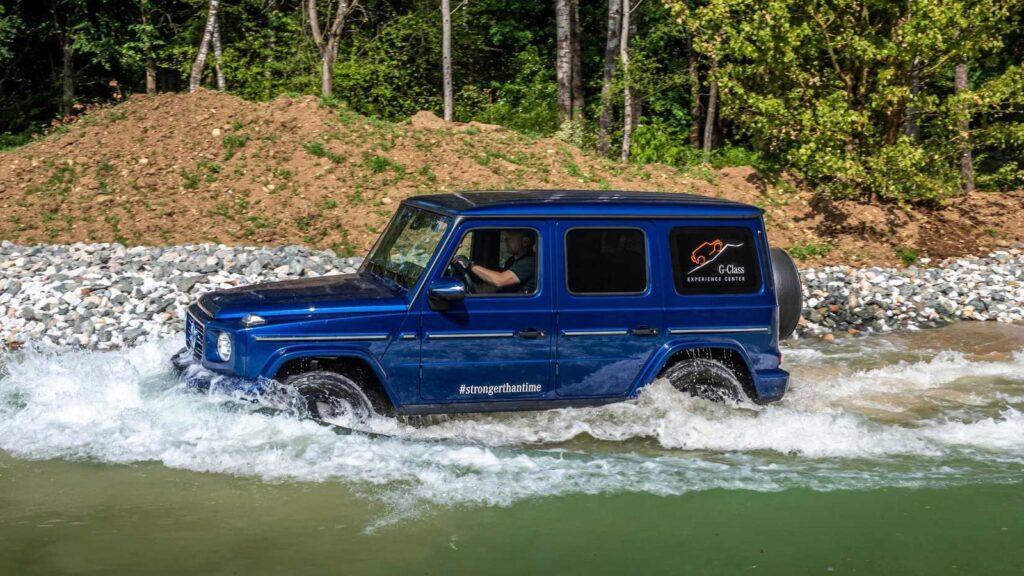
The electric Mercedes-Benz G-Class already feels like a natural test bed for unusual off-road ideas.
With four individually controlled motors and the kind of terrain brief that invites overengineering, the G 580 with EQ Technology is now linked to a patent that imagines something well beyond deep-water wading.
The idea is simple in concept and deeply eccentric in execution, turning the boxy electric 4×4 into a vehicle that could float and manoeuvre across water.
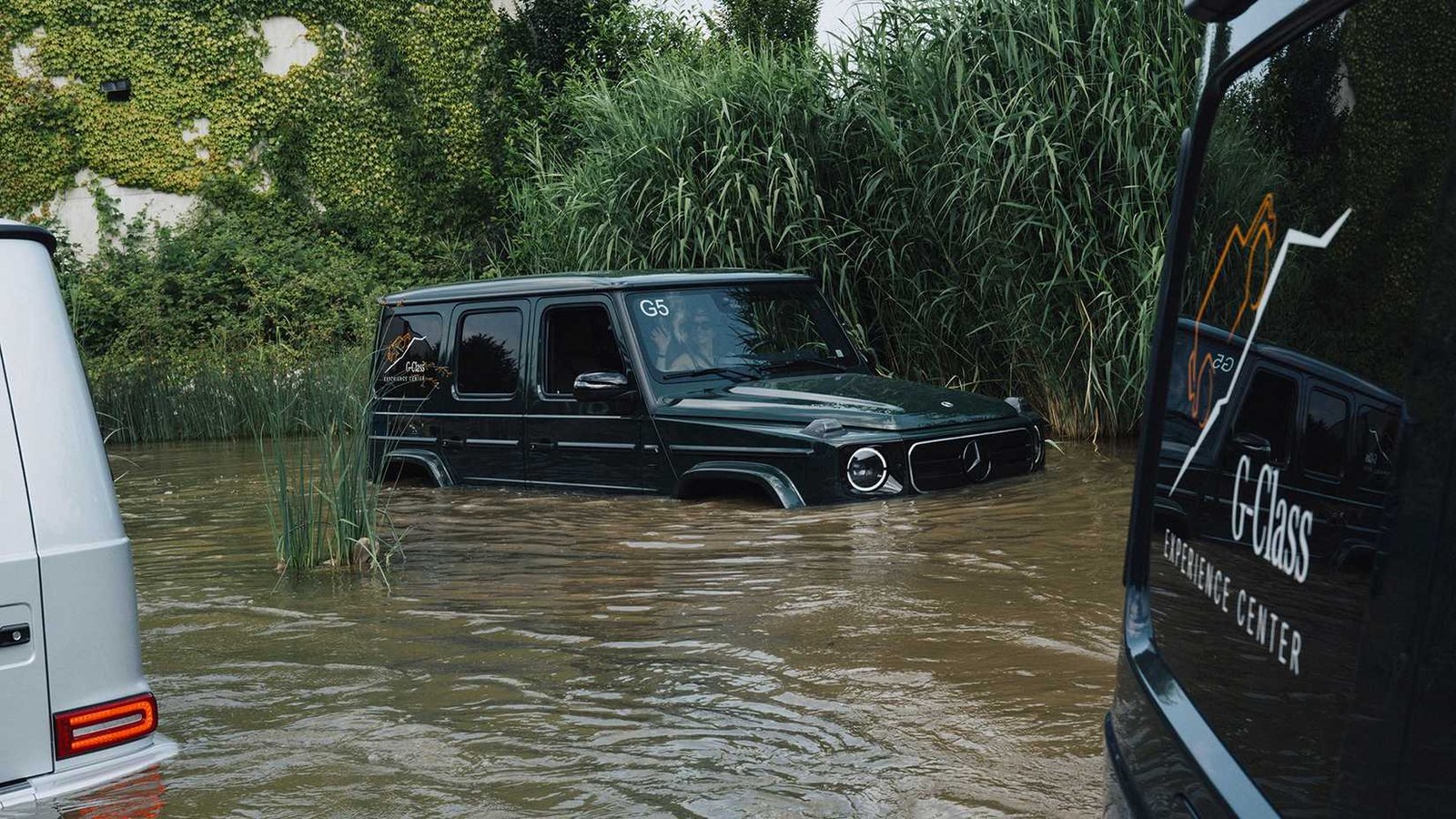
At a glance
- Mercedes-Benz has patented a system that could help an electric G-Class float and travel across water.
- The concept uses removable inflatable or foam buoyancy sections positioned in the wheel arches.
- It remains an engineering concept for now, with no confirmed production plan or launch timing.
How the G-Class flotation system would work
The patent describes buoyancy modules that could be fitted inside the wheel arches of a Mercedes-Benz G-Class.
These sections could be inflatable or made from foam, giving the vehicle enough additional displacement to stay afloat rather than simply wade through water.
What makes the idea more interesting is that the buoyancy wouldn’t necessarily be fixed.
The system could adjust the volume of each section independently, helping compensate for uneven vehicle loads, current, or movement in the water.
That matters because a large SUV floating on water has to manage balance as much as forward motion.
A G-Class carrying passengers, luggage, recovery gear, or roof-mounted equipment could sit unevenly without some form of adjustable support.

Four electric motors could help it steer on water
The electric G-Class gives Mercedes an unusually flexible starting point for this kind of idea.
The G 580 with EQ Technology uses four individually controlled electric motors, one for each wheel, which opens up possibilities that a conventional driveline can’t easily match.
On water, the wheels could remain steerable and act partly like rudders.
Mercedes also outlines the possibility of varying torque between the wheels or spinning them in opposite directions, allowing the vehicle to influence its direction while afloat.
In theory, that could help the SUV point itself toward shore or manoeuvre through slow-moving water without relying on a separate marine propulsion system.
It’s a very G-Class answer to a very niche problem, using the vehicle’s existing hardware in a more extreme operating environment.

Storage and inflation keep the concept self-contained
The proposal also considers how the equipment could live on the vehicle when it isn’t being used.
One possibility is storing the flotation elements around the spare-wheel area, a neat fit for the G-Class’s rear-mounted wheel architecture.
Inflation could be handled by the vehicle’s tyre compressor, which would make the system more self-contained and reduce the need for extra external equipment.
That detail is important because an amphibious add-on only makes sense for an off-road vehicle if it can be deployed without turning into a separate expedition project.
Details & Specifications
| Brand | Mercedes-Benz |
|---|---|
| Model | G 580 with EQ Technology |
| Concept | Patent for a flotation system that could allow the electric G-Class to travel across water |
| Buoyancy system | Removable inflatable or foam sections positioned inside the wheel arches |
| Adjustment | Independently variable buoyancy volume for each section |
| Drivetrain relevance | Four individually controlled electric motors could vary wheel torque for movement and steering on water |
| Steering approach | Steerable wheels could act like rudders |
| Storage concept | Potential storage around the spare-wheel area |
| Inflation concept | Could use the vehicle’s tyre compressor |
| Status | Patent concept only, with no confirmed production plan |
A clever idea rather than a showroom promise
A patent doesn’t mean Mercedes is preparing to sell an amphibious G-Class.
Automakers regularly protect ideas that may never reach production, especially when a new electric platform creates unusual engineering possibilities.
Still, the concept fits the G-Class character better than it might first appear.
This is a vehicle with decades of military, utility and off-road credibility, now reinterpreted through electric drive and software-controlled torque.
If nothing else, the filing shows how Mercedes is thinking about the electric G-Class as more than a battery-powered version of an icon.
For collectors, off-road enthusiasts and anyone who enjoys the stranger edges of automotive engineering, the idea of a floating G-Class is exactly the kind of unlikely concept that makes the electric era more interesting.