LVMH’s latest quarterly numbers show a luxury market still moving forward, but without the easy acceleration seen in stronger cycles.
The French group posted modest organic growth for the third quarter of 2026, while its Watches & Jewelry division continued to outperform the wider business.
For watch and luxury observers, the figures point to a market where demand hasn’t disappeared, but where regional pressure and uneven category performance are shaping the year.
At a glance
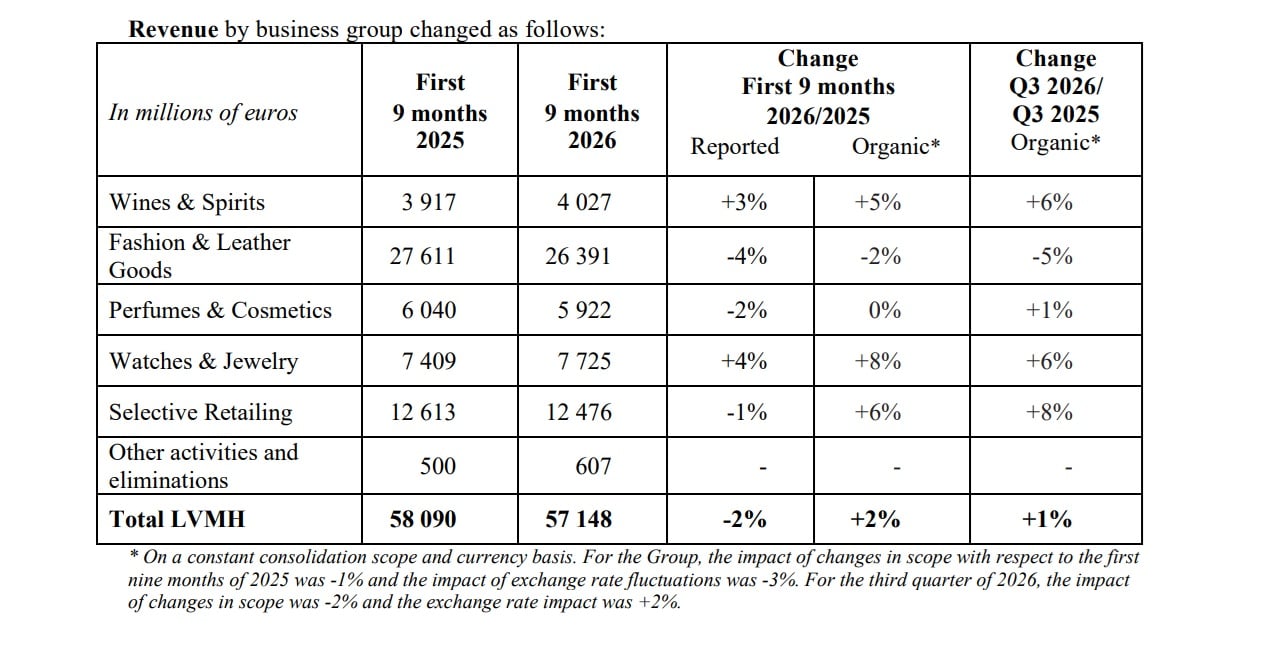
- LVMH recorded organic revenue growth of 1% in Q3 2026 and 2% over the first nine months of the year.
- Watches & Jewelry remained positive, rising 6% organically in Q3 and 8% over the first nine months.
- A softer environment in China weighed on performance, while the United States, Europe and Japan delivered good growth.
Watches & Jewelry remain a relative bright spot
LVMH’s Watches & Jewelry division delivered organic growth of 6% in the third quarter of 2026.
Across the first nine months of the year, the division rose 8% organically, with revenue reaching €7.725 billion.
That performance stands out inside a group where growth has become more selective and less evenly distributed across divisions.
LVMH doesn’t break out individual brand performance within Watches & Jewelry, so it isn’t possible to separate the contribution of jewelry from watchmaking with precision.
Still, the divisional result suggests that high-end watches and jewelry continue to hold up better than some other parts of the luxury market.
Fashion & Leather Goods lose pace
The clearest drag came from Fashion & Leather Goods, historically LVMH’s largest and most powerful growth engine.
The division recorded negative organic growth of 5% in the third quarter and was down 2% over the first nine months of 2026.
Revenue for Fashion & Leather Goods reached €26.391 billion over the first nine months, keeping it by far the group’s largest business area despite the contraction.
The contrast with Watches & Jewelry is notable because it shows how uneven the luxury slowdown has become.
Rather than a uniform pullback, the numbers suggest that consumers are being more selective by category, geography and brand strength.
Regional pressure from China shapes the quarter
LVMH’s third-quarter performance reflected a less buoyant business environment in China.
That softness matters because China has long been one of the most important demand centers for global luxury, particularly for fashion, jewelry and watches.
At the same time, the United States, Europe and Japan recorded good growth, offering some counterweight to weaker conditions in China.
For global luxury groups, this regional split is now one of the most important questions of 2026.
Growth is still present, but it’s coming from a more complicated map than in previous high-growth years.
Market reaction remains cautious
For the first nine months of 2026, LVMH reported revenue of €57.148 billion and organic growth of 2%.
The third-quarter figure of 1% organic growth points to a business that remains resilient, but no longer has the same broad momentum across all divisions.
Investor sentiment has reflected that more cautious view.
LVMH shares have fallen by about 40% since the beginning of the year, closing at €384.50 on Monday, October 12, before the earnings announcement.
For collectors and luxury watchers, the Watches & Jewelry numbers offer one of the more encouraging signals inside the group’s results.
The broader picture is more restrained, but the category continues to show why hard luxury can behave differently when the cycle turns more demanding.