BOVET’s watchmaking has always carried a theatrical quality, from its inclined architecture to its ornate handcrafts, but the drama only works because the engineering beneath it is unusually self-reliant.
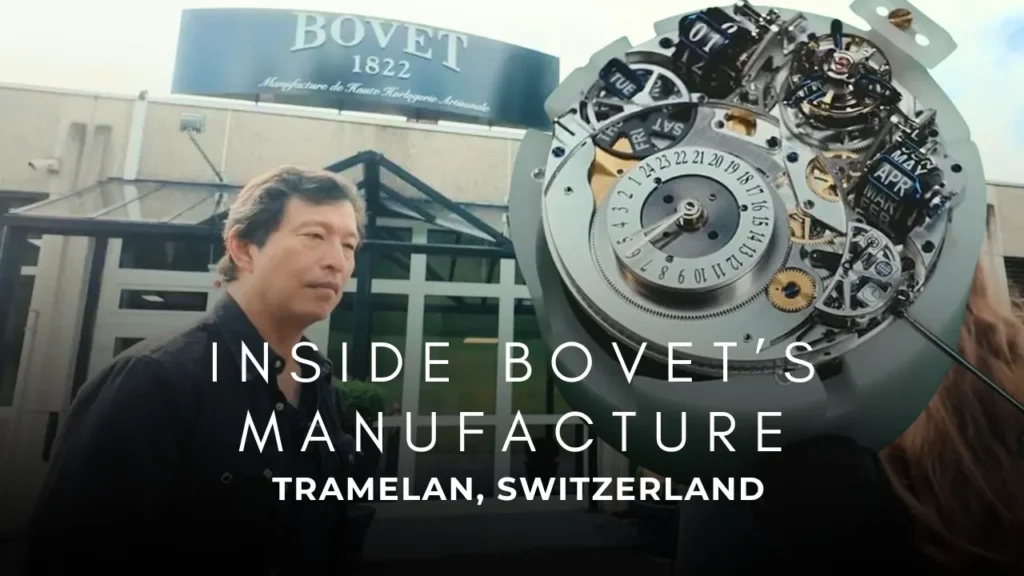
At the brand’s manufacture in Tramelan, that independence becomes tangible in the form of technical offices, machining rooms, finishing benches and quality checks that shape a watch long before it reaches final assembly.
For an independent house, the scale of internal capability is the story here.
At a glance
- BOVET produces more than 95% of the components used in its timepieces within its own facilities.
- The Tramelan manufacture handles technical development, precision machining, finishing, prototyping and staged quality control.
- The approach gives BOVET unusual independence when creating complex pieces such as the Récital 28 and Récital 30.
Tramelan gives BOVET its technical independence
BOVET’s identity is often associated with the historic Château de Môtiers, where artisanal craft and decorative watchmaking remain central to the house’s character.
Tramelan represents the other half of that equation.
This is where the brand’s mechanical ambition is translated into components, tolerances and production methods precise enough to support its most demanding ideas.
The manufacture produces more than 95% of the components used in BOVET watches, including hairsprings, regulating organs, movement parts, mainplates, dials and, increasingly, cases.
That level of vertical integration is rare among independent maisons and gives BOVET greater control over design, development timelines, quality and long-term technical direction.
It also means a concept can move from an idea to a working calibre with fewer compromises imposed by outside capability.
From the technical office to the manufacture floor
The process begins in the technical office, where new movements and complications are conceived, drawn, tested and refined before components are ever cut.
For a brand known for unconventional displays and complex three-dimensional construction, this early development work is critical.
Once designs move into production, the work becomes a study in incremental precision.
Profile turning, machining and other high-accuracy processes are used to create gear wheels, pinions, screws, barrel components and mainplates.
These parts may appear minute in isolation, but their geometry determines how efficiently energy is stored, transferred and regulated throughout the movement.
Finishing at this level isn’t merely decorative.
Microscopic treatment of surfaces can help reduce friction, improve mechanical efficiency and support reliability across components that interact thousands of times a day.
That functional finishing sits alongside the more visible forms of haute horlogerie finishing collectors expect from BOVET, creating a bridge between performance and beauty.
Prototyping complex ideas into usable watches
BOVET’s more ambitious watches require a close conversation between engineers, watchmakers and production specialists.
The Récital 28 offers a useful lens into that process, as complex mechanisms have to be evaluated not only as concepts but as parts that can be made, adjusted, assembled and serviced.
In this environment, prototyping isn’t a single step.
It is a feedback loop where tolerances, component shapes and functional relationships are tested until the mechanism behaves as intended.
The Récital 30 shows another side of the same discipline.
Technical complexity has little value if the collector’s experience feels awkward, so the manufacture’s challenge is to make sophisticated mechanics feel legible and intuitive on the wrist.
That distinction matters in modern haute horlogerie, where innovation is measured not only by the number of parts or the difficulty of the mechanism, but by how naturally the finished watch communicates its purpose.
Quality control as part of the watchmaking culture
At Tramelan, quality control is built into the progression of a component rather than reserved for the end of the process.
A part must meet expectations before it can move to the next stage, which helps prevent errors from becoming embedded deeper in the movement.
This kind of staged inspection is especially important when so many components are made internally.
The benefit of independence is control, but that control only has value when measurement, inspection and adjustment are treated as everyday disciplines.
Together, the Château de Môtiers and the Tramelan manufacture explain why BOVET occupies such a specific place in independent watchmaking.
One side preserves traditional artistic crafts, while the other provides the industrial and technical backbone needed to create increasingly ambitious mechanical watches.
For collectors, that combination is the real appeal.
BOVET’s watches are expressive objects, but their confidence comes from a manufacture capable of turning difficult ideas into finished horology under its own roof.