Formula 1 is preparing for one of its most significant technical pivots in years.
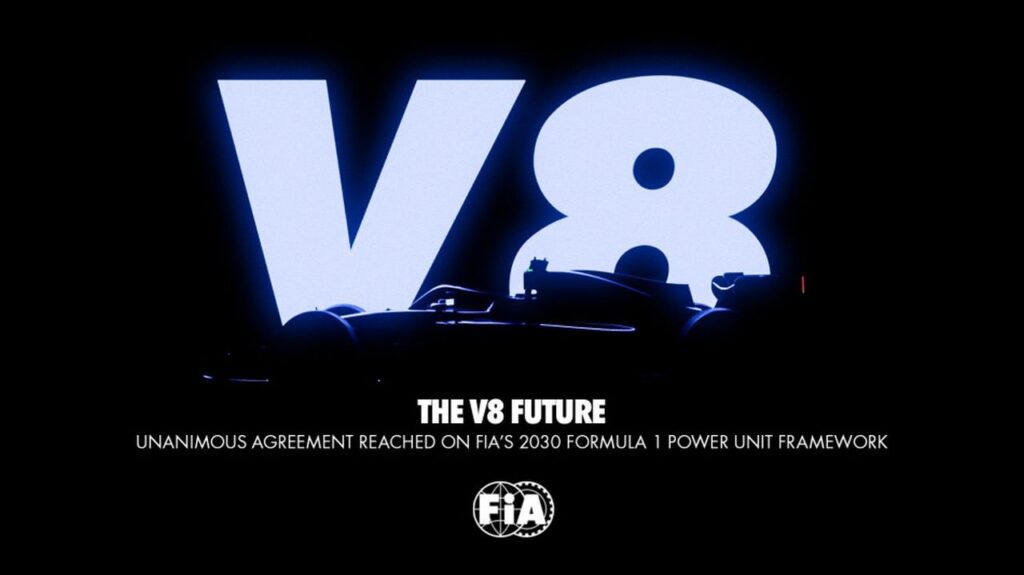
The FIA, Formula One Management, the teams and the sport’s power unit manufacturers have unanimously agreed the 2030 Formula 1 Power Unit technical framework, setting the stage for turbocharged V8 engines to replace the current V6 hybrids.
It’s a move with obvious emotional pull, but the direction is just as much about reducing complexity, weight and cost as it is about sound.

At a glance
- Formula 1 has agreed a 2030 power unit framework that brings back V8 engines.
- The new engines will be 2.1-litre turbocharged V8s with limited hybridisation.
- The FIA says the aim is a lighter, simpler and cheaper power unit paired with a more agile chassis.
A 2030 power unit reset for Formula 1
The new regulations are scheduled to come into effect from the 2030 season.
Under the agreed framework, Formula 1 teams will move to a 2.1-litre turbocharged V8 powertrain, with some geometrical specifics carried over from the current power unit architecture.
The hybrid element won’t disappear entirely, but it will be limited compared with the current V6 hybrid era.
That distinction matters, because Formula 1 isn’t simply returning to its old V8 template.
The previous V8 period was defined by naturally aspirated engines, while the 2030 formula will pair eight cylinders with turbocharging and a reduced hybrid package.
Lighter, simpler and less costly
The FIA’s stated objective is to deliver a power unit that is less complex, lighter and cheaper than the current systems.
The engines will also be matched to a chassis concept described as lighter and more agile, suggesting the 2030 rules are being framed around the overall character of the cars rather than the engine alone.
FIA President Mohammed Ben Sulayem described the agreement as “a significant milestone in shaping the future of Formula 1.”
He said the return of V8 engines is an opportunity to “reconnect with the DNA” of the championship, citing sound, emotion and pure racing as central to the decision.
Ben Sulayem also pointed to “lighter, simpler and more affordable cars” that put driver skill at the heart of competition.
The link to Formula 1’s previous V8 era
Formula 1 last raced with V8 engines before the current V6 hybrid era began.
From 2006 to 2013, the category used 2.4-litre naturally aspirated 90-degree V8 engines, restricted to 18,000 rpm.
Those engines remain closely associated with a very different soundscape and a more immediate character than today’s turbo-hybrid units.
The 2030 framework won’t recreate that period exactly, but it clearly acknowledges the cultural weight those engines still carry with fans.
Details & Specifications
| Series | Formula 1 |
|---|---|
| Technical framework | 2030 Formula 1 Power Unit regulations |
| Engine configuration | Turbocharged V8 |
| Displacement | 2.1 litres |
| Hybrid system | Limited hybridisation |
| Current engine type to be replaced | V6 hybrid power units |
| Confirmed by | FIA, Formula One Management, teams and Formula 1 Power Unit manufacturers |
| Planned introduction | 2030 Formula 1 season |
| Previous F1 V8 era | 2006 to 2013 |
| Previous V8 specification | 2.4-litre naturally aspirated 90-degree V8, restricted to 18,000 rpm |
For Formula 1, the 2030 V8 framework is more than a nostalgic engine choice.
It signals a wider attempt to reshape the cars around lower complexity, reduced weight and a stronger sensory connection with the audience, while keeping a measured link to hybrid technology.