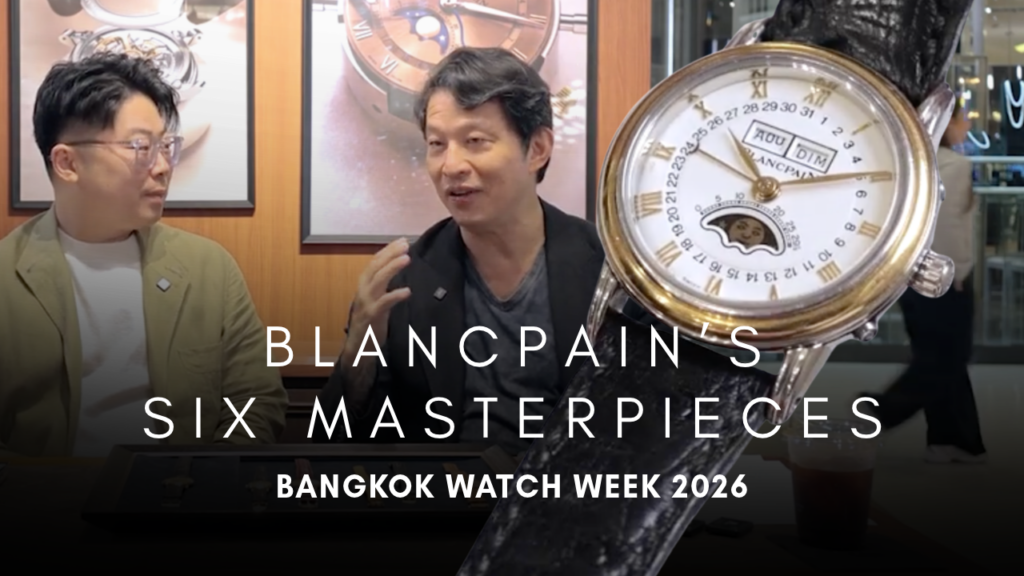
Blancpain’s Six Masterpieces sit at the centre of one of modern watchmaking’s most consequential comebacks.
At Bangkok Watch Week 2026, the maison’s pop-up at Siam Paragon brought renewed attention to the watches that helped reframe mechanical horology after the quartz crisis.
Rather than chase electronic precision, Blancpain leaned into the old language of craft, complication and restraint.
At a glance
- Blancpain’s Six Masterpieces revisited the complications that helped reassert traditional mechanical watchmaking in the 1980s and early 1990s.
- The sequence ranged from calendar and moonphase watches to repeaters, chronographs, a split-seconds chronograph and a flying tourbillon.
- The story culminated in 1991 with the Blancpain 1735 Grand Complication, which united several of those ideas in one watch.
A mechanical answer to the quartz era
When Jacques Piguet and Jean-Claude Biver took control of Blancpain in 1981, Swiss mechanical watchmaking was still recovering from the damage inflicted by quartz technology.
The obvious commercial response would have been to compete on accuracy, price or convenience.
Blancpain chose a more difficult path.
Its argument was that mechanical watchmaking still had a reason to exist when it expressed skill, emotion and complexity that electronics couldn’t meaningfully replace.
That positioning now feels familiar across the luxury watch industry, but in the early 1980s it was a pointed statement of intent.
The Six Masterpieces became Blancpain’s proof of concept, showing collectors that traditional complications could be revived with seriousness rather than nostalgia alone.
The six watches that formed the language
The sequence began with elegant calendar work, including a complete calendar with moonphase that placed classical display and mechanical charm back in the foreground.
A remarkably thin hand-wound Villeret then reinforced another Blancpain theme, one based on discretion rather than visual noise.
From there, the project moved deeper into high complication.
The automatic perpetual calendar carried one of traditional watchmaking’s great intellectual mechanisms into a form intended for regular wear.
The minute repeater added the acoustic dimension, reminding collectors that fine watchmaking could be heard as well as seen.
The automatic chronograph and split-seconds chronograph brought a sportier and more technical edge to the programme, with the latter adding the ability to time split intervals through one of chronograph watchmaking’s most admired mechanisms.
The flying tourbillon completed the arc with a complication strongly associated with horological spectacle and technical theatre.
The people and movements behind the revival
The Six Masterpieces were not only a branding exercise.
They depended on the technical ecosystem around Blancpain, including Jacques Piguet, Jean-Claude Biver, Edmond Capt and the movement resources of Frédéric Piguet.
That last name matters because the period’s credibility rested on real mechanical capacity, not merely the revival of historic terminology.
Blancpain’s watches from this era were built around the idea that complication could return to contemporary collecting with elegance and continuity.
They also helped define what is now often called neo-vintage watchmaking, a category that sits between modern manufacturing and the more fragile world of earlier vintage pieces.
The 1735 Grand Complication brought it together
The culmination arrived in 1991 with the Blancpain 1735 Grand Complication.
It brought together a perpetual calendar, split-seconds chronograph, minute repeater and tourbillon in a single watch.
That combination made the 1735 more than a capstone model.
It served as a statement that the Six Masterpieces were part of a coherent mechanical vocabulary rather than a disconnected run of complicated watches.
More than three decades later, the appeal is partly technical and partly cultural.
Wei Koh has described these watches as some of the most compelling values in collecting today, a view that reflects the growing attention around important neo-vintage complicated watches.
Details & Specifications
| Brand | Blancpain |
|---|---|
| Series | Six Masterpieces |
| Key period | Developed after Jacques Piguet and Jean-Claude Biver took control of Blancpain in 1981 |
| Notable watches and complications | Complete calendar with moonphase, thin hand-wound Villeret, automatic perpetual calendar, minute repeater, automatic chronograph, split-seconds chronograph and flying tourbillon |
| Key figures | Jacques Piguet, Jean-Claude Biver and Edmond Capt |
| Movement context | Supported by the technical resources of Frédéric Piguet |
| Culminating model | Blancpain 1735 Grand Complication |
| 1735 complications | Perpetual calendar, split-seconds chronograph, minute repeater and tourbillon |
| 1735 year | 1991 |
For collectors drawn to the moment when mechanical watchmaking found its modern voice again, Blancpain’s Six Masterpieces remain unusually rich territory.
They’re not merely complicated watches from a transitional era, but a compact history of how confidence returned to Swiss high watchmaking.