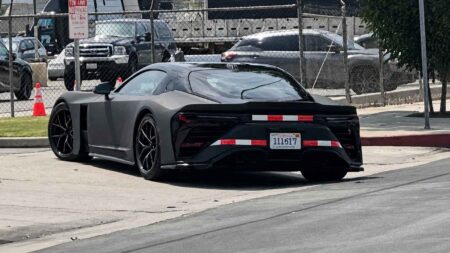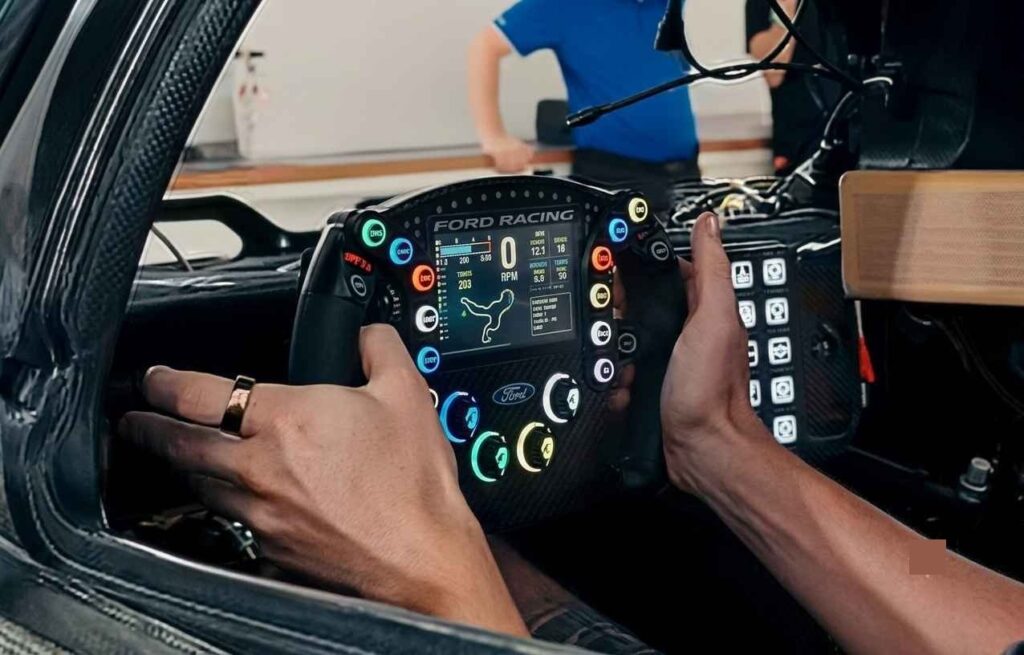
Ford’s return push at the sharp end of endurance racing now has a soundtrack.
The brand’s Le Mans hypercar has completed its first start-up, giving a first listen to a V8 hybrid machine developed for the LMDh rulebook.
It’s an important moment, not because the numbers are wild, but because the project is moving from workshop promise to circuit reality.
At a glance
- Ford’s V8-powered Le Mans hypercar has fired up for the first time.
- The car uses a 5.4-litre Coyote-derived race engine with a regulation hybrid system.
- Track testing is scheduled to begin in August across several European circuits.
A Coyote-derived V8 built for LMDh
The combustion engine starts with Ford’s familiar Coyote architecture, though this is no showroom transplant.
For prototype duty, it has been heavily reworked into a 5.4-litre race unit and paired with the hybrid package required under LMDh regulations.
Total system output is capped at 671 horsepower, a figure that sounds modest beside modern road-going hypercars but makes sense in the context of endurance racing.
At Le Mans and in top-level sports car racing, lap time is only part of the equation.
Efficiency, drivability, thermal control, tyre usage and reliability can matter just as much over a race distance.
Oreca gives the project a serious backbone
The chassis comes from Oreca, the French constructor with deep experience in prototype racing.

That choice gives Ford a proven technical partner at a point where the margins are tight and development time is precious.
In LMDh, manufacturers bring their own powertrain identity and bodywork language to a controlled platform, which places huge importance on integration.
The first start-up is the visible milestone, but the harder work begins once the car starts building mileage at speed.
European testing will put the car in front of its drivers
Ford’s full track development program is due to begin in August, with runs planned across several European circuits.
That phase will give the engineering group its first proper read on cooling, hybrid deployment, systems behaviour and long-run consistency away from static testing.
The factory driver group includes Logan Sargeant, Mike Rockenfeller, Sebastian Priaulx, Matt Campbell, Nick Yelloly and Tom Blomqvist.
It’s a varied line-up, mixing endurance experience with contemporary single-seater and sports car credentials.
For Ford, the months ahead will be less about headline speed and more about learning how the car behaves when the tyres are worn, the fuel load changes and the systems are under pressure.
Details & Specifications
| Brand | Ford |
|---|---|
| Model | Le Mans hypercar |
| Category | LMDh endurance prototype |
| Engine | 5.4-litre V8 race unit derived from Ford Coyote architecture |
| Hybrid system | LMDh regulation hybrid system |
| Maximum output | 671 hp total system output cap |
| Chassis | Oreca |
| Development drivers | Logan Sargeant, Mike Rockenfeller, Sebastian Priaulx, Matt Campbell, Nick Yelloly, Tom Blomqvist |
| Testing | European track program scheduled to begin in August |
The first ignition doesn’t win races, but it marks the moment a program begins to feel real.
For Ford, the next measure of progress will come not from a garage video, but from lap after lap of disciplined development work on European asphalt.