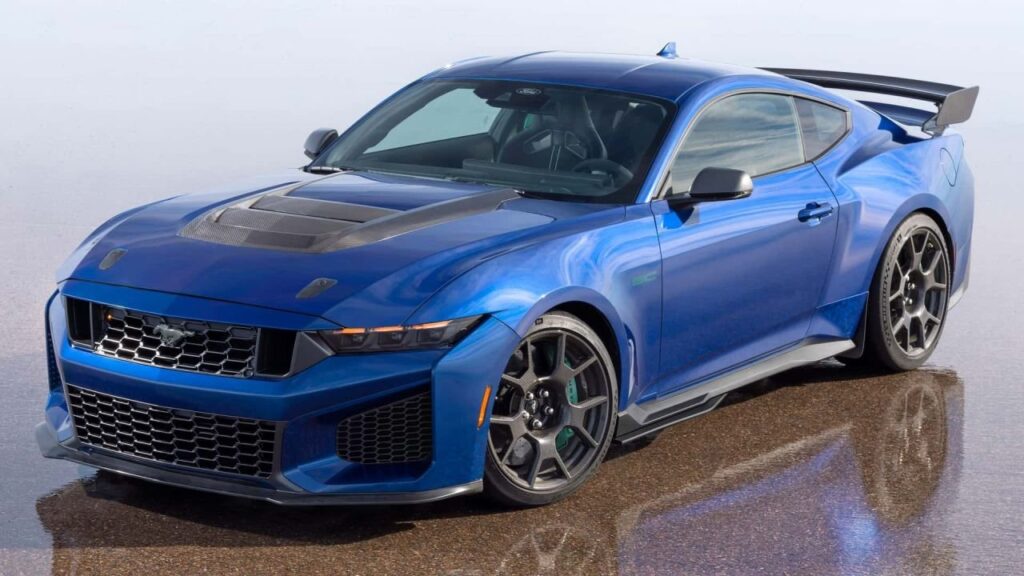
Ford isn’t backing away from the Mustang, but the future shape of America’s most recognisable pony car is becoming a more interesting question.
Recent comments from CEO Jim Farley suggest the manual gearbox has unusually strong protection inside Ford, while the V8’s long-term position is less explicitly guaranteed.
That distinction matters because the Mustang’s identity has long been built around both, even as emissions rules and market pressures make the easy answers harder.

At a glance
- Ford remains committed to the Mustang, though the latest executive comments stopped short of an absolute pledge on the V8.
- Jim Farley gave his strongest backing to the manual Mustang, reframing a question about the V8 around the gearbox instead.
- The current 5.0-litre Coyote V8 continues, but emissions regulations already affect output in some markets.
The manual gets the clearest protection
Asked whether Ford would keep a V8-powered Mustang alive for as long as possible, Farley began with the kind of defiant phrasing enthusiasts tend to remember.
“Out of our cold, dead hands will we not have…”, he said, before landing not on the V8, but on “a manual Mustang.”
It’s a subtle shift, but not an insignificant one.
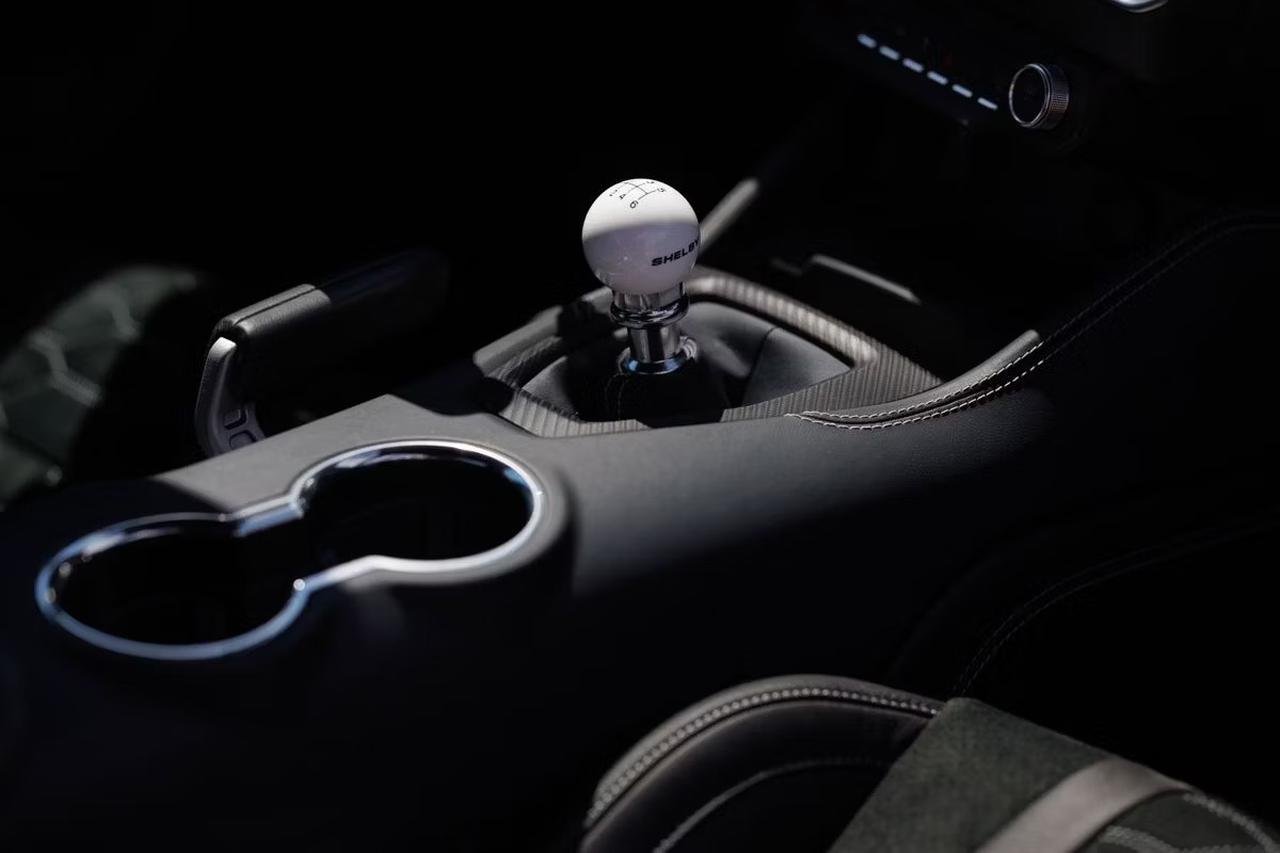
The question was about the engine, yet the answer put the manual transmission at the centre of Ford’s emotional commitment.
For drivers who still want a clutch pedal in a new performance car, that’s no small thing.
Manual gearboxes are disappearing across the performance market, often faster than combustion engines themselves, so Ford’s willingness to defend the format gives the Mustang a rare point of continuity.

The V8 is still here, but the language is different
None of this means the V8 Mustang is about to vanish.
Ford continues to build demand around eight-cylinder engines, particularly in the United States, where the Mustang’s cultural weight remains closely tied to the sound and response of a naturally aspirated V8.
The current 5.0-litre Coyote remains central to the car’s appeal, especially for buyers who see the Mustang as one of the last broadly attainable V8 performance coupes.
Still, executive wording is watched closely in an industry where product planning is shaped years ahead of public announcements.
Farley has previously made it clear that the Mustang itself is safe under his leadership, saying there won’t be a time without one while he remains at Ford.
That promise protects the nameplate more clearly than it protects every traditional ingredient attached to it.
Emissions pressure is already changing the equation
The difficult part for Ford is not enthusiasm, but regulation.
Tightening emissions rules make large-displacement performance engines harder to justify globally, especially when compliance demands differ from one market to another.
The European-market Mustang already shows the effect, with the 5.0-litre Coyote producing less power there than in some other markets to meet regulations.
That doesn’t make the V8 obsolete, but it does show the compromise required to keep it in showrooms.
For Ford, the question may eventually become whether the V8 can remain central everywhere, or whether the Mustang’s future relies more heavily on gearbox choice, chassis character and the broader emotional pull of the badge.
Details & Specifications
| Brand | Ford |
|---|---|
| Model | Mustang |
| Engine discussed | 5.0-litre Coyote V8 |
| Transmission discussed | Manual gearbox |
| Market note | European-spec Mustangs produce less power to meet regulations |
| Company position | Ford remains committed to the Mustang nameplate |
The bigger takeaway is that Ford appears determined to keep the Mustang alive as a driver’s car, even if the exact recipe has to evolve.
For now, the V8 remains part of the story, but the manual may be the piece Ford is most prepared to defend out loud.