Pop-up headlights are one of those design ideas that belong almost completely to another era.
Ferrari, though, came close to revisiting them for the 849 Testarossa, a car whose name already carries plenty of visual history.
The result isn’t a mechanical throwback, but a clever piece of front-end design that nods to the past without pretending modern regulations don’t exist.

At a glance
- Ferrari seriously explored pop-up headlights during the 849 Testarossa’s design development.
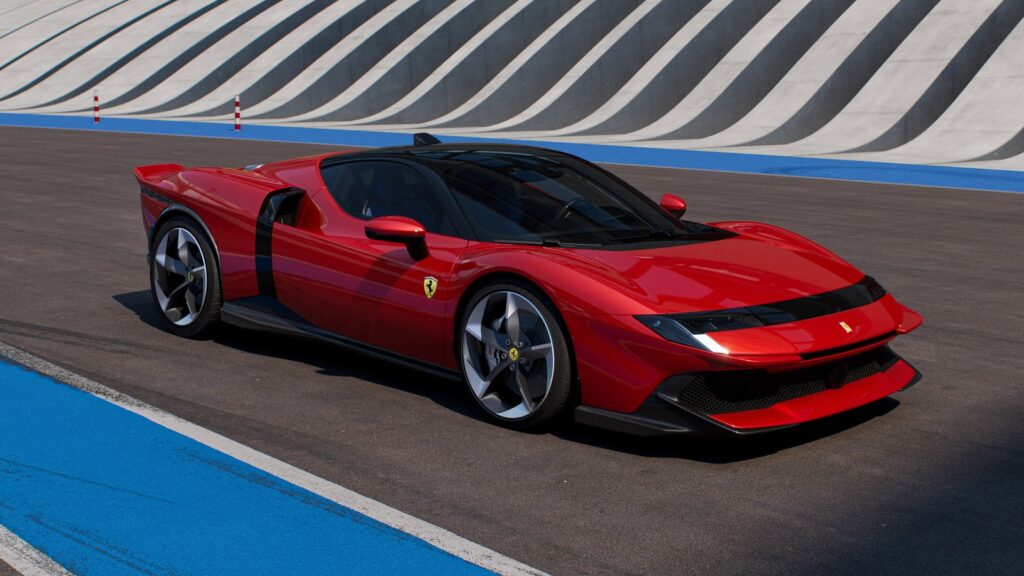
- The final car uses a slim, full-width black light bar to echo the closed look of classic hidden lamps.
- Global safety and pedestrian protection rules made moving headlight mechanisms too difficult to homologate across key markets.
How Ferrari revisited a forbidden shape
Lead designer Jason Furtado has discussed how the 849 Testarossa team looked closely at the idea of reviving pop-up headlights.
That wasn’t nostalgia for its own sake.
Ferrari’s back catalogue gives the feature real emotional weight, with cars like the 512 BB, 288 GTO, F40 and F355 turning hidden headlights into part of the marque’s visual identity.

On those cars, the lamps weren’t just functional details.
They changed the character of the whole front end, giving the nose a clean, low, almost sealed-off expression when closed and a more animated look when raised.
The black light bar does the remembering
The 849 Testarossa ultimately takes a different path.
Instead of moving lamps, Ferrari uses a slim black light bar that stretches across the nose and creates a similar visual impression to old pop-ups in their closed position.
It’s a smart compromise because it gives the car a graphic connection to Ferrari’s wedge-era heroes without adding the complexity of a hidden mechanical system.
The treatment also makes the car look wider, lowering the visual weight of the front end and tying the lighting into the aerodynamic surfaces below.
This bridge-like front lighting approach can also be seen on the Ferrari 12Cilindri, where it gives the nose a sharply defined identity rather than relying on conventional headlamp shapes.
Modern rules made the decision for Ferrari
The romance of pop-up headlights runs straight into the reality of modern homologation.
Safety rules and pedestrian protection requirements in major markets such as the United States and China make complex moving headlight systems far harder to certify today.
For a global Ferrari, the issue isn’t whether the idea could be made beautiful.
It’s whether one design can satisfy every key region without compromising packaging, compliance, aerodynamics or reliability.
That challenge effectively ended the possibility of true pop-ups on the 849 Testarossa.
Why the 849 Testarossa reference works
The more interesting part is that Ferrari didn’t simply abandon the idea.
It translated the memory of pop-up headlights into a fixed, modern signature, which is often a better use of heritage than copying an old solution outright.
For enthusiasts, the reference is clear enough to register immediately.
For everyone else, the black band gives the 849 Testarossa a cleaner and more distinctive face than a conventional pair of slim LED units might have done.
That balance is what makes the design work.
The 849 Testarossa doesn’t bring back pop-up headlights, but it shows Ferrari still understands why people miss them.