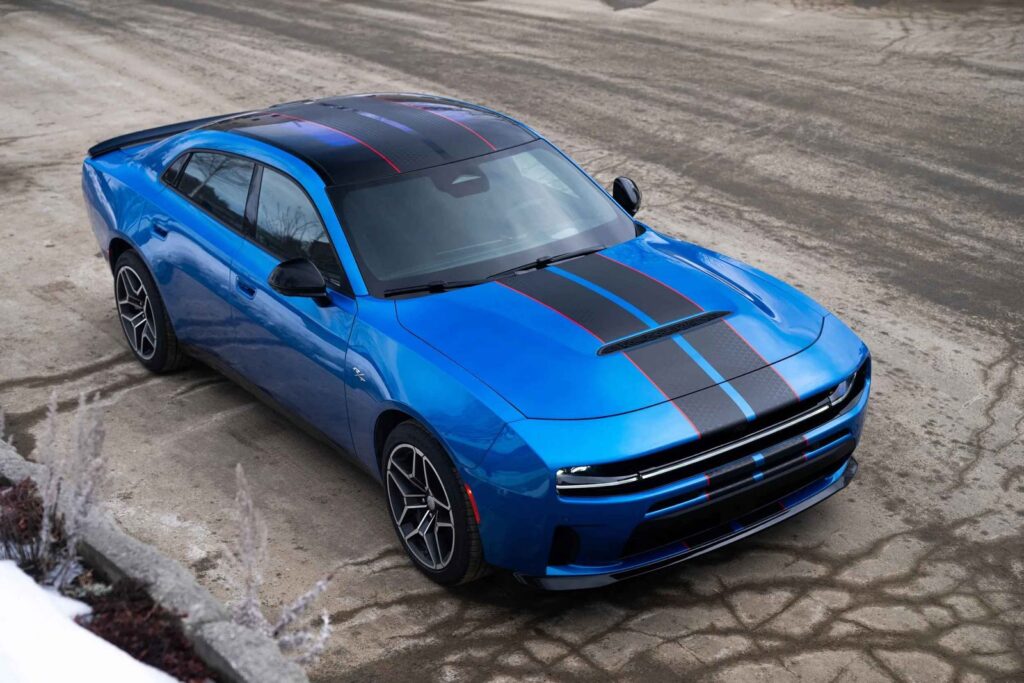
The Dodge Charger is entering its 60th year with exactly the sort of gesture its audience expects.
Rather than letting the milestone pass with a badge pack or commemorative trim, Dodge is preparing a more powerful gas-powered Charger for an August debut, adding fresh heat to a lineup already centred on the twin-turbo Hurricane inline-six.
It’s a meaningful moment for a nameplate that has had to navigate changing regulations, shifting buyer tastes and the emotional weight of replacing V8 theatre with a new-generation performance formula.

At a glance
- Dodge will reveal a hotter gas-powered Charger at Roadkill Nights in Pontiac, Michigan, on August 8, 2026.
- The current ICE Charger range uses a 3.0-litre twin-turbo Hurricane inline-six, with the Scat Pack already rated at 550 hp.
- The new version is expected to push beyond today’s Scat Pack output as the Charger nameplate turns 60.
A 60th birthday with proper Charger intent
The Charger has always carried more cultural weight than a typical performance car badge.
It’s part muscle car, part pop-culture fixture and part rolling argument for excess, which makes a higher-output gas model a fitting way to mark six decades of the name.
Dodge has already made the modern Charger’s direction clear by placing the 3.0-litre twin-turbo Hurricane inline-six at the heart of its internal-combustion range.
That engine choice was always going to be scrutinised by buyers who associate the Charger with large-displacement V8s, but the early numbers gave Dodge a credible starting point.
The standard gas-powered Charger produces 420 hp and 468 lb-ft of torque, while the Scat Pack lifts that to 550 hp and 531 lb-ft.
Those outputs put the new-generation car well beyond simple nostalgia, even before this more aggressive variant enters the conversation.

The Hurricane engine has room to climb
Dodge hasn’t released the output figure for the incoming model, which is exactly why the debut at Roadkill Nights matters.
The natural target is clear enough, though, because the Scat Pack already sits at 550 hp and the next step needs to feel materially different.
A figure beyond 600 hp would make sense for the positioning of a hotter Charger, especially given how much attention the Hurricane six has attracted from tuners and performance builders.
The more interesting question is how Dodge chooses to shape the car around the engine.
Peak horsepower will get the headline, but throttle response, cooling, calibration and drivability will decide whether this feels like a fully resolved factory performance model rather than a number-led special.
That distinction matters for a Charger, because the badge has traditionally appealed to drivers who want usable force as much as straight-line theatre.
Roadkill Nights is the right stage
The reveal is scheduled for the 11th edition of Roadkill Nights in Pontiac, Michigan, on Saturday, August 8, 2026.
That setting is not incidental.
Roadkill Nights has become one of Dodge’s most fitting stages, with a crowd that understands drag-strip culture, modern horsepower and the brand’s particular way of selling performance.
Launching a stronger gas-powered Charger there gives Dodge a built-in audience of enthusiasts rather than a polite auto-show crowd waiting for a press conference to end.
It also lets the brand frame the car around acceleration, sound and attitude, which remain central to how buyers judge this nameplate.
Details & Specifications
| Brand | Dodge |
|---|---|
| Model | Charger gas-powered performance variant |
| Current engine family | 3.0-litre twin-turbo Hurricane inline-six |
| Current standard output | 420 hp and 468 lb-ft of torque |
| Current Scat Pack output | 550 hp and 531 lb-ft of torque |
| Debut event | Roadkill Nights |
| Debut location | Pontiac, Michigan |
| Debut date | August 8, 2026 |
What it means for Charger buyers
For loyalists, the key issue is not simply whether the new Charger can produce big power without a V8.
It’s whether Dodge can make the car feel emotionally connected to the lineage while using a different mechanical language.
The existing Scat Pack already shows that the Hurricane six can carry serious performance numbers, but a more powerful version has a larger symbolic job.
It needs to reassure buyers that the gas-powered Charger still has a wild side, even as the broader performance market changes around it.
If Dodge lands the calibration and positioning, this could become the car that helps bridge the gap between old-school Charger identity and the brand’s next chapter.
For now, the essential promise is simple enough: the Charger’s 60th anniversary won’t be quiet, and Dodge appears intent on keeping its most famous performance sedan firmly in the horsepower conversation.