
Arnold & Son’s DSTB has always been about the exact second, displayed with the deliberate tick of a mechanical deadbeat-seconds hand.
The new DSTB Stop-Seconds adds the missing half of that idea, letting the wearer set the watch to the exact second as well as read it.
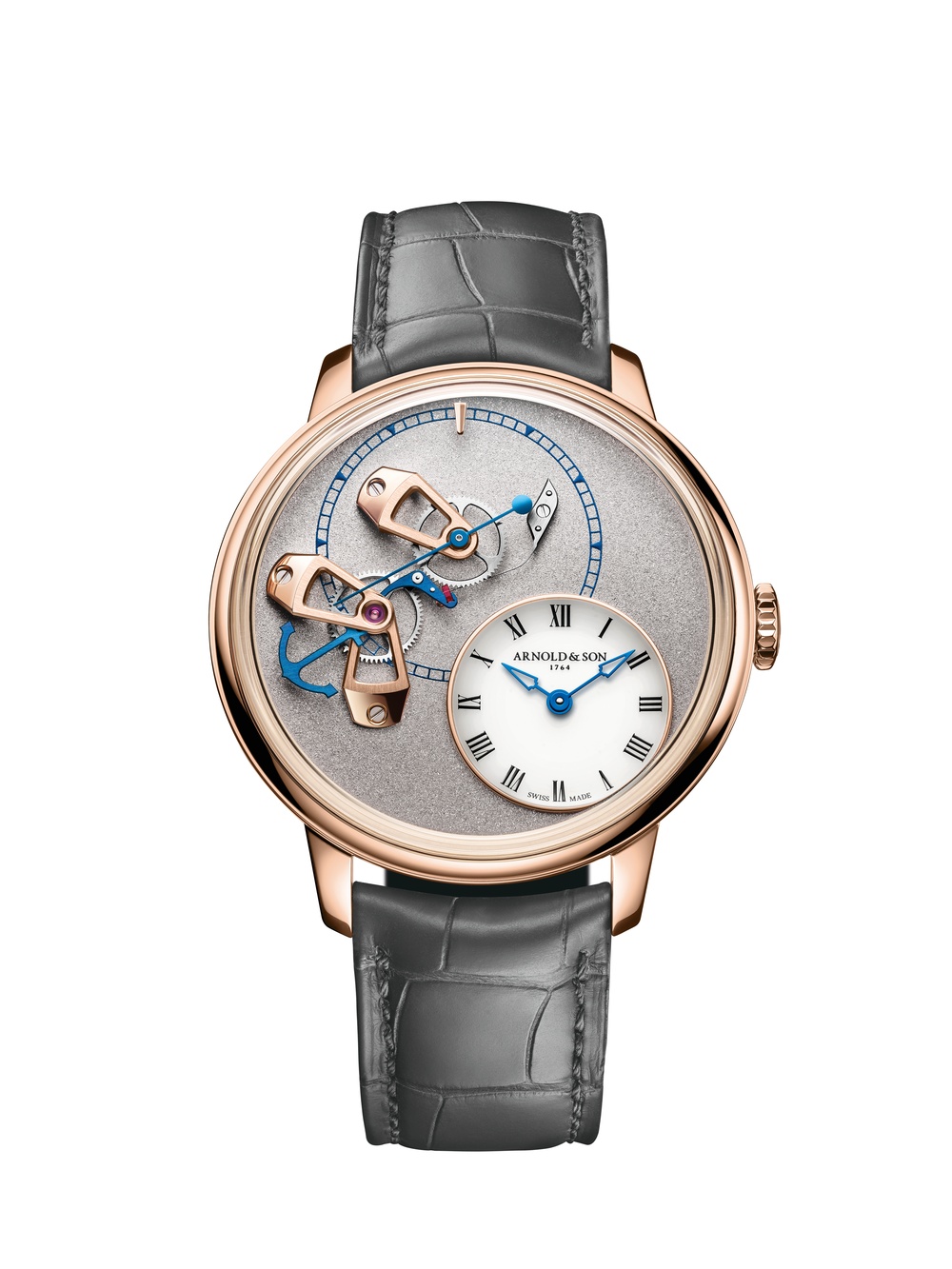
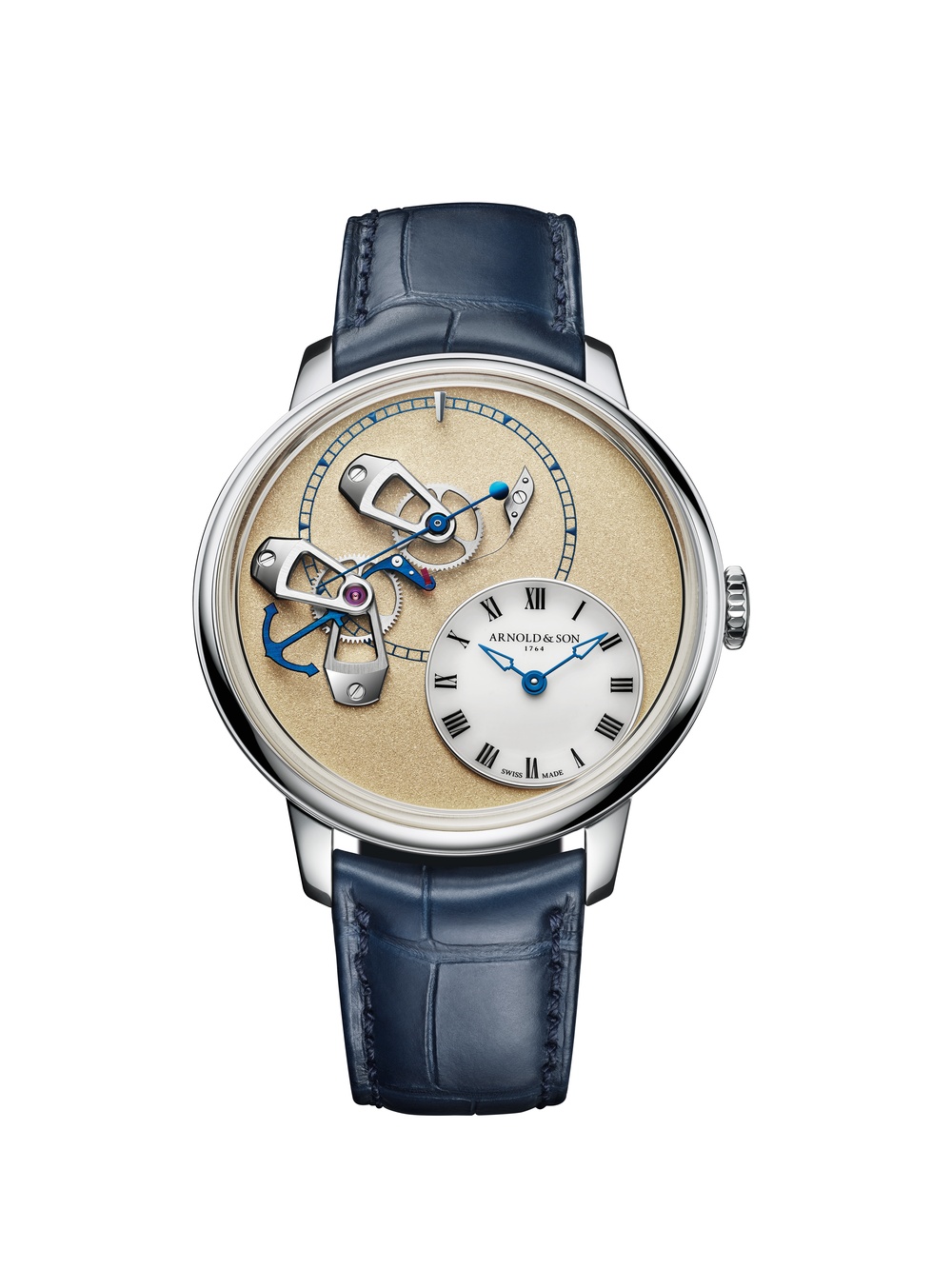
It arrives as two 42mm limited editions, pairing red gold with a Cliff Grey dial and platinum with a warmer Kingsand dial.

At a glance
- Arnold & Son has added a stop-seconds function to the DSTB for the first time.
- The watch combines the collection’s visible dial-side true-beat mechanism with a hidden stop lever activated by the crown.
- The two versions are limited to 36 pieces combined, priced at £48,300 in red gold and £59,600 in platinum.
The exact second now sets as precisely as it reads
Deadbeat seconds are one of watchmaking’s more counterintuitive pleasures.
Where most mechanical seconds hands appear to sweep because the balance is beating several times per second, a deadbeat-seconds mechanism stores and releases energy so the hand advances in one crisp jump per second.
At a glance, that can resemble the motion of a quartz watch, but the purpose here isn’t imitation.
The appeal is legibility, since a hand that lands directly on a marker each second is easier to read precisely than one sitting somewhere between two points.
In the DSTB, short for Dial-Side True Beat, Arnold & Son places that mechanism on the dial, turning a technical solution into the watch’s visual signature.
The collection has used the idea since 2014, but this new version addresses a practical gap in the concept.
Until now, the DSTB could show the exact second but couldn’t be stopped easily at the crown to set it against a reference signal.
That’s because a true-beat mechanism and a conventional stop-seconds system don’t naturally work together.
The former is constantly managing stored tension for its once-per-second jump, so stopping the display is more involved than simply arresting the balance.
A hidden lever with chronometer logic
Arnold & Son’s answer is a dedicated stop lever, activated when the crown is pulled out.
It halts the seconds hand and the stored tension in the true-beat system, then releases the display immediately when the crown is pushed back in.
The action recalls the method once used with marine chronometers, where the hands could be prepared ahead of a time signal and released at the precise moment.
Arnold & Son states that a one-second timing error at sea could translate to a positional error of 463.8 metres, which explains why this sort of precision was more than academic in navigation.
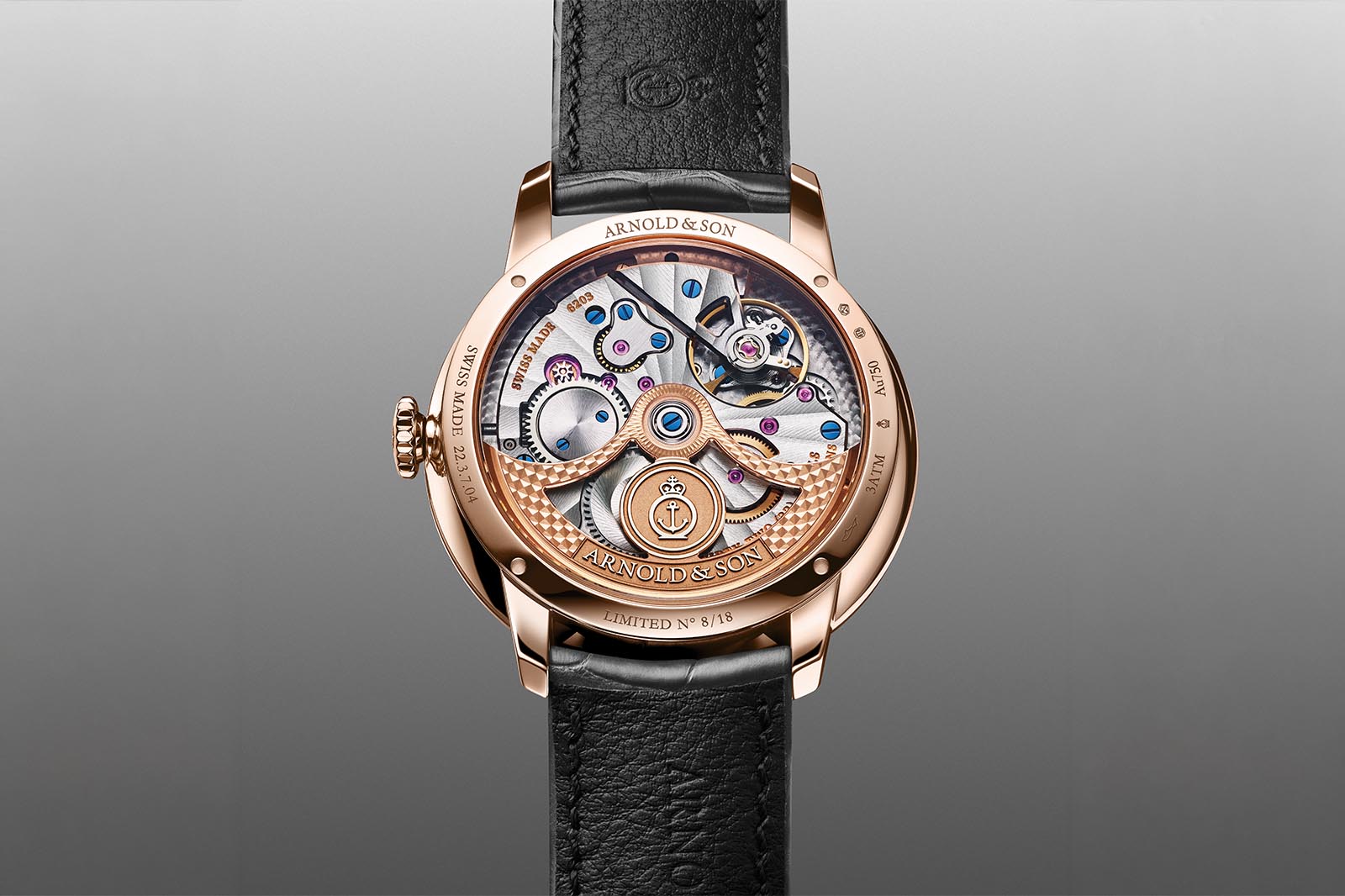
The stop lever isn’t visible from the dial or through the sapphire caseback.
That makes this a very Arnold & Son kind of complication, technically meaningful but not performative.
Cliff Grey and Kingsand bring the DSTB down a tone
The two new colourways feel quieter than some earlier DSTB executions.
The red gold case is matched with Cliff Grey, a cooler dial shade that Arnold & Son links to the cliffs of John Arnold’s native Cornwall.
The platinum version gets Kingsand, a gold-toned dial colour connected by the brand to the gilded brass mainplates used in Arnold’s original movements.
Both watches keep the established DSTB architecture, with the true-seconds works displayed at the top of the dial.
Gold bridges and a fire-blued steel anchor frame the mechanism, while the seconds hand tracks across a blue outer scale.
Hours and minutes sit lower on a white opal sub-dial with Roman numerals and a subtly concave surface.
The sub-dial frames match the case metal, using red gold on the Cliff Grey edition and platinum on the Kingsand edition.
The A&S6303 movement and limited production
Inside is Arnold & Son’s in-house automatic A&S6303 movement, a development of the A&S6203 used in the existing DSTB 42.
The important change is the stop-seconds lever, even though the component itself stays out of view.
The movement runs at 4Hz, or 28,800 vibrations per hour, and offers a 55-hour power reserve.
Both versions measure 42mm across and 12.95mm thick, with a domed sapphire crystal treated with anti-reflective coating on both sides and a flat sapphire caseback.
Water resistance is rated to 30 metres.
The red gold Cliff Grey watch comes on a warm grey hand-stitched alligator leather strap, while the platinum Kingsand version is fitted to an ink blue hand-stitched alligator leather strap.
Each closes with a pin buckle in the same metal as the case.
Details & Specifications
| Brand | Arnold & Son |
|---|---|
| Model | DSTB Stop-Seconds |
| Case size | 42mm diameter, 12.95mm thick |
| Case material | Red gold or platinum |
| Dial | Cliff Grey with red gold case, Kingsand with platinum case |
| Movement | In-house automatic A&S6303 |
| Complication | Dial-side true-beat seconds with stop-seconds function |
| Frequency | 4Hz, 28,800vph |
| Power reserve | 55 hours |
| Water resistance | 30 metres |
| Crystal | Domed sapphire crystal with anti-reflective coating on both sides, flat sapphire caseback |
| Strap | Hand-stitched alligator leather with matching metal pin buckle |
| Price | £48,300 in red gold, £59,600 in platinum |
| Availability | Limited to 36 pieces combined, 18 in each colourway |
The DSTB Stop-Seconds doesn’t change the basic daily accuracy proposition of the watch, but it makes the whole concept more complete.
For collectors who already understand why a mechanical watch would be engineered to tick once per second, the ability to set that tick exactly is likely to be the detail that matters most.