Zenith has long occupied a distinctive place inside LVMH’s watchmaking division, thanks in large part to the enduring reputation of the El Primero movement.
Now the Le Locle manufacture appears to be facing a more difficult chapter, with recent financial strain, job losses and a retail closure pointing to a period of retrenchment rather than expansion.
For a brand built around technical legitimacy and a deep archive, the question is less about whether Zenith matters and more about how it positions itself for the next phase.

At a glance
- Zenith is facing a major short-term reset amid recent financial pressure, including job losses and a retail closure.
- The brand remains anchored by its movement heritage, especially the El Primero calibre first created in 1969.
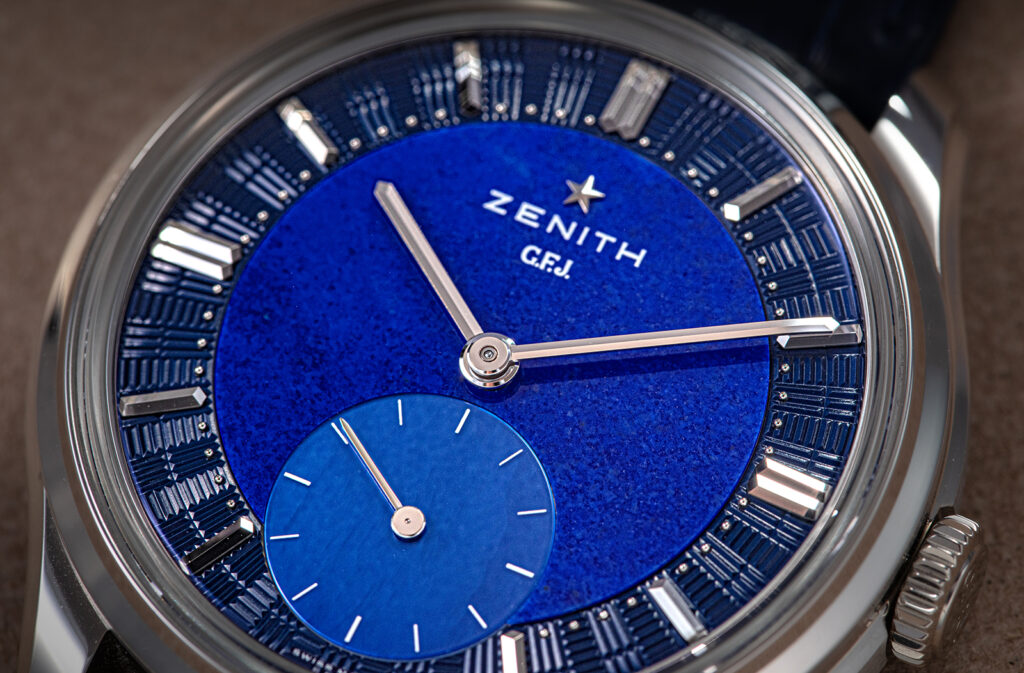
- The G.F.J. stands out as a brighter point in the current collection, with distinctive dials and a classic movement focus.
A hard reset for a historic manufacture
Speculation around Zenith’s future has been building for some time, largely tied to the brand’s financial difficulties in recent years.
Within LVMH’s watchmaking portfolio, Zenith is not simply another logo on the shelf.
It carries the weight of one of modern watchmaking’s best-known chronograph stories, and that history makes any restructuring feel more significant than a routine commercial adjustment.

The immediate outlook, however, appears challenging.
Job losses and a retail closure suggest a brand narrowing its footprint while it works through a more disciplined strategy.
The El Primero legacy still matters
Zenith’s greatest asset remains the El Primero, the calibre first created in 1969 and still central to the brand’s identity.

Few movement names have crossed over into broader enthusiast recognition with the same force.
That matters because Zenith’s credibility has always rested on engineering substance rather than pure lifestyle positioning.
In a market where heritage is often used loosely, the El Primero gives the brand a concrete technical foundation to build around.
The G.F.J. shows where Zenith still has momentum
Not everything around Zenith points downward.
The G.F.J. has emerged as a bright spot in the current line-up, helped by its unusual dial work and its connection to a classic movement language.
It suggests that Zenith still has room to speak to collectors who want something more specific than a generic luxury sports watch.
That kind of product matters during a reset because it reminds the market why the brand deserves attention in the first place.
Leadership and the next chapter
Zenith is led by CEO Benoit de Clerck, who now faces the task of protecting the manufacture’s historic strengths while navigating a more constrained short-term environment.
The challenge is clear enough.
Zenith needs to keep the credibility of its movement-driven identity intact while making decisions that address the business reality around the brand.
For collectors, the coming period will be worth watching closely.
Zenith’s position is under pressure, but its best assets remain unusually strong: a serious movement archive, a recognisable chronograph legacy and enough design character to stand apart when the product is focused.