Richard Mille’s most compelling gem-set watches are not simply diamond-covered versions of familiar models, because the stones are often planned as part of the case, the movement, or the entire visual structure of the watch.
Gemsetting meets the tonneau case
Traditional gemsetting in watchmaking usually begins with precious metal that can be drilled, cut, raised and burnished with a high degree of predictability.
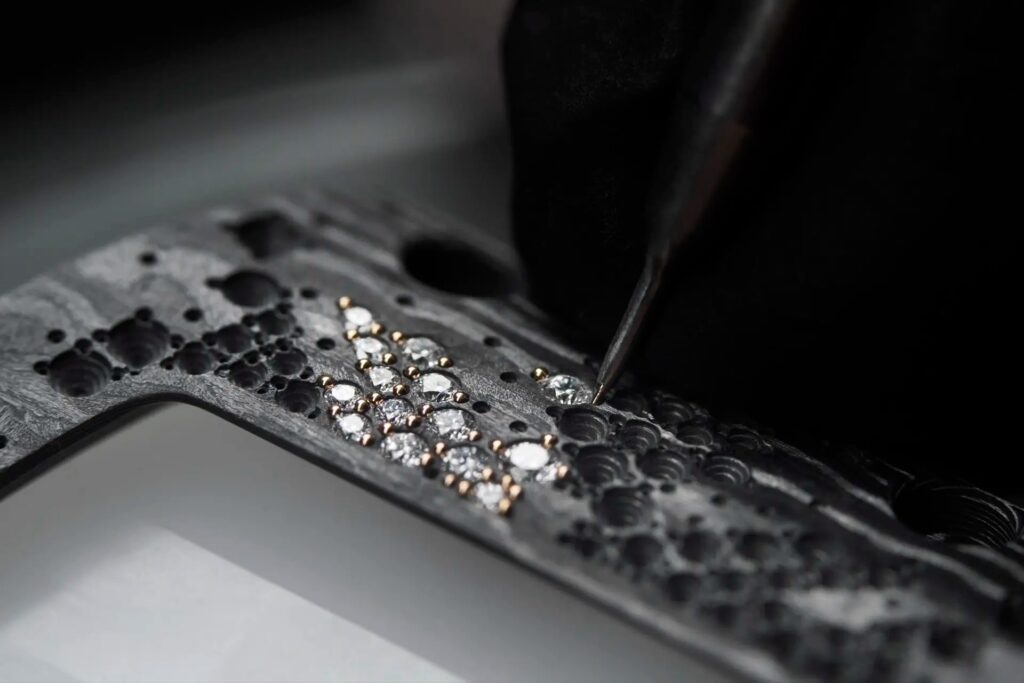
Pavé setting uses small beads of metal to hold each stone, snow setting creates a more irregular field of differently sized diamonds, and invisible setting hides the retaining structure beneath grooved stones mounted on rails.
Richard Mille complicates that language with cases that are arched, layered, skeletonised and deeply three-dimensional, especially in the brand’s signature tonneau shape.
The result is a kind of gemsetting that has to think like case engineering, where stone placement, surface curvature and structural tolerance are inseparable.
Carbon TPT changes the rules
Carbon TPT is one of the clearest examples of why Richard Mille’s gem-set watches require unconventional methods.

The material is made from hundreds of ultra-thin carbon filament layers, each around 30 microns thick, impregnated with resin and heated under pressure to create a light, rigid composite.
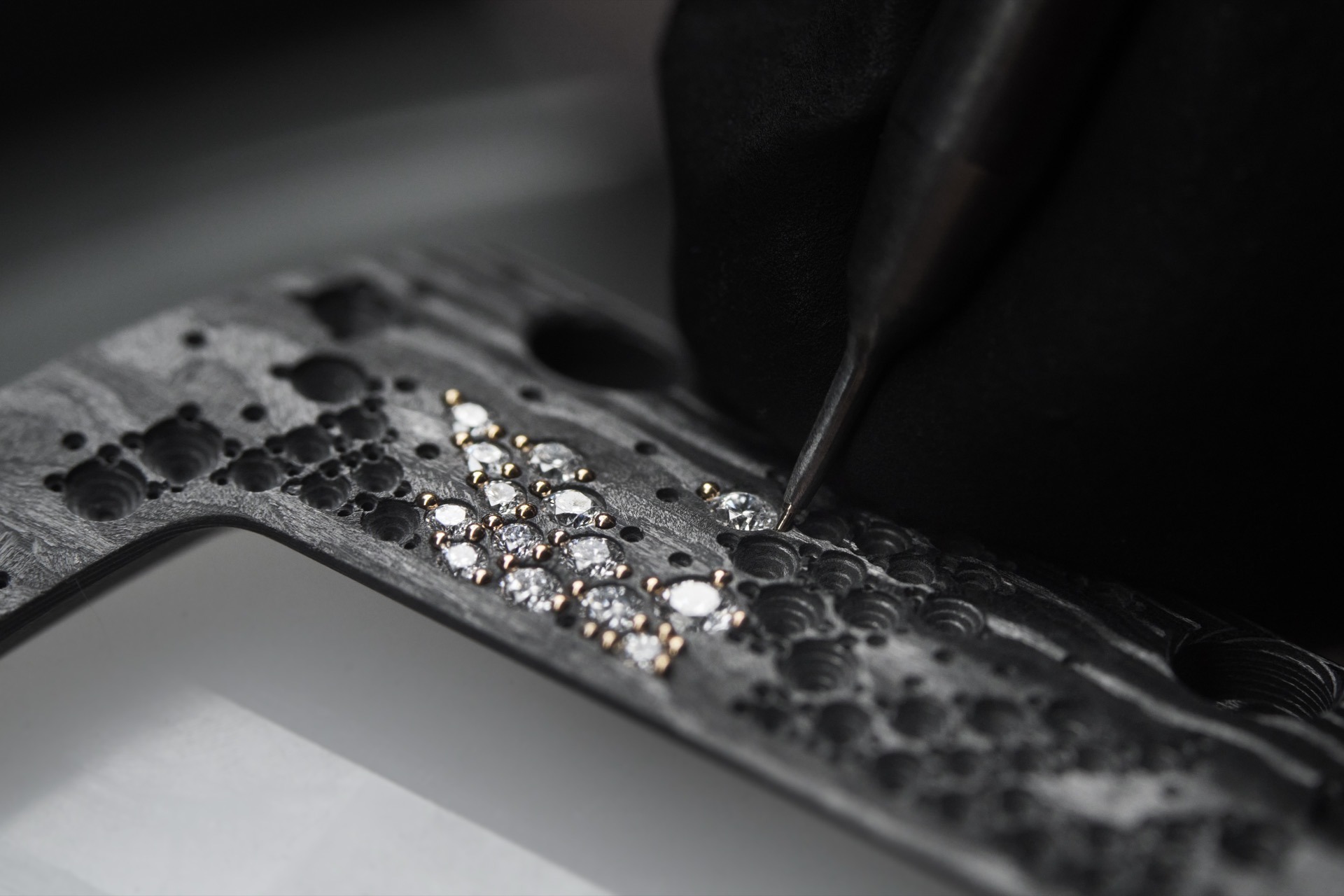
That is excellent for a high-performance watch case, but it creates an obvious problem for a gemsetter, because there is no gold surface from which to raise a securing bead.
Richard Mille and ProArt developed a process using diamond-head CNC milling cutters to create individual cavities in the Carbon TPT, after which separate gold prongs are made, hand-polished and inserted one by one.
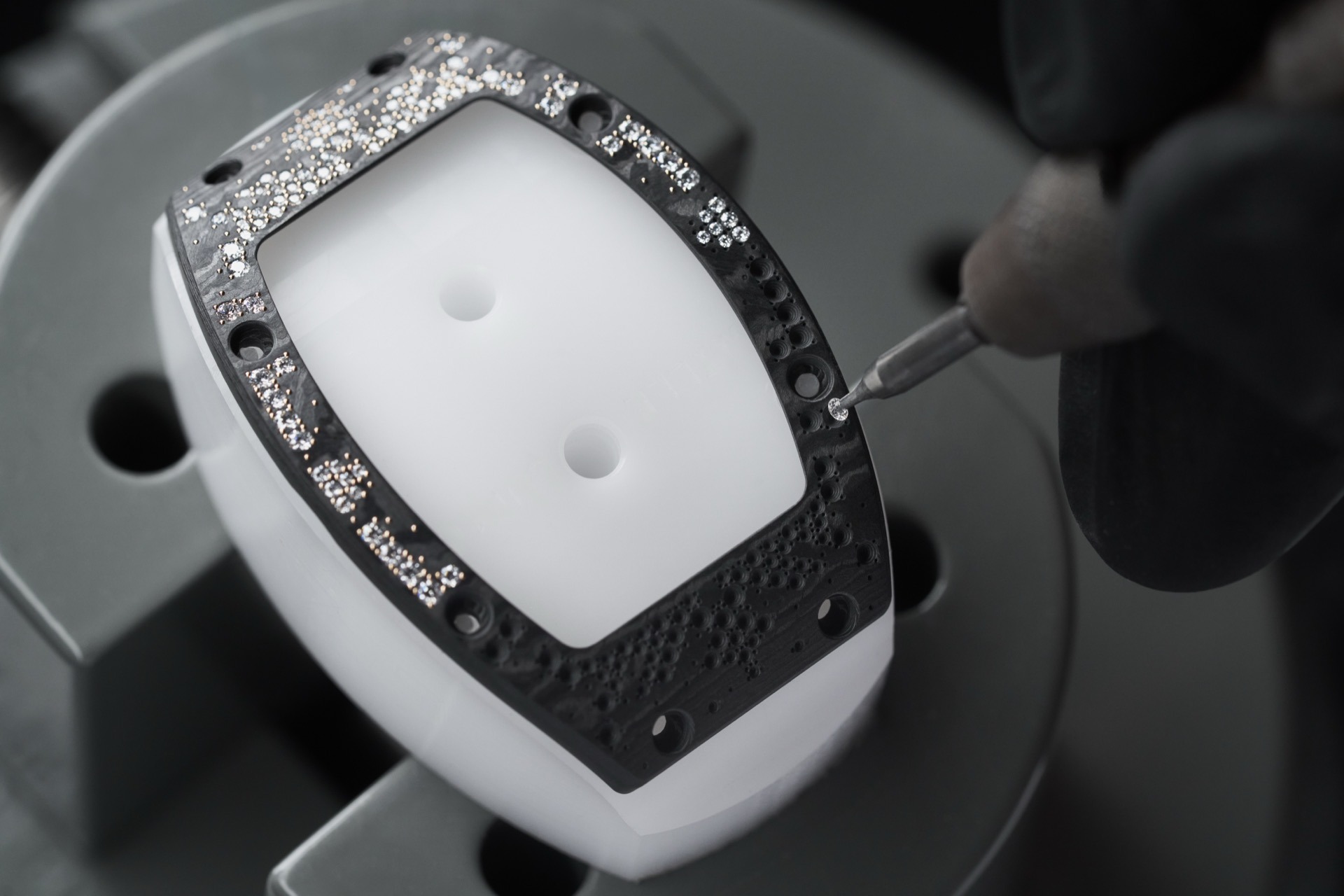
Preparing and setting a single front bezel can take around three days, a measure of how far the work sits from conventional decorative diamond setting.
Ceramic and sapphire demand different answers
Ceramic brings a different challenge, since its hardness makes normal cutting and setting approaches difficult to control at the required scale.
Under the direction of Cécile Guenat, Richard Mille adapted a direct microblasting process to prepare ceramic surfaces for gemsetting, allowing tiny diamonds to be secured with individually manufactured and polished gold prongs.
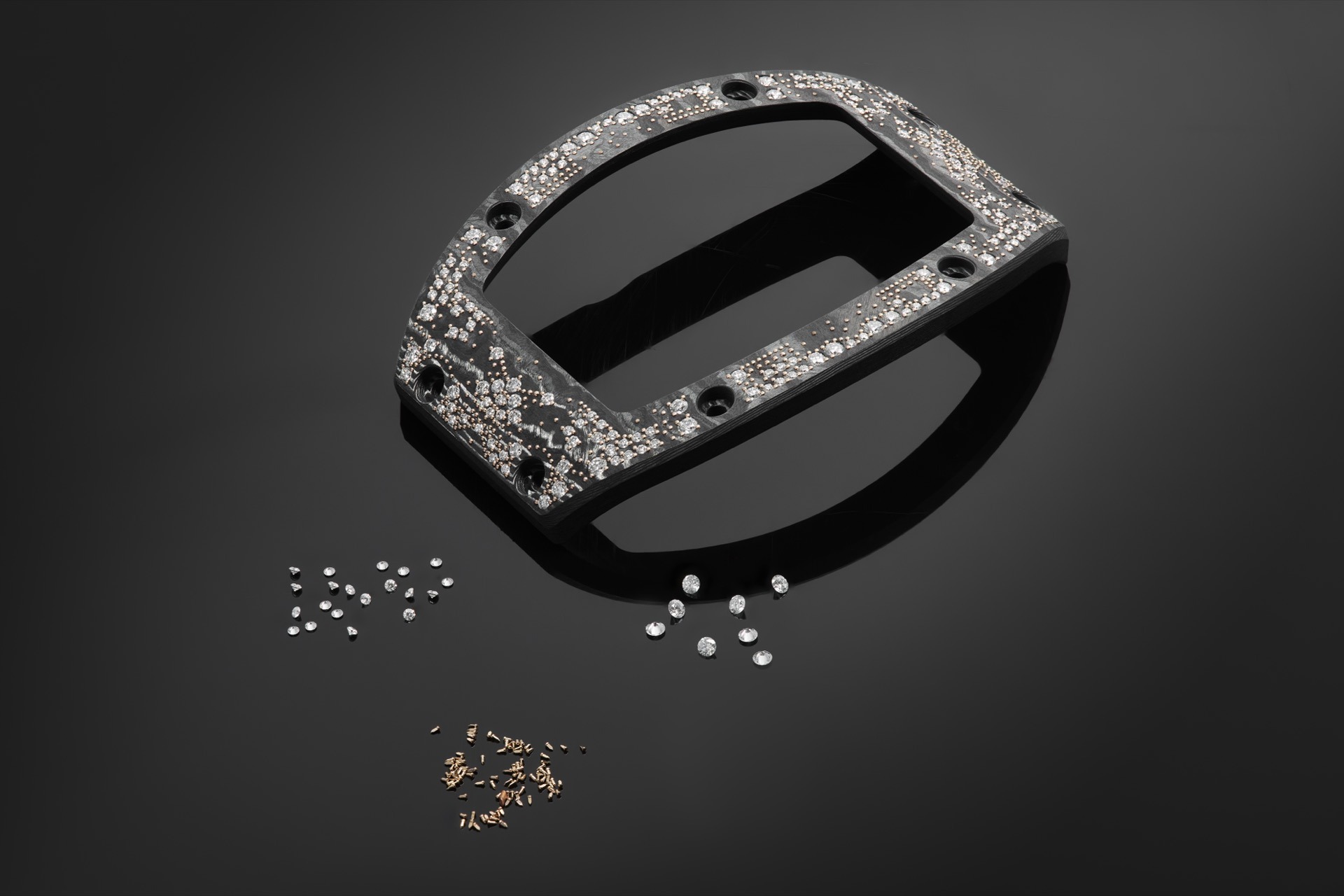
On certain ceramic pieces, diamonds as small as 0.25mm are held in red-gold prongs, turning a material once thought hostile to such work into a viable gem-set case surface.
Sapphire requires another route again, with laser cutting used to carve stone cavities to tolerances measured in microns.
Stone moves into the movement
The most radical expression of this thinking arrived inside the watch rather than on the exterior.
The RM 018 Tourbillon Boucheron, released in 2008, used hard stones and diamonds to create actual gear wheels, including tiger-eye, jasper and black onyx components finished with hand-worked sunray profiles by Boucheron’s Place Vendôme atelier.
The project took more than four years to develop and pushed gemstones beyond ornament into the realm of functioning calibre architecture.
A year later, the RM 019 Tourbillon advanced the idea further with a movement baseplate carved from black onyx.
The in-house workshop and the HJ-01 pieces
Richard Mille formalised this expertise with the launch of its in-house gemsetting workshop in 2019, after more than a decade of experimentation dating back to the RM 007 in 2005.
The RM HJ-01 haute joaillerie collection shows how complete that philosophy has become, combining ruby, blue sapphire, violet sapphire and emerald across four unique tonneau watches using bezel, bead and snow settings.
These are watches for collectors who want more than a jewellery treatment applied to a technical case.
At its best, Richard Mille’s gemsetting turns stones into architecture, making the sparkle inseparable from the engineering that defines the watch.