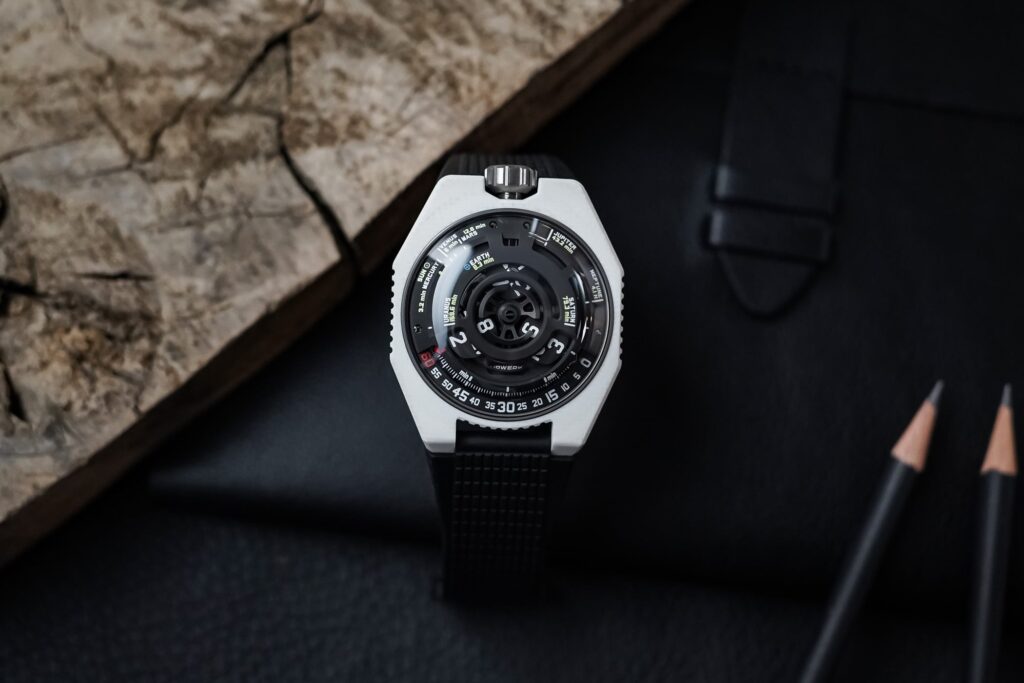
Urwerk has never treated time as a flat reading of hours and minutes, and the UR-100V Lightspeed Ceramic leans fully into that habit.
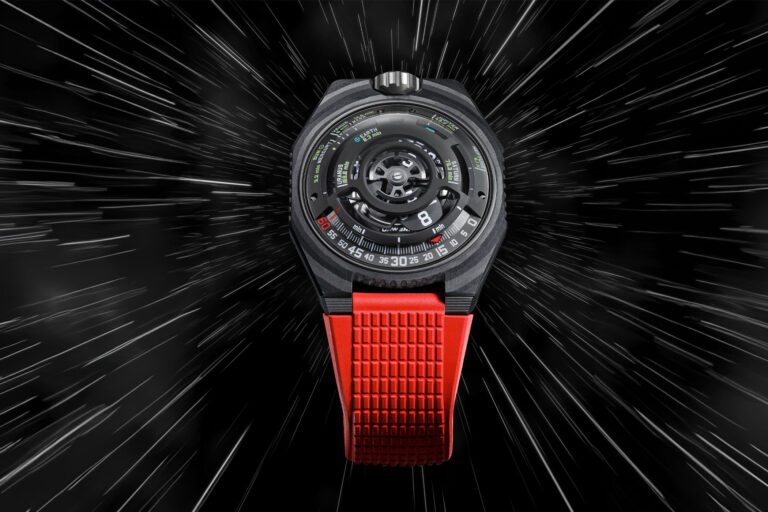
This new take on the UR-100 keeps the brand’s familiar satellite-hour architecture, then adds a celestial layer that tracks the travel time of sunlight across the solar system.
It’s a watch for collectors who like their mechanics with a little physics attached.
At a glance
- Urwerk has introduced the UR-100V Lightspeed Ceramic, a new white composite-cased version of its UR-100 wandering-hour watch.
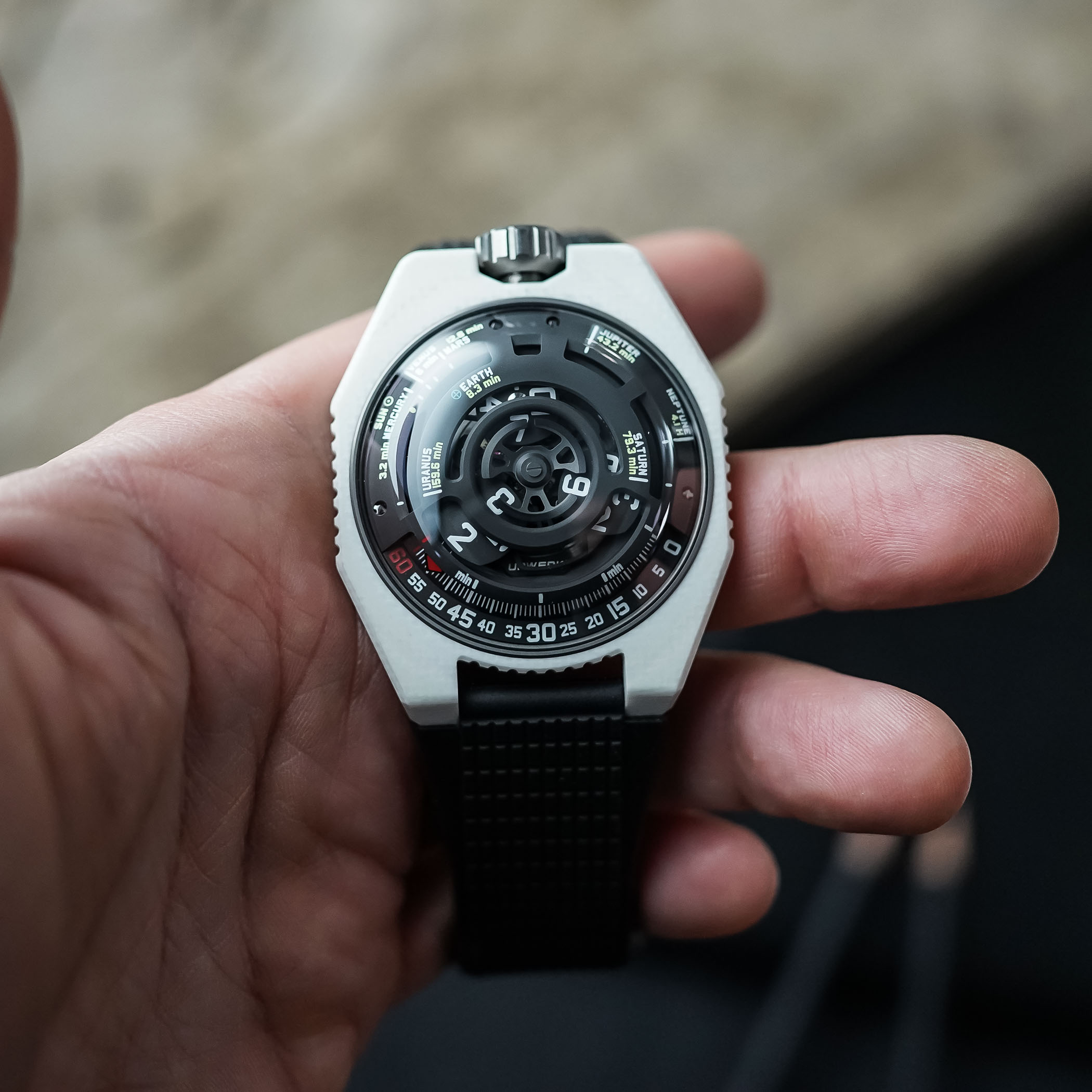
- The display shows conventional time while also indicating how long sunlight takes to reach Mercury, Venus, Earth, Mars, Jupiter, Saturn, Uranus and Neptune.
- The watch is priced at CHF 67,000 before taxes and is delivered with black and white rubber straps.
A white composite case with a quieter kind of drama
The UR-100 has become one of Urwerk’s most recognisable forms since its 2019 debut, partly because it brings the maison’s satellite-hour language into a case that remains surprisingly wearable.
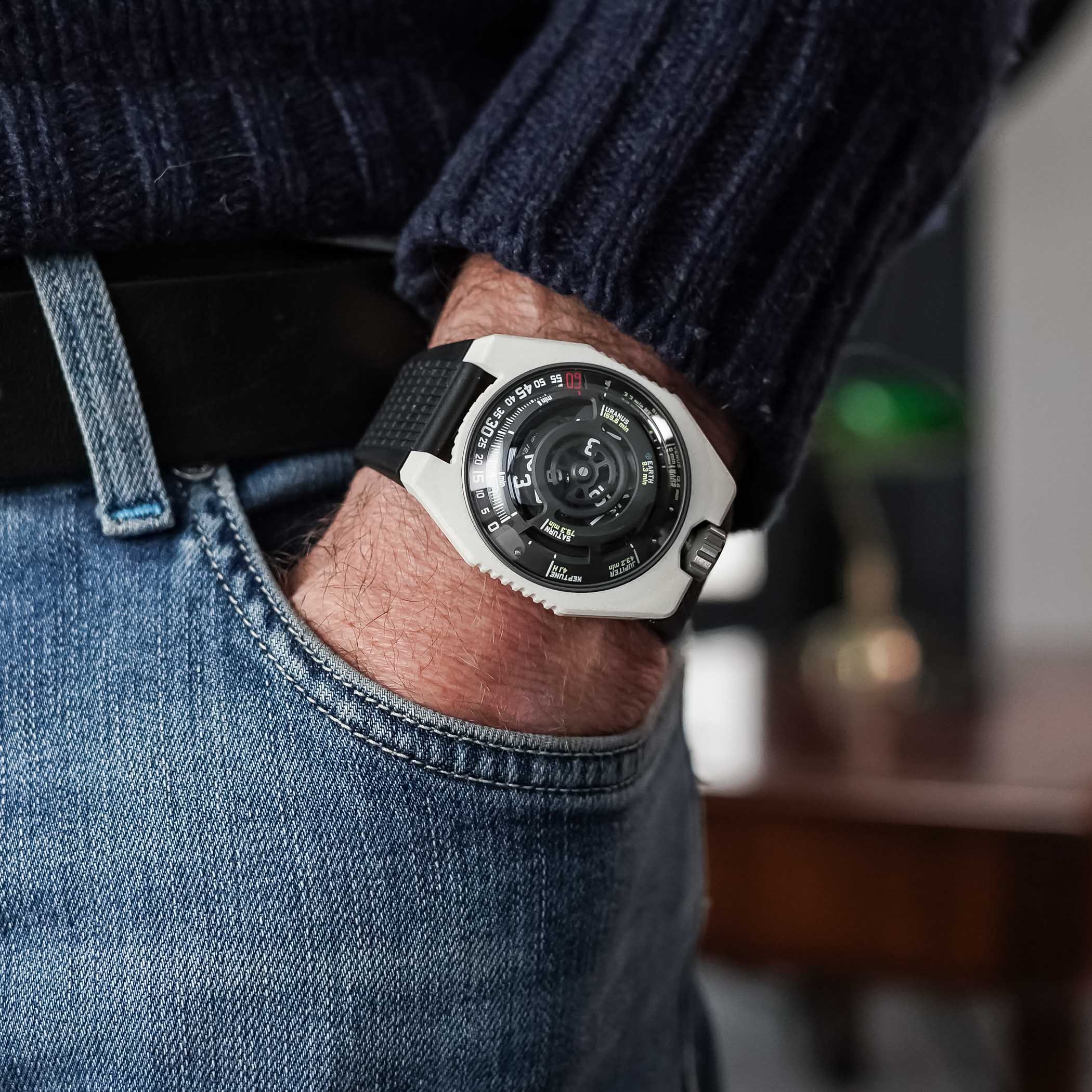
The UR-100V Lightspeed Ceramic measures 43mm wide, 51.73mm long and 14.55mm thick, with the crown placed at 12 o’clock and an integrated rubber strap helping the watch sit more naturally than the numbers might suggest.
The important change here is the case material.
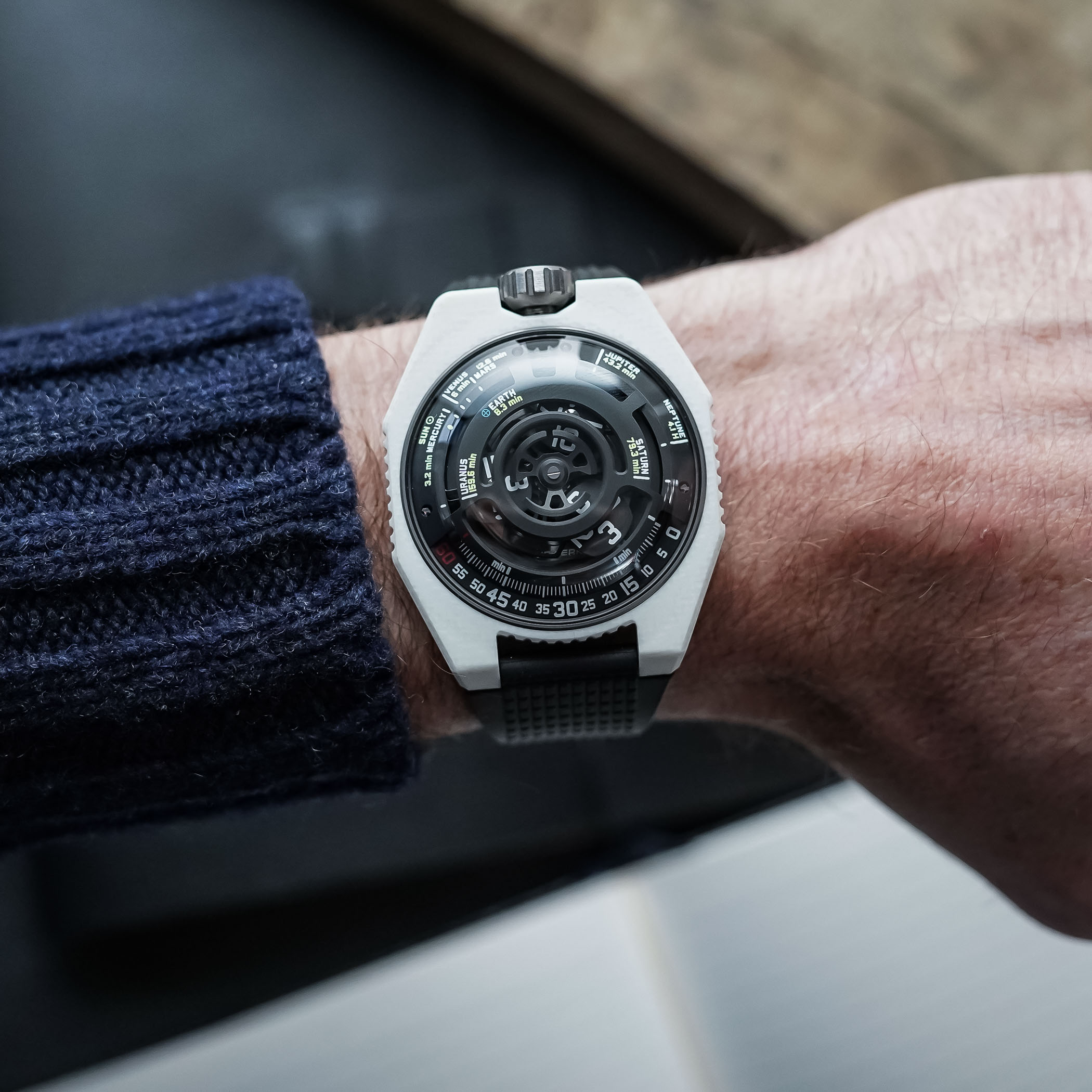
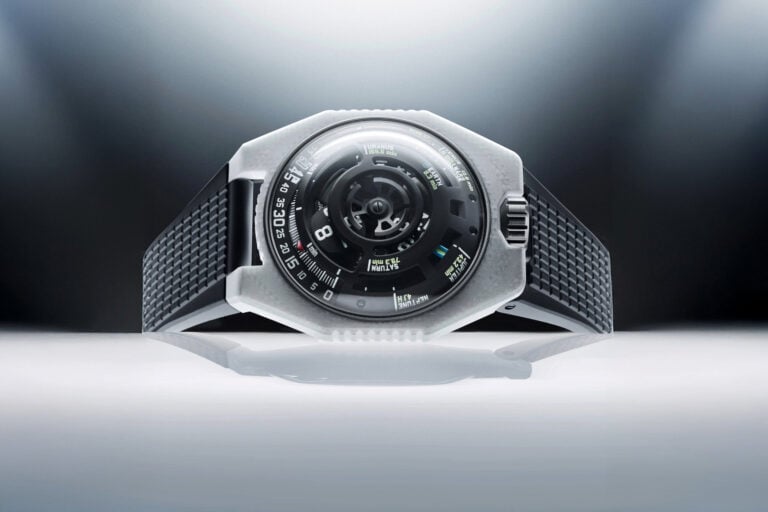
Rather than using a conventional ceramic shell, Urwerk has worked with a composite that combines white ceramic with silver fibreglass and carbon, all set within a white polymer matrix.
The idea is to preserve ceramic’s resistance to scratches while improving toughness through the reinforcing layers beneath the surface.
Visually, it gives the watch an unusual character.
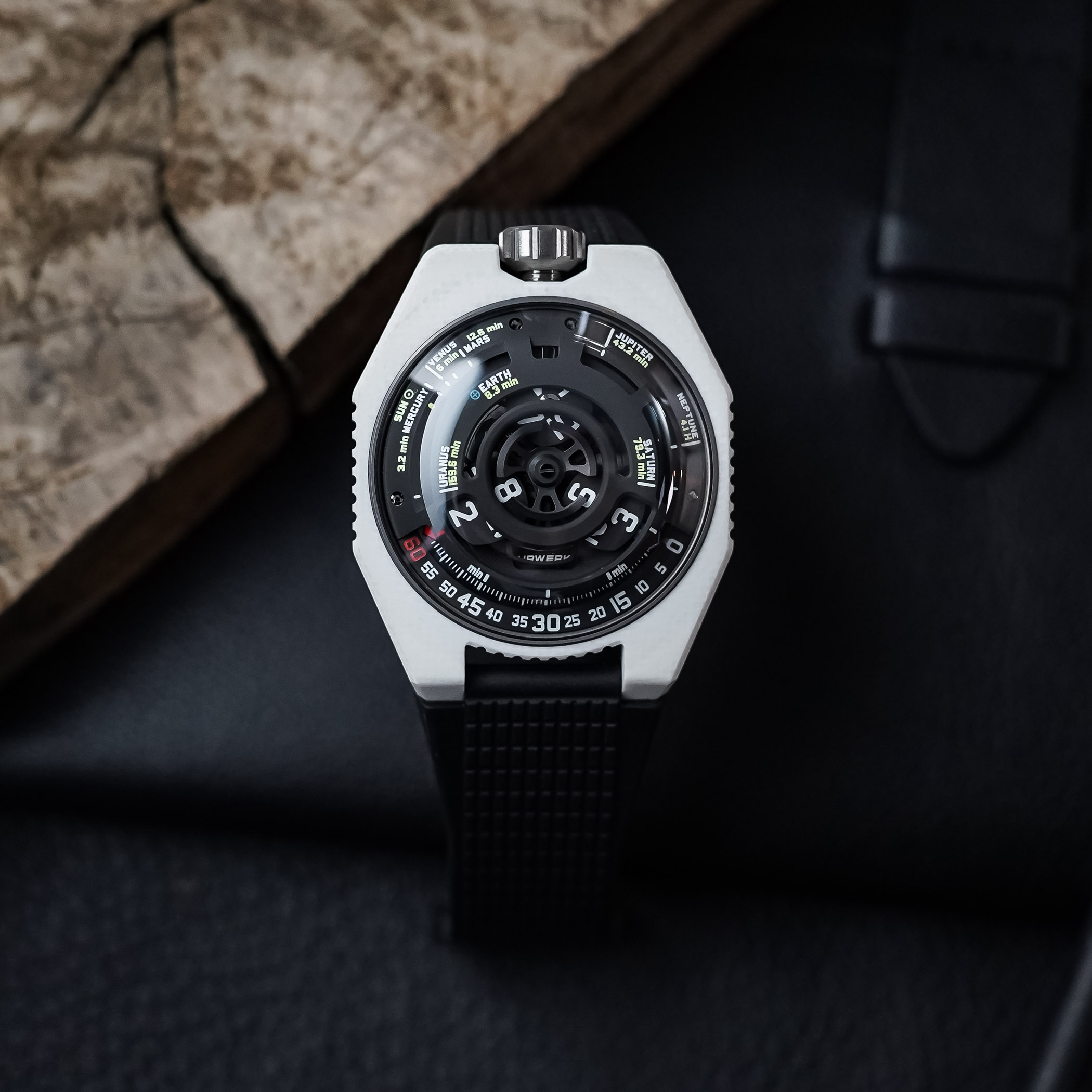
The case isn’t simply glossy white or flat matte white, and its silver-grey striations shift as the light catches the material.
That subtle movement gives the exterior a more technical, layered feel than a standard monochrome ceramic case.
The back is DLC-treated grade 5 titanium, finished with shotblasted and sandblasted surfaces, and fitted with a sapphire crystal view into the movement.
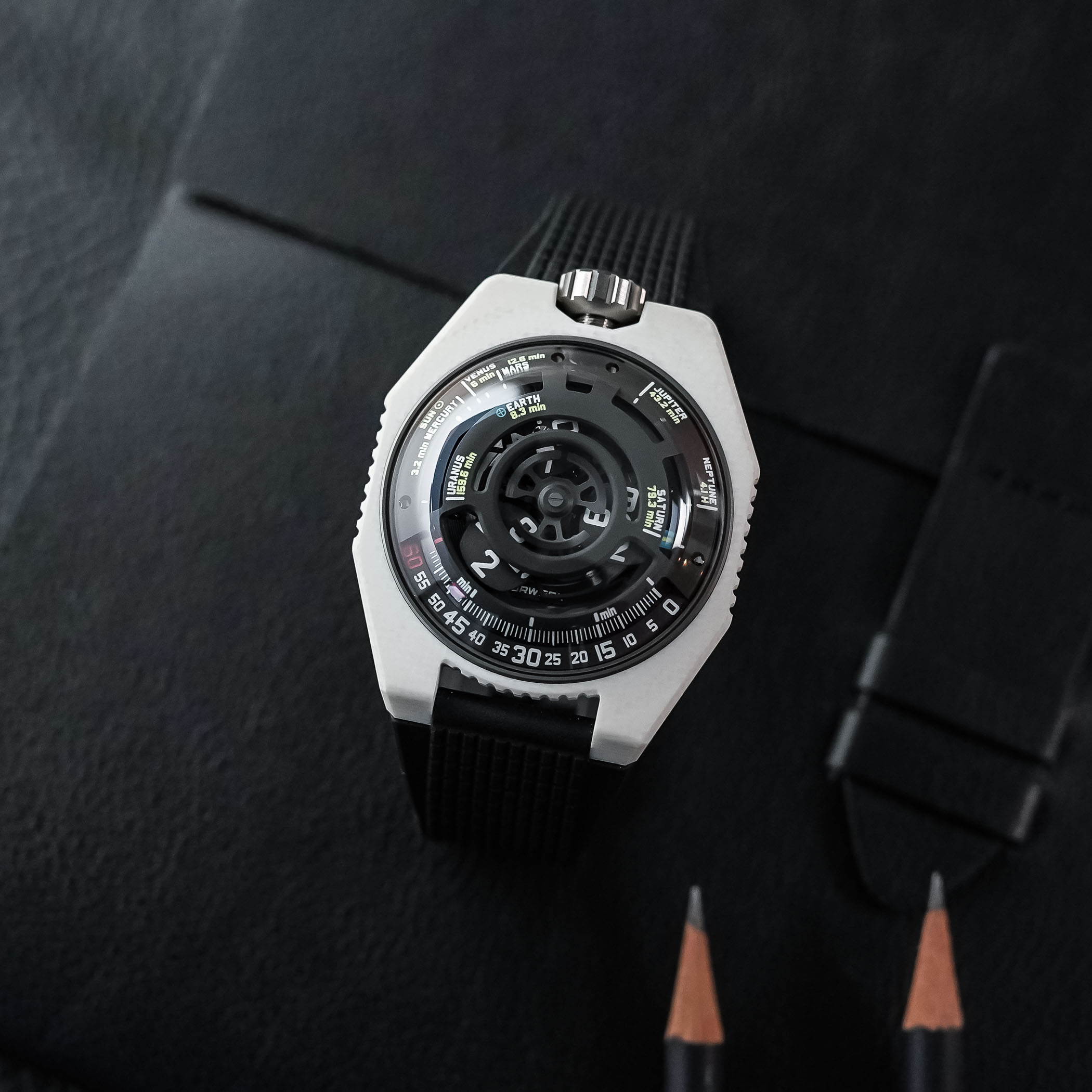
A wandering-hour display with a solar-system detour
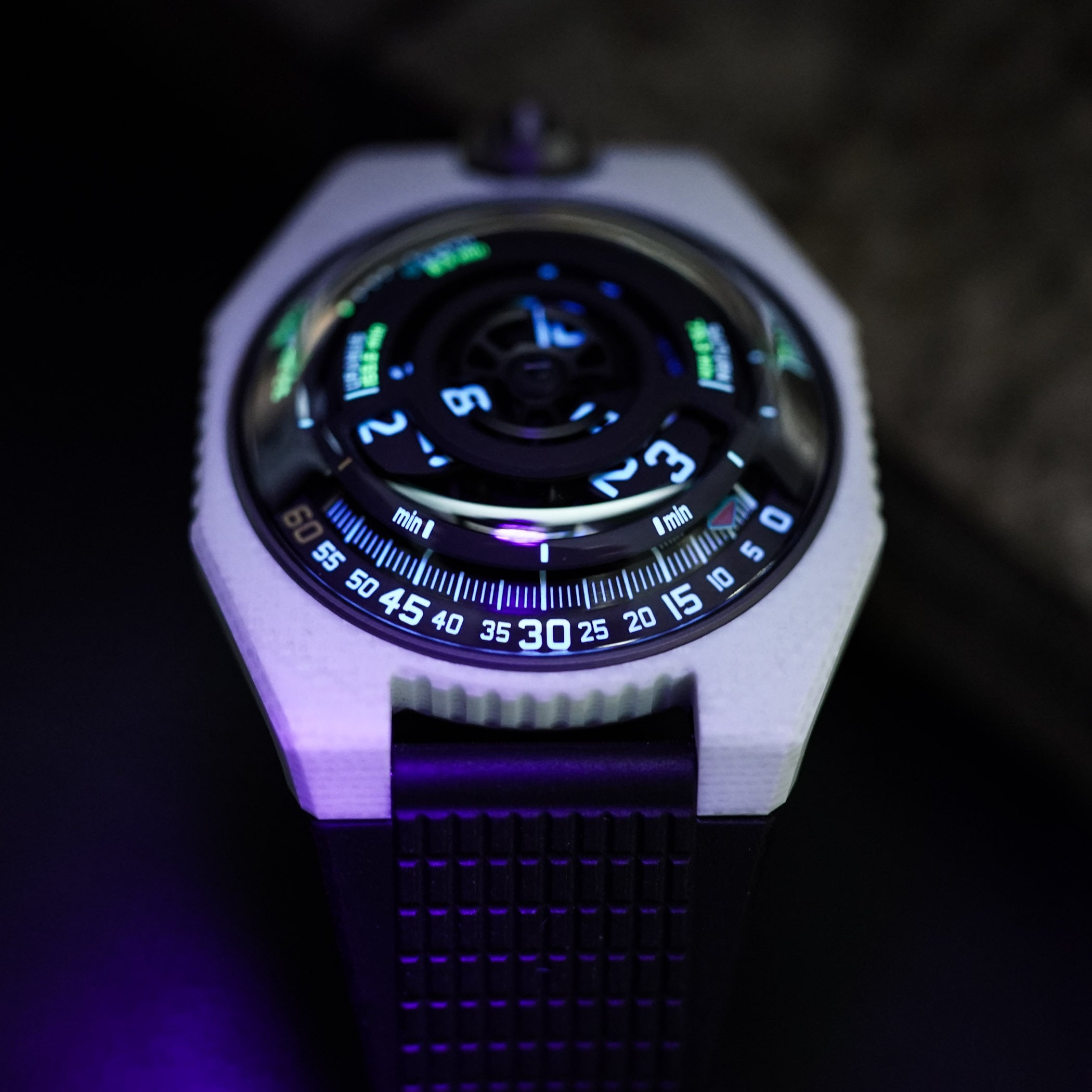
At the centre of the watch is Urwerk’s signature wandering-hour satellite system.
Three rotating satellites carry the hour numerals, with each satellite travelling across a 120-degree minute scale before handing over to the next hour.
On this model, the hours and minutes use blue emission Super-LumiNova, adding legibility to an otherwise concept-heavy dial.
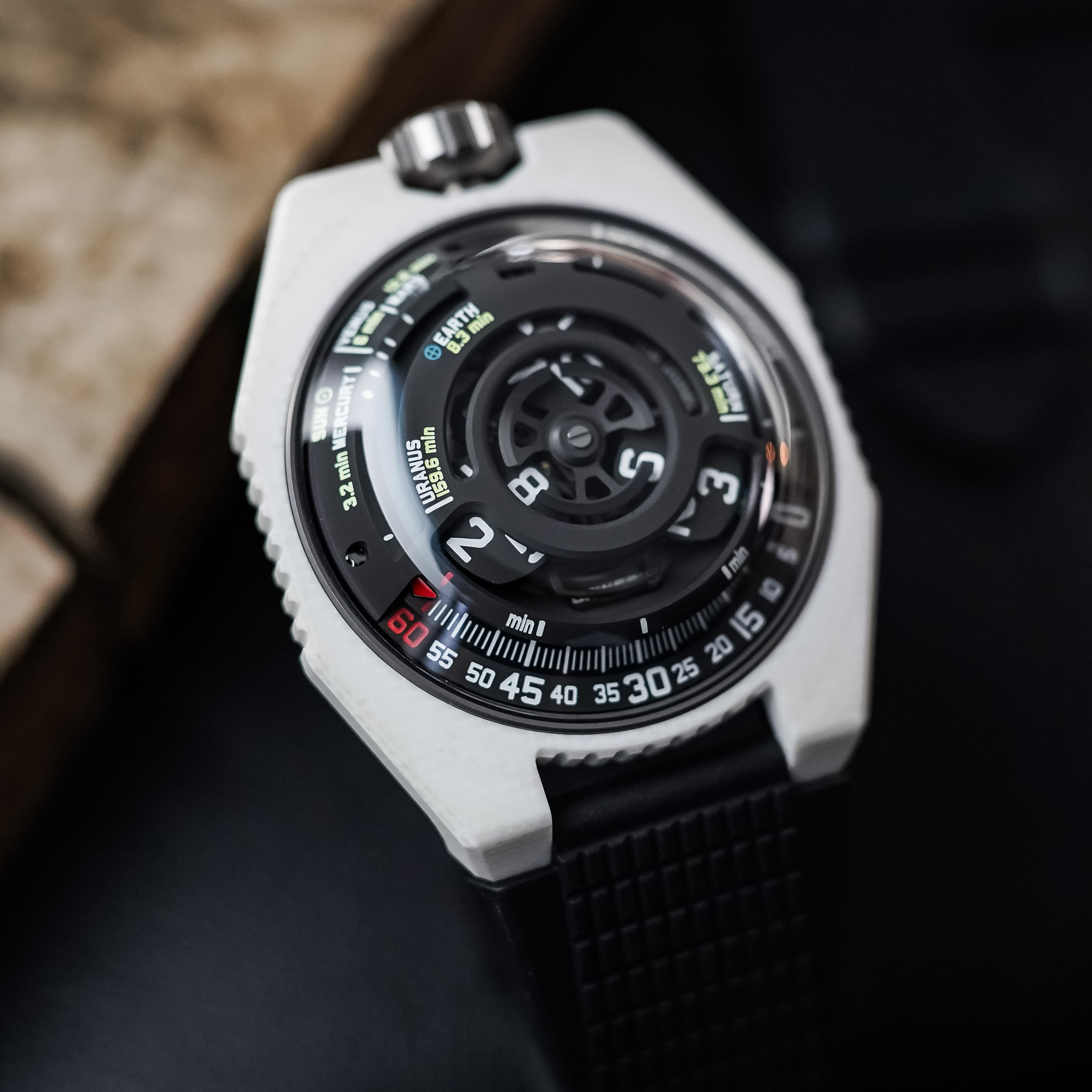
The Lightspeed concept takes the UR-100 away from its earlier Earth-motion displays and points the watch outward.
A small blue and green hand attached to the carousel completes a full rotation in three hours, acting as a mechanical photon as it marks the time required for sunlight to reach each planet.
Mercury is reached after 3.2 minutes, while Earth sits at 8.3 minutes.

Neptune, at the outer end of the sequence shown on the watch, is more than four hours away in light-travel terms.
It’s not a complication built around daily usefulness, and that’s exactly the point.
The UR-100V Lightspeed Ceramic turns an astronomical fact into a mechanical narrative, reminding the wearer that even ordinary daylight arrives with a delay.
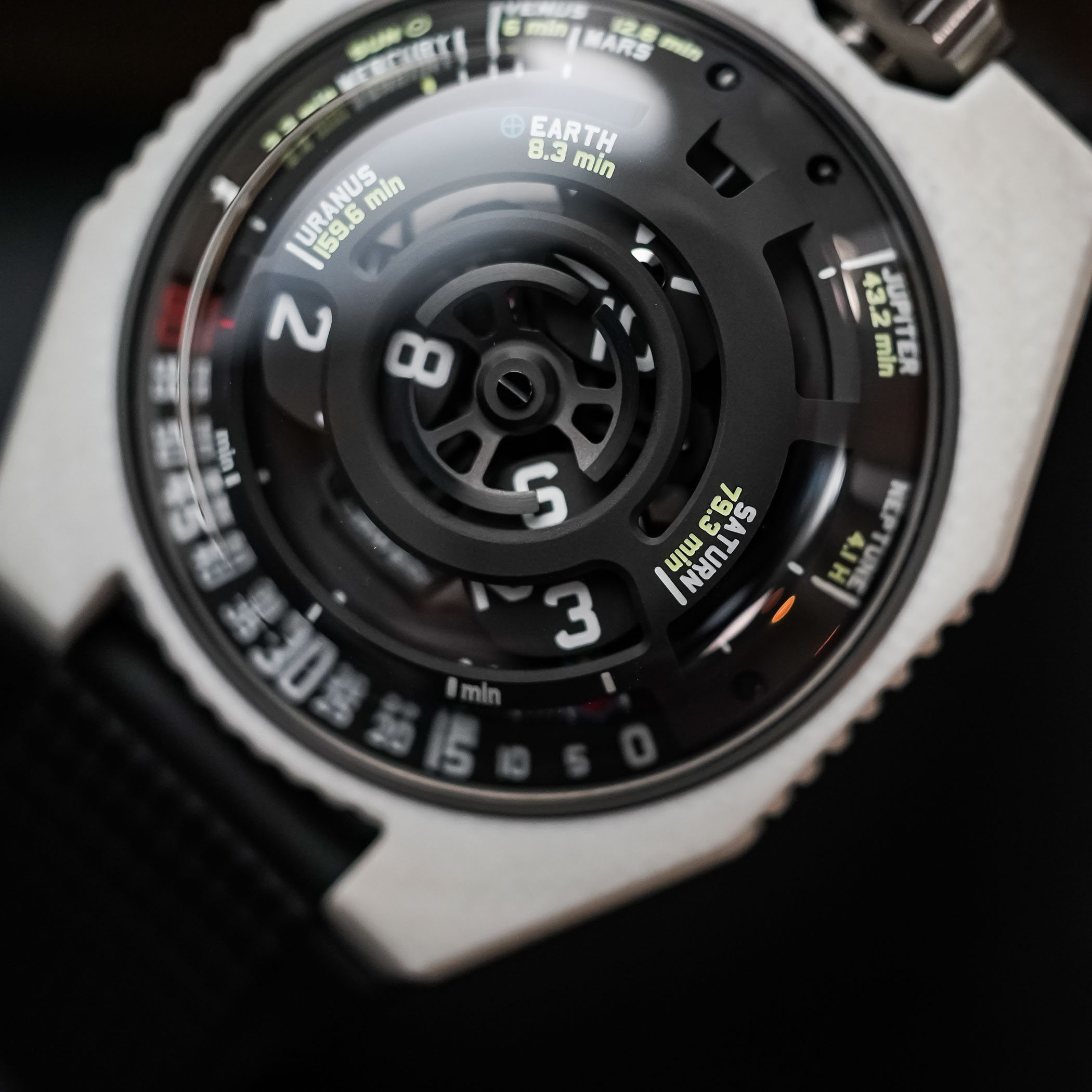
Inside the UR-12.02 calibre
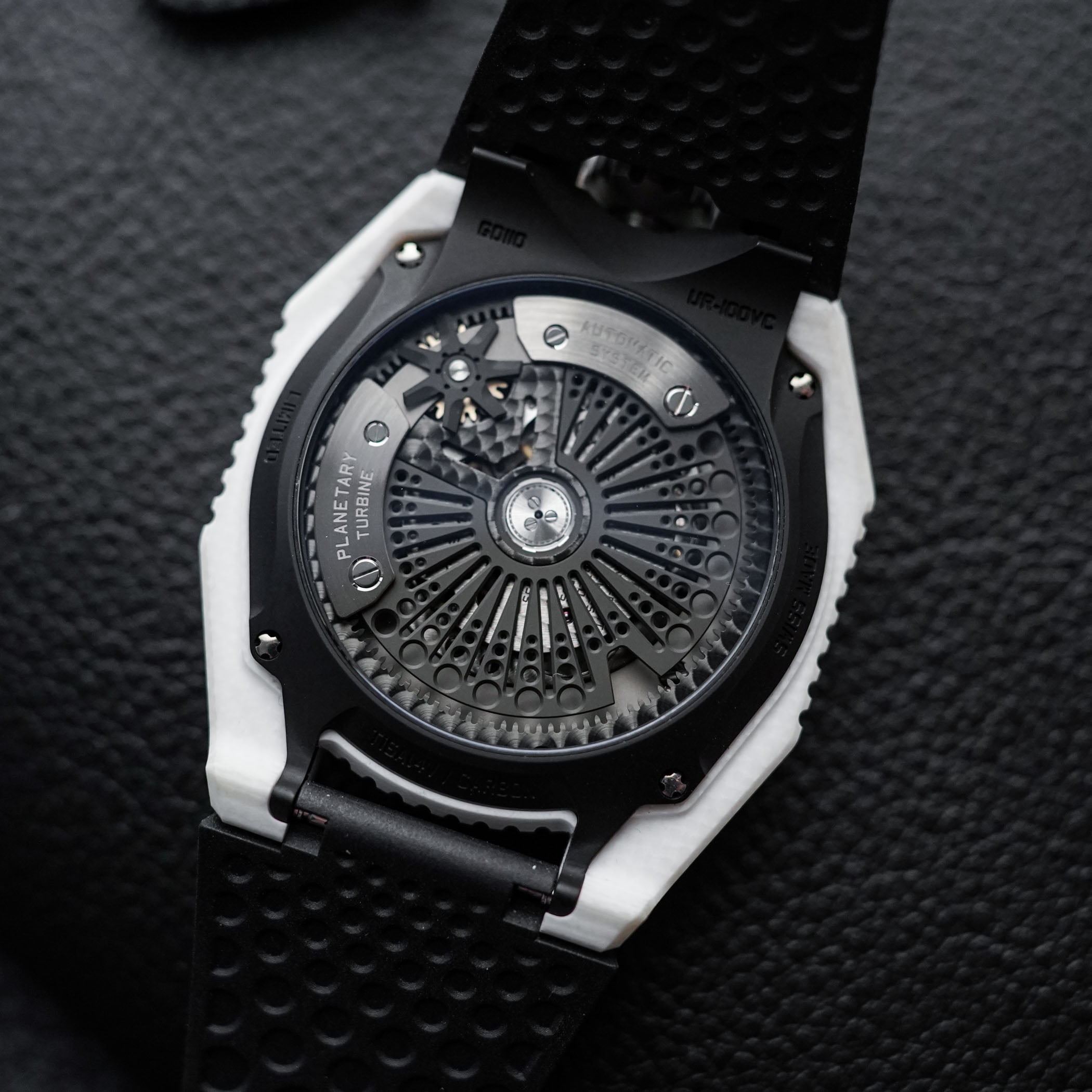
The watch is powered by the automatic calibre UR-12.02, developed with Vaucher and paired with Urwerk’s in-house display module.
The movement uses aluminium satellites mounted on beryllium-bronze Geneva crosses, with an aluminium carousel and ARCAP alloy used for the carousel and triple baseplates.
Urwerk’s Windfänger system is also present.
This air-resistance turbine regulates the winding rotor’s speed, a practical touch designed to reduce stress and help long-term reliability.
The calibre runs at 28,800 vibrations per hour and offers a 48-hour power reserve.
Its finishing stays close to Urwerk’s industrial vocabulary, with circular graining, sandblasting, satin finishing and shot-blasting rather than classical decorative flourish.
Details & Specifications
| Brand | Urwerk |
|---|---|
| Model | UR-100V Lightspeed Ceramic |
| Case size | 43mm wide x 51.73mm long x 14.55mm thick |
| Case material | White ceramic with silver fibreglass and carbon |
| Caseback | DLC-treated titanium with sapphire crystal |
| Crown | Screw-down crown at 12 o’clock |
| Water resistance | 50 metres |
| Dial display | Satellite hours with red arrow-tipped minute indicator on a 120-degree arched track |
| Additional indication | Time taken for sunlight to reach eight planets |
| Lume | Blue emission Super-LumiNova on hours and minutes |
| Movement | Automatic calibre UR-12.02 |
| Movement development | Developed with Vaucher, with Urwerk in-house display module |
| Jewels | 40 |
| Frequency | 28,800vph |
| Power reserve | 48 hours |
| Rotor | Black drilled Sun-shaped aluminium rotor with Windfänger airscrew |
| Straps | Black rubber strap and white rubber strap with deployant clasp |
| Price | CHF 67,000 before taxes |
The UR-100V Lightspeed Ceramic is unlikely to convert anyone looking for a discreet daily watch, but that has never been Urwerk’s territory.
Its appeal lies in how confidently it blends material experimentation, satellite-hour mechanics and a poetic view of astronomical time into a watch that still belongs to the compact UR-100 family.