Southwark has a way of making London feel more textured, less staged and more alive.
The Hoxton, Southwark taps into that mood with unusual confidence, placing guests close to the South Bank while giving them plenty of reason to stay inside.
Set on Blackfriars Road, the hotel works as both a practical London base and a social address in its own right, with a lobby that hums from morning coffee to late drinks and a rooftop restaurant that makes the skyline part of the experience.

At a glance
- The Hoxton, Southwark is a 192-room hotel on Blackfriars Road, close to the South Bank, Tate Modern, Shakespeare’s Globe and Borough Market.
- Its appeal centres on industrial-inspired interiors, a lively lobby, all-day dining at Albie and Seabird, a seafood-led rooftop restaurant on the 14th floor.
- It suits travellers who want a well-connected London stay with strong food, design and neighbourhood energy built into the hotel itself.
Southwark as a London base
Location is one of the hotel’s clearest strengths.
From Blackfriars Road, the South Bank is within easy reach, with Tate Modern, Shakespeare’s Globe and Borough Market all close enough to shape a weekend without demanding much planning.
Southwark Underground station is nearby, Blackfriars station is comfortably walkable, and the Thames sits just a few streets away.

That access matters because this part of London rewards wandering.
Southwark carries traces of industry, theatre, food culture and contemporary art in a way that feels more layered than polished, and The Hoxton uses that character rather than trying to smooth it out.
A lobby with neighbourhood energy
The Hoxton has built much of its reputation on the idea that a hotel lobby should be more than a waiting room.

In Southwark, that idea feels especially convincing.
The move from the traffic and movement of Blackfriars Road into the hotel is immediate, but the energy doesn’t disappear.
Instead, it shifts into a warmer rhythm of laptops over coffee, small meetings, long lunches and cocktails as the light changes.

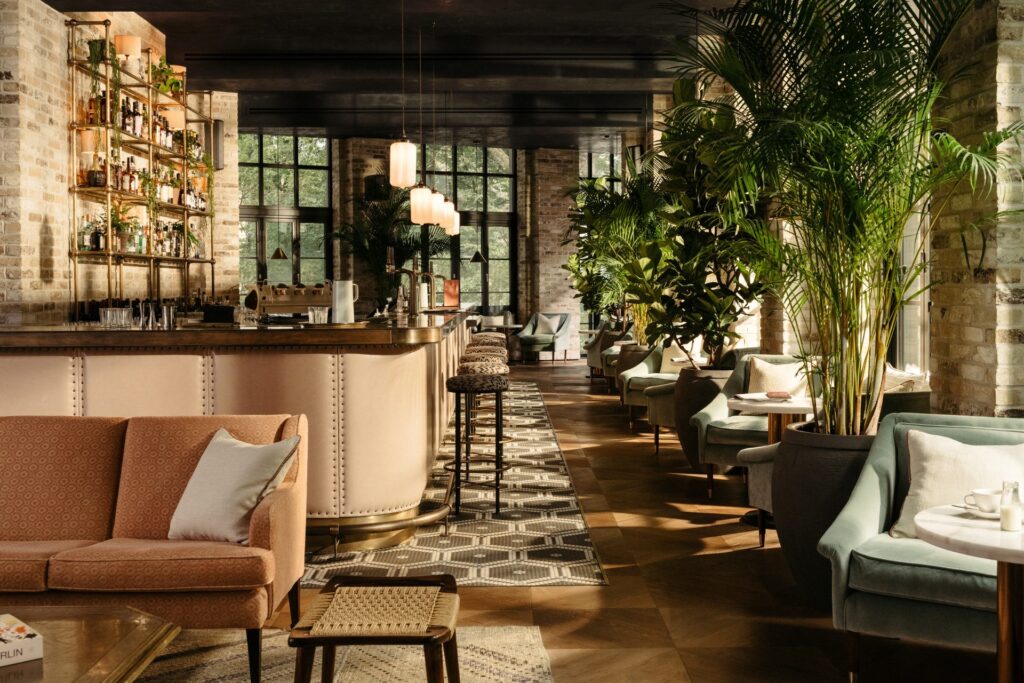
The design draws from South London’s industrial past, with concrete, exposed brick and warehouse-style details giving the space its backbone.
Crucially, it avoids feeling severe.
Warm lighting, greenery, soft seating and smaller corners within the larger room make the public spaces feel sociable without becoming anonymous.
It’s fashionable without working too hard to prove the point, which is often the difference between a hotel people pass through and one locals actually use.
Albie downstairs and Seabird above the city
Food and drink are central to the hotel’s personality.
At ground level, Albie operates as an all-day restaurant and lobby bar, but it feels more like a Southwark hangout than a hotel convenience.
Breakfast moves at an unhurried pace, lunch folds into afternoon coffee, and by evening the same space has taken on the easy mood of a neighbourhood bar.
The mezzanine adds another layer, hosting guest chef supper clubs and live DJ sets, giving the restaurant a life beyond standard hotel dining.
Fourteen floors up, Seabird changes the perspective entirely.
The rooftop restaurant is built around sea-to-table cooking with Spanish and Portuguese influences, anchored by a marble raw bar and a notably extensive oyster list.
The room is designed around the view, with floor-to-ceiling windows and a terrace that place London’s skyline at the centre of lunch, dinner or drinks.
Oysters are the natural starting point, but the broader menu leans into seafood designed for sharing, with Iberian coastal flavours giving the restaurant a sense of escape without losing its London setting.
What makes Seabird work is that it doesn’t feel like a rooftop venue loosely attached to a hotel.
Paired with Albie, it gives The Hoxton, Southwark a complete rhythm, one rooted at street level and one lifted above the city.
Industrial rooms with a softer edge
The rooms continue the hotel’s South London design language with concrete ceilings, exposed brick walls and large warehouse-style windows.
Those details could easily push the mood too far toward austerity, but parquet floors, plush headboards and warmer textures bring the scheme back into balance.
Room categories run from Snug and Cosy to the larger Biggy rooms, giving the hotel flexibility for short stays, solo trips and more spacious weekends.
Across the categories, the essentials remain consistent, including comfortable beds, walk-in rainfall showers and a layout that favours usefulness as much as atmosphere.
That balance is important after a full day in London.
The public spaces encourage lingering, while the rooms make retreat feel just as appealing.
The Hoxton, Southwark works because it feels tied to its address rather than imposed on it.
It gives travellers a well-connected base near some of London’s strongest cultural and food destinations, then adds enough of its own character that staying in can feel like part of the plan.