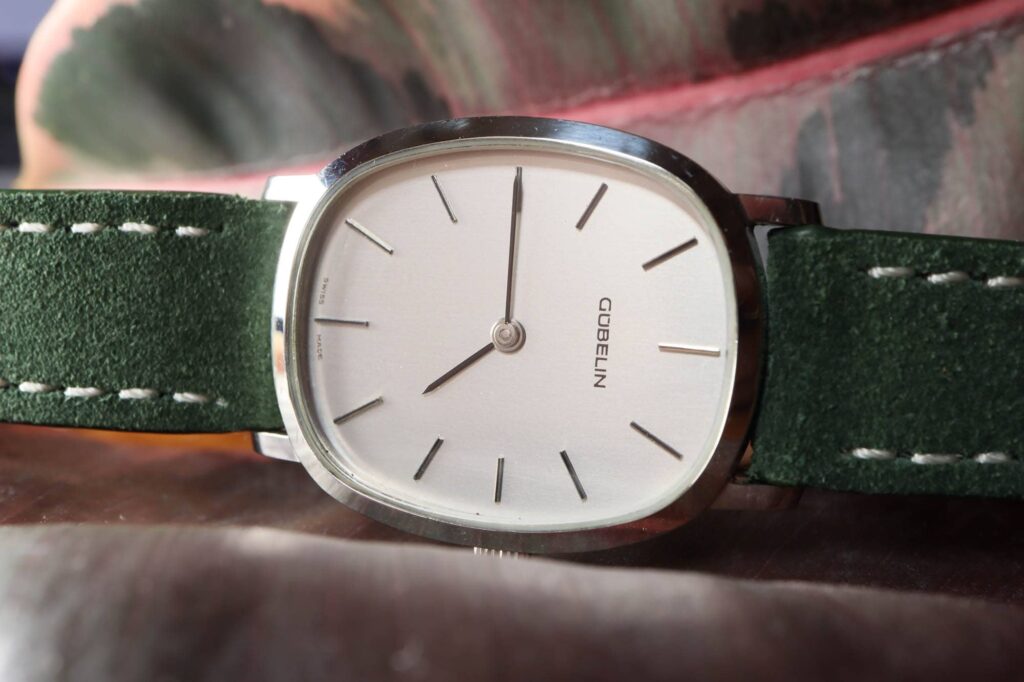
Gübelin is a familiar name to collectors who follow double-signed watches, especially pieces retailed alongside brands such as Patek Philippe, Audemars Piguet and Heuer. Less commonly discussed are watches sold under Gübelin’s own name, including a small, ultra-thin Ellipse-style dress watch from the 1970s era that combines retailer history, restrained design and a respected hand-wound movement.
Why Gübelin Matters to Watch Collectors
Gübelin began in Lucerne in 1854 as an independent watch shop focused on repairs and sales. The business was originally led by Mauritz Breitschmid, a watchmaker who later entered into partnership with Eduard Jakob Gübelin, his young apprentice and eventual son-in-law.
Over time, Gübelin became an important name in the jewelry trade and developed relationships with prominent watchmakers. Collectors often encounter the Gübelin name on double-signed dials from brands including Patek Philippe, Audemars Piguet and Heuer.
Those retailer-signed watches can include highly regarded models such as the Disco Volante, Calatrava, Nautilus and Ellipse. Today, many of those co-signed examples command significant prices, which makes Gübelin’s own watches an interesting and often more approachable area of study.
A Gübelin Watch With Familiar Ellipse Proportions
The Gübelin Ellipse-style watch stands out because of its close visual relationship to the design language associated with Patek Philippe’s Ellipse models. The materials and finishing standards are not presented as equivalent, but the general formula is clear: a compact, elegant dress watch built around a thin case and soft elliptical shape.
The example described measures 31mm across and 35mm lug-to-lug, making it notably conservative by modern standards. At only 6mm thick, it is the kind of watch intended to sit low and discreetly on the wrist.
One practical detail is the 16mm lug width, which is narrower than the comparable Patek reference mentioned in the source material. That can make strap hunting more difficult, though not impossible.
The Peseux 7001 Movement Inside
While the exact production date of the watch is not confirmed, the movement offers a useful clue. The watch uses the Peseux 7001, a hand-wound movement originally released in 1971. Based on that movement, the watch is believed to have reached the market around the mid-1970s.
Peseux was a respected movement manufacturer before being acquired by ETA in 1985. After the acquisition, the 7001 continued under the ETA name and has remained in production into the modern era.
The movement is known for its suitability in thin dress watches. It measures 2.5mm thick, offers more than 42 hours of power reserve and runs at 21,600 beats per hour. Its long production life has also made it familiar beyond vintage watches, with modern brands such as Christopher Ward, Zelos and Maen using versions of the movement.
Why These Watches Are Hard to Research
Unlike better-known double-signed watches, Gübelin-branded watches have not received the same level of documentation. The specific Ellipse-style example discussed in the source appears to be one of the few thoroughly documented examples available online.
That lack of documentation is part of the appeal, but it also creates challenges. Collectors may find scattered listings for Gübelin watches, but details can vary widely depending on model, condition and complications. Some other Gübelin watches on auction platforms can sell for strong prices when the specification or condition supports it.
Buying Considerations for Collectors
The source example was purchased very inexpensively after being listed with a misspelling, “Gobelin,” which likely reduced its visibility in search results. That kind of find is unusual, but it highlights an important point for collectors: knowledge and patient searching can matter as much as budget.
For anyone looking for similar watches, broad searches can help. Saved searches for “Gübelin,” alternate spellings and generic terms such as “men’s watch” may surface listings that are missed by more targeted searches.
Collectors should also be aware that similar-looking watches exist from other makers. Juvenia, for example, made a watch with a related design, though the source notes that those examples appear smaller and use lesser movements.
A Small Watch With a Larger Story
The Gübelin Ellipse-style watch is not simply a budget alternative to a famous design. Its interest comes from the way it connects several threads of collecting: retailer-signed history, 1970s dress-watch design, slim mechanical movements and the overlooked output of an important jewelry retailer.
For collectors who already appreciate double-signed dials, Gübelin’s own watches offer a less familiar path into the same world. They are not always easy to identify, document or buy, but that obscurity is exactly what makes them worth watching.