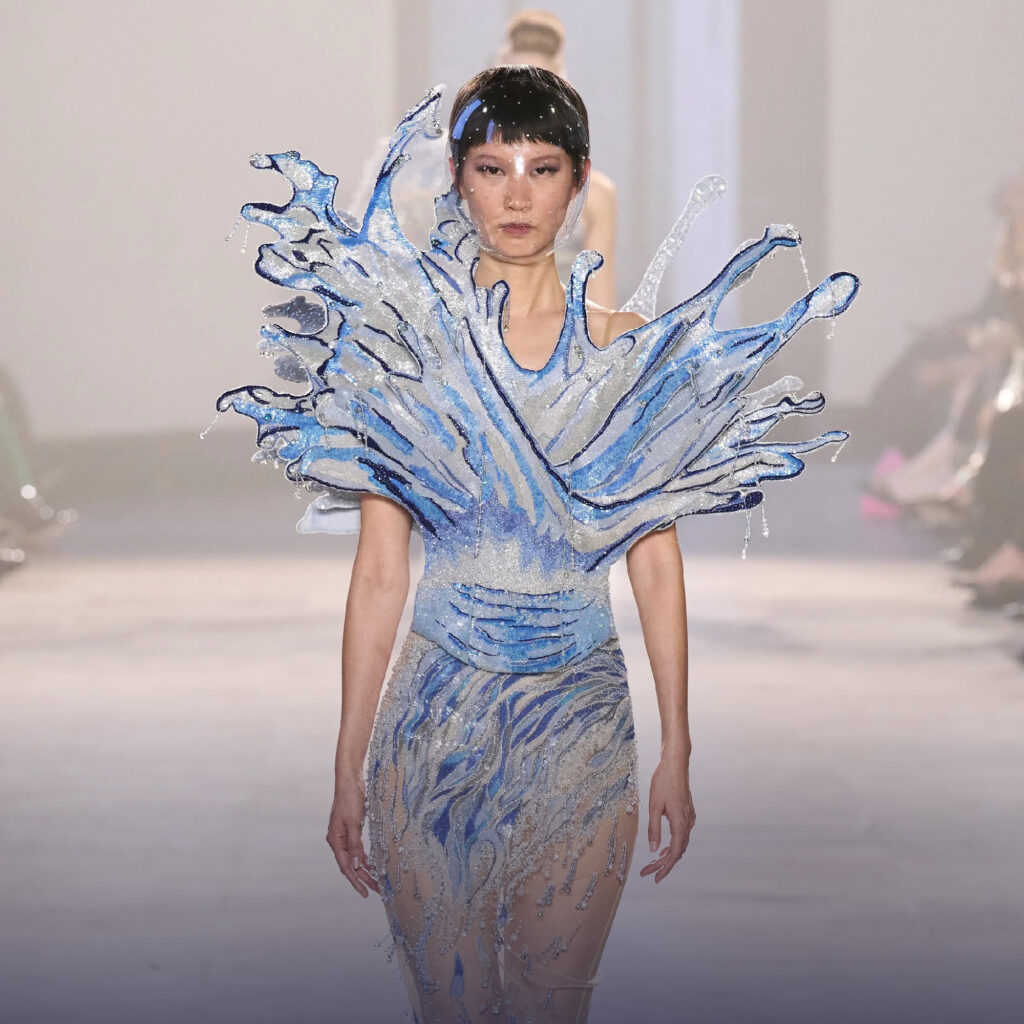
Rahul Mishra’s Alchemy brings a notably calm kind of authority to the Paris haute couture calendar.
Rather than leaning on spectacle, the collection works through texture, light and handwork, using the ancient idea of the five elements as a framework for garments that feel thoughtful rather than theatrical.
The result is a show best read up close, where embroidery, density and movement do the talking.

At a glance
- Rahul Mishra presented Alchemy during Haute Couture Week in Paris, shaping the collection around earth, water, fire, air and ether.
- The strongest looks rely on intricate embroidery, layered surfaces, sequins, beadwork and sheer fabrics rather than exaggerated volume.
- The collection reinforces Mishra’s position as an Indian couturier with a distinct, craft-led voice within the Paris couture system.
The elemental idea behind Alchemy
Alchemy is not a literal costume study of nature.
Mishra uses earth, water, fire, air and ether as emotional and material cues, allowing each element to shape the mood of the garment rather than appear as an obvious motif.
That distinction matters because the collection’s intelligence sits in its restraint.

The clothes don’t announce their concept with heavy-handed symbolism, but reveal it through surface, silhouette and the way light travels across the body.
Mishra has long been associated with complex embroidery and couture-level handwork, yet here the craft feels especially integrated.
The workmanship is not there simply to impress; it becomes the language through which the collection speaks.

Ten runway looks that defined the collection
The first major statement comes through the black gowns, which give the collection its sense of gravity.
Dense embroidery moves across the body like mineral strata or distant constellations, creating depth without resorting to excess.
A second standout is another black evening silhouette where the decoration appears almost cosmic.

It reads as earth seen through a more abstract lens, less pastoral than geological, with the body treated as a dark, shifting landscape.
The third defining moment arrives in the shorter silver looks.
Covered in sequins and beadwork, these pieces carry the water idea with a reflective, liquid quality that feels more contemporary than ceremonial.

A fourth look builds on that same silver language but with a sharper sense of movement.
It suggests how couture can translate into a modern wardrobe without losing the discipline and precision expected from the category.
The fifth standout belongs to the fire sequence, where embroidery climbs across corseted structures in controlled, flame-like lines.

There is tension in these pieces, but Mishra keeps the drama measured, avoiding the obvious trap of turning fire into costume.
A sixth look continues that idea with a stronger architectural presence.
The corseted form gives the embroidery somewhere to push against, making the garment feel charged rather than merely decorated.

The seventh and eighth highlights come from the lighter, sheer pieces, where the collection shifts from density to atmosphere.
Delicate embroidery over transparent fabrics creates silhouettes that seem to hover around the body, bringing air and ether into focus without making either feel fragile.
The ninth look is less about a single embellishment technique than about balance.

It sits between opacity and transparency, showing how Mishra can move from grounded weight to near-weightlessness within the same collection.
The tenth defining look is the one that best captures Alchemy’s broader mood.
It is controlled, intricate and quietly expressive, the kind of couture that asks for a slower gaze rather than an instant reaction.

Craftsmanship without visual noise
Mishra’s atelier is built around patient handwork, often involving garments that take months to complete.
In Alchemy, that labour is visible but not loud.
The embroidery has density, but it rarely feels heavy for its own sake.

Sequins and beadwork are used to change the behaviour of light, while layering gives the silhouettes depth without turning them into sculptural spectacle.
That approach gives the show its unusual rhythm.
Where many couture collections chase impact through scale, Mishra is more interested in perception, asking how a dress changes when seen in motion, in shadow or from a few steps closer.

Rahul Mishra’s place in modern couture
As an Indian designer working within the Paris couture calendar, Mishra occupies a distinctive space.
His work doesn’t attempt to mimic traditional European couture codes, nor does it depend on surface-level cultural references.
Instead, he brings a framework rooted in craft, philosophy and the natural world.
That gives Alchemy a global quality without making it feel anonymous.
The collection’s only possible limitation is also part of its character.
Its tone is so controlled and contemplative that it occasionally leaves you wanting one sharper rupture, a moment of disruption to break the rhythm.
Still, Alchemy is not built for quick gratification.
Its strength lies in coherence, patience and a belief that couture can still reward attention in an age of instant consumption.
For followers of haute couture who value technique with meaning behind it, Rahul Mishra’s Alchemy stands out as one of the season’s more quietly persuasive statements.