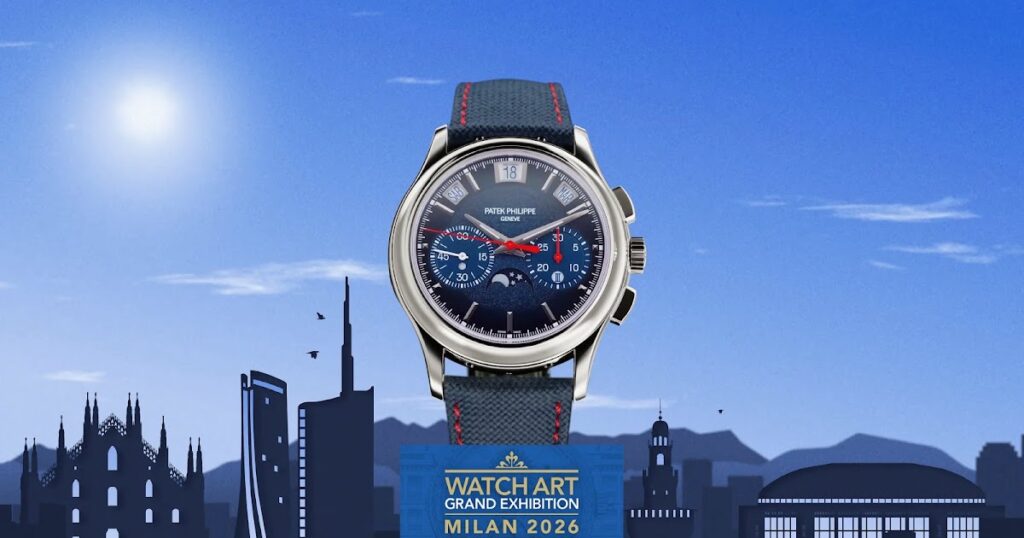
Patek Philippe’s WATCH ART Grand Exhibition Milano 2026 has opened at CityOval in Milan’s CityLife district, transforming the restored Palazzo delle Scintille into a broad portrait of the manufacture’s world.
With more than 500 watches, movements and objects spread across approximately 2,900 square metres, this is the largest WATCH ART exhibition Patek Philippe has staged to date.
It’s also the first edition held in Italy, giving Milan a particularly prominent place in the travelling exhibition’s story after previous stops in Dubai, Munich, London, New York, Singapore and Tokyo.

At a glance
- Patek Philippe’s WATCH ART Grand Exhibition Milano 2026 has opened at CityOval with more than 500 watches, movements and objects.
- The exhibition spans contemporary collections, museum loans, Rare Handcrafts, movement production, archives and major complicated watches.
- Milan is the seventh city to host WATCH ART and the first in Italy, with seven limited editions created for the Italian market.
Geneva Recreated Under Milan’s CityOval Dome
CityOval gives the exhibition a dramatic architectural frame, thanks to the building’s 30-metre-high dome and its history as the former Palazzo delle Scintille.
Rather than presenting watches in a conventional row of showcases, Patek Philippe has built a sequence of rooms that move through its Geneva identity, workshops, museum holdings and technical universe.
The Geneva references begin almost immediately.

A nine-metre-high sculpture made from more than 2,000 translucent droplets evokes the Jet d’Eau, one of the city’s defining landmarks.
Streets, architectural details and immersive installations continue the idea, placing the watches within the visual language of the city where Patek Philippe has been rooted since its founding.
That sense of place matters because WATCH ART is less about a single launch moment and more about explaining how the brand thinks across centuries, disciplines and complications.

The Current Collection Gains Context
One of the central spaces is dedicated to the contemporary Patek Philippe catalogue, arranged across the maison’s principal families and complications.
Calatrava, Nautilus and Aquanaut models appear alongside perpetual calendars, chronographs, minute repeaters and other high-complication pieces.
Seen together, the room makes clear how wide the current range has become without losing the restrained visual codes that collectors tend to associate with the manufacture.

It also helps separate the different layers of Patek Philippe ownership, from everyday-wearable designs to watches that exist almost as mechanical demonstrations.
The exhibition gives particular weight to movement making, with another room devoted to calibre development, component production and finishing.
Displays explain the stages behind individual parts, while research and development areas give visitors a glimpse of the technical work that comes before a completed movement reaches the case.

Engineers and specialists are present in this section, which gives the space a more active quality than a static museum display.
Rare Handcrafts With an Italian Thread
The Rare Handcrafts section changes the rhythm of the exhibition by shifting attention from mechanics to decoration, technique and patience.
Miniature painting on enamel, cloisonné enamel, hand engraving, micro-wood marquetry, guilloché and gem-setting are all represented.

Around 25 exceptional pieces have been created with Italian themes, including wristwatches, pocket watches and clocks.
The Italian references feel especially fitting in Milan because they let the craft remain the focus while connecting the objects to familiar artistic and architectural traditions.
The presence of artisans working in front of visitors is one of the section’s strengths.

Watching a dial or decorative element take shape by hand makes the time investment behind these pieces easier to understand than any finished showcase object could manage on its own.
Museum Pieces, Archives and Grand Complications
The historical section is among the exhibition’s strongest draws, with around 80 pieces from the Patek Philippe Museum in Geneva travelling to Milan.
The selection includes objects from the museum’s Antique Collection and the Patek Philippe Collection, ranging from early horological instruments to watches central to the manufacture’s own history.

Highlights include the first known Patek Philippe perpetual calendar wristwatch from 1925, the 1948 World Time Ref. 1415 HU and a 1918 pocket watch with minute repeater and 30-day power reserve once owned by James Ward Packard.
A separate historical owners section brings a more personal dimension, with watches connected to figures such as Queen Victoria and Pope Leo XIII.
These pieces shift the emphasis from technical achievement alone to the circumstances in which watches were commissioned, gifted, worn and preserved.

The exhibition also introduces a dedicated area for Patek Philippe’s historical archives.
Drawings, correspondence, technical documents and other preserved material reveal another side of watchmaking history, one that usually sits behind the finished object.
For collectors who care about provenance and scholarship, this archival section may be one of the most quietly rewarding rooms in the exhibition.

The complicated watches area brings together a broad selection of high-complexity pieces, with a separate zone for supercomplications.
The Calibre 89 and Star Caliber 2000 appear here as major milestones in Patek Philippe’s pursuit of mechanical complexity.
The Master of Sound room narrows the focus to chiming watches, including the Grandmaster Chime with its 20 complications, along with minute repeaters and the Sky Moon Tourbillon Ref. 6002R-001.

Demonstrations by master watchmakers give these pieces a different presence, since chiming watches are never fully understood by sight alone.
Milano Special Collection Introduces Seven Limited Editions
The exhibition also serves as the setting for the Milano Special Collection, a group of seven limited editions created specifically for the Italian market.
The most technically prominent is the platinum Ref. 5978P-010, which combines a manually wound chronograph with an instantaneous perpetual calendar.

It is powered by the new Calibre CHR 29-535 PS QI.
The day and month are shown through apertures at 12 o’clock, while the date appears at 6 o’clock.
Its black dial and platinum case give the watch a sober character despite the complexity beneath the surface.
The Milano Special Collection also includes a trio of Calatrava watches sharing a design inspired by the Ref. 6007, offering a more direct visual connection to the Italian theme.
For Patek Philippe, bringing WATCH ART to Milan is more than a travelling exhibition stop.
It is a carefully staged meeting between Geneva watchmaking culture and one of Europe’s most design-conscious cities, with enough historical depth, craft and mechanical substance to satisfy seasoned collectors while remaining accessible to visitors discovering the brand’s universe for the first time.