NOMOS has taken one of the more unexpected turns of Watches & Wonders 2026. The Glashütte brand best known for clear typography, slim cases and democratic pricing has introduced Twice Unique, a series of paired watches that put artisanal dials at the center of the conversation.
Each set combines a stainless steel watch with a matching 18-carat gold counterpart, giving collectors two related expressions of the same idea rather than a single standalone release.
At a glance
- NOMOS Twice Unique is a new family of paired watches shown at Watches & Wonders 2026.
- Each pair includes a stainless steel model and an 18-carat gold model with distinctive artistic dial work.
- The project uses familiar NOMOS case families and in-house movements while exploring rarer, more craft-led dial designs.
The actual proposition is simple but unusual for NOMOS, with the brand selling these watches in pairs rather than as individual models.

The idea brings together existing NOMOS shapes, including Ludwig, Orion, Tangente 33, Tangente neomatik 38 Update and Tetra, with dials that move far beyond the usual restraint of the catalogue.
Paired watches from a brand built on clarity
NOMOS has always had a disciplined streak, and that’s part of its appeal.
Founded in 1990 in Glashütte by Roland Schwertner, the brand grew by combining Saxon watchmaking, in-house calibres and a design language shaped by functional modernism.

Its watches usually feel precise rather than decorative, with Bauhaus-adjacent restraint, carefully judged proportions and a strong sense that price still matters.
Twice Unique doesn’t abandon that framework so much as test its edges.
By using known cases and movements, NOMOS keeps the architecture familiar while allowing the dial to carry the creative risk.

Textile patterns meet Saxon watchmaking
Among the most striking Twice Unique pieces are the watches inspired by Anna Diederichs, the German textile designer and artist who moved to Paris in 1969 and worked for the fashion house Dessins Kanitz.
The Ludwig Rive Gauche brings one of her sketches onto the dial, with visible pencil-like traces and a vivid field of scarlet punctuated by carmine and cream circles.
It’s a long way from a standard Ludwig dial, yet the small seconds, narrow case profile and formal hands keep the watch recognisably within the NOMOS world.

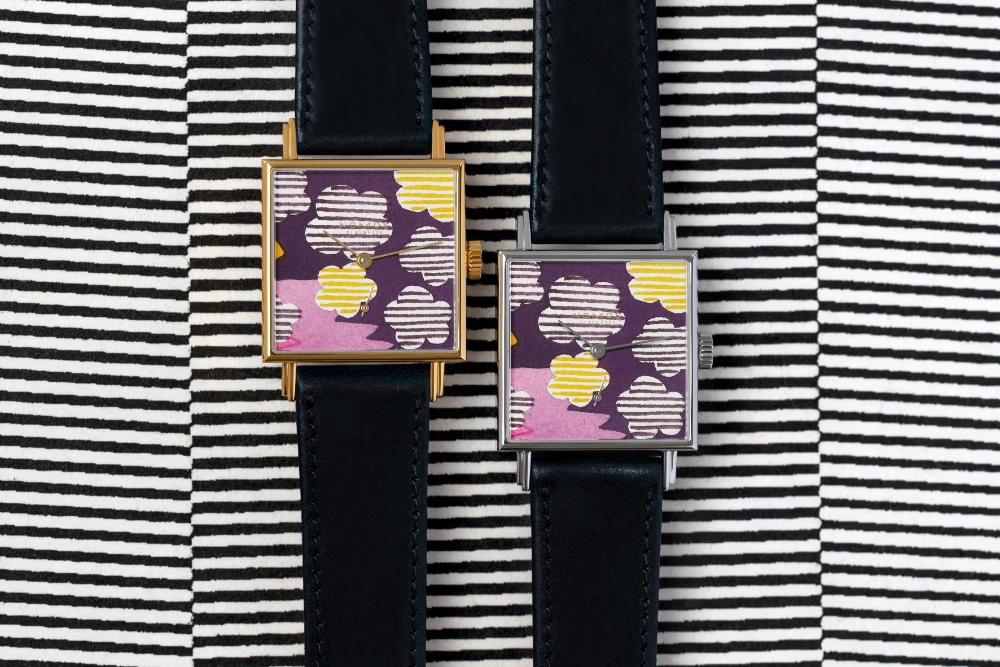
The Tetra Paris 1966 takes a different route, using a floral textile pattern with horizontal lines and a saturated palette.
That pairing feels especially natural, because the square 27.5 mm Tetra case has always been the brand’s more defiant shape.
Urania brings the night sky to the dial
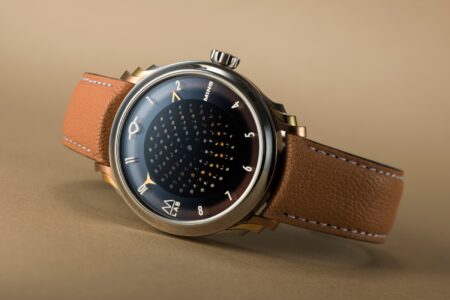
The Urania watches push the artisanal angle further, replacing graphic pattern with a dark blue astronomical scene.

Small silvery marks are applied by hand with an ultra-fine mouse-hair brush, creating the impression of stars scattered across an obsidian sky.
Some of those points are executed in Super-LumiNova, giving the dial a warm glow when the light drops.
It’s a poetic use of lume, less about legibility as a tool-watch feature and more about extending the dial concept after dark.

A more collectible side of NOMOS
The most interesting thing about Twice Unique is not simply that NOMOS has made gold watches, because the brand has done that before.
What matters is the format, since a steel-and-gold pair with matching artistic treatment changes how a collector engages with the watch.
One model can be worn more freely, while the other has a more precious, archival quality.
That dynamic gives the project a quietly historical feel without turning it into pastiche.
Twice Unique will make the most sense to existing NOMOS collectors who already understand the brand’s cleaner work and want to see how far its design system can stretch.
For first-time buyers, the regular catalogue will remain the more practical entry point, but these paired pieces show a welcome willingness from NOMOS to treat craft and experimentation as part of its future.
Details & Specifications
| Brand | NOMOS Glashütte |
|---|---|
| Collection | Twice Unique |
| Launch context | Watches & Wonders 2026 |
| Case materials | Stainless steel and 18-carat gold, sold as a pair |
| Case families | Ludwig, Orion, Tangente 33, Tangente neomatik 38 Update and Tetra |
| Dial themes | Anna Diederichs-inspired textile artwork, Rive Gauche, Paris 1966 and Urania night-sky designs |
| Movement | NOMOS in-house mechanical movements |
| Availability | Sold in pairs in very limited numbers |
FAQ
What is NOMOS Twice Unique?
NOMOS Twice Unique is a Watches & Wonders 2026 project built around paired watches, with each set combining a stainless steel model and a matching 18-carat gold version. The watches use familiar NOMOS case families but place the emphasis on more expressive, craft-led dials.
Why are the Twice Unique watches sold as pairs?
The concept is that each pair offers two related interpretations of the same design idea, rather than a single regular-production model. It gives collectors a steel watch that can be worn more casually and a gold counterpart with a more precious, collectible character.
Which NOMOS models are used for Twice Unique?
The collection draws on established NOMOS shapes including Ludwig, Orion, Tangente 33, Tangente neomatik 38 Update and Tetra. That keeps the proportions and mechanical base familiar while allowing the dials to move into more artistic territory.
What makes the dials different from standard NOMOS watches?
Twice Unique shifts away from the brand’s usual pared-back typography and colour restraint. Some dials are inspired by the textile work of Anna Diederichs, while the Urania pieces use a dark night-sky treatment with hand-applied silvery details and selected Super-LumiNova accents.
Are NOMOS Twice Unique prices and availability confirmed?
The watches are described as being made in very limited numbers and sold only as steel-and-gold pairs. Pricing has not been confirmed in the available details, so collectors should expect availability and allocation to matter more than with a standard NOMOS catalogue release.