MB&F has always been most interesting when it treats watchmaking as sculpture rather than product design.
HM12 The Guardian takes that idea further, pairing a highly complex wristwatch with a purpose-built robot companion created with L’Epée 1839.
It’s a watch, a mechanical figure and a statement about where independent horology can go when function is allowed to share space with imagination.
At a glance
- MB&F has introduced HM12 The Guardian, a Horological Machine that combines a wristwatch with a fully realised robot companion.
- The watch features jumping hours, trailing minutes, a flying tourbillon, a double-sided micro-rotor and an independent mechanical face shield.
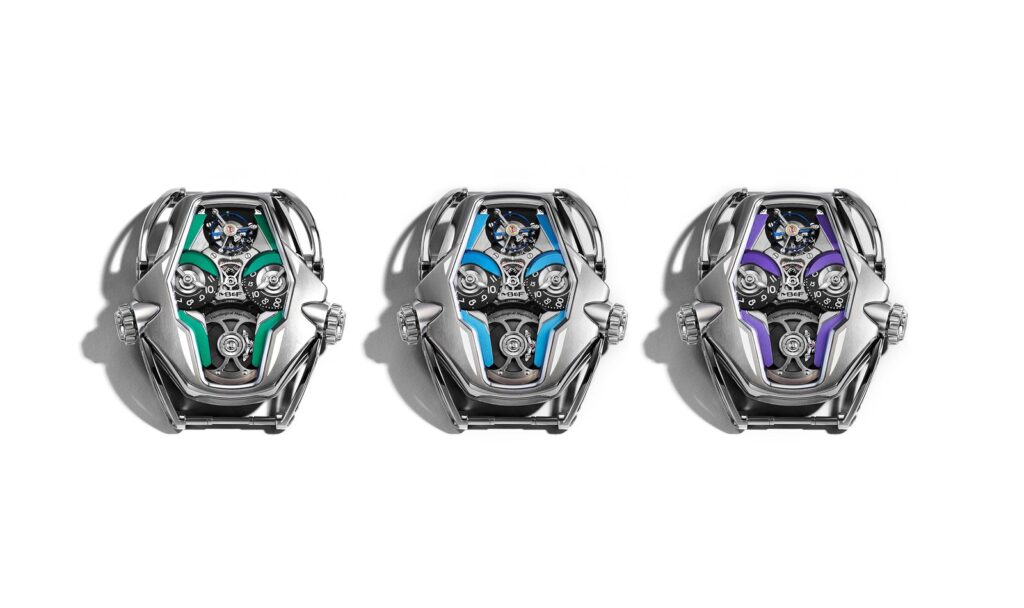
- Production is limited to 36 pieces worldwide, split across blue, green and purple editions of 12 pieces each.
A Horological Machine with a face
HM12 doesn’t try to resemble a conventional wristwatch, and that’s precisely the point.
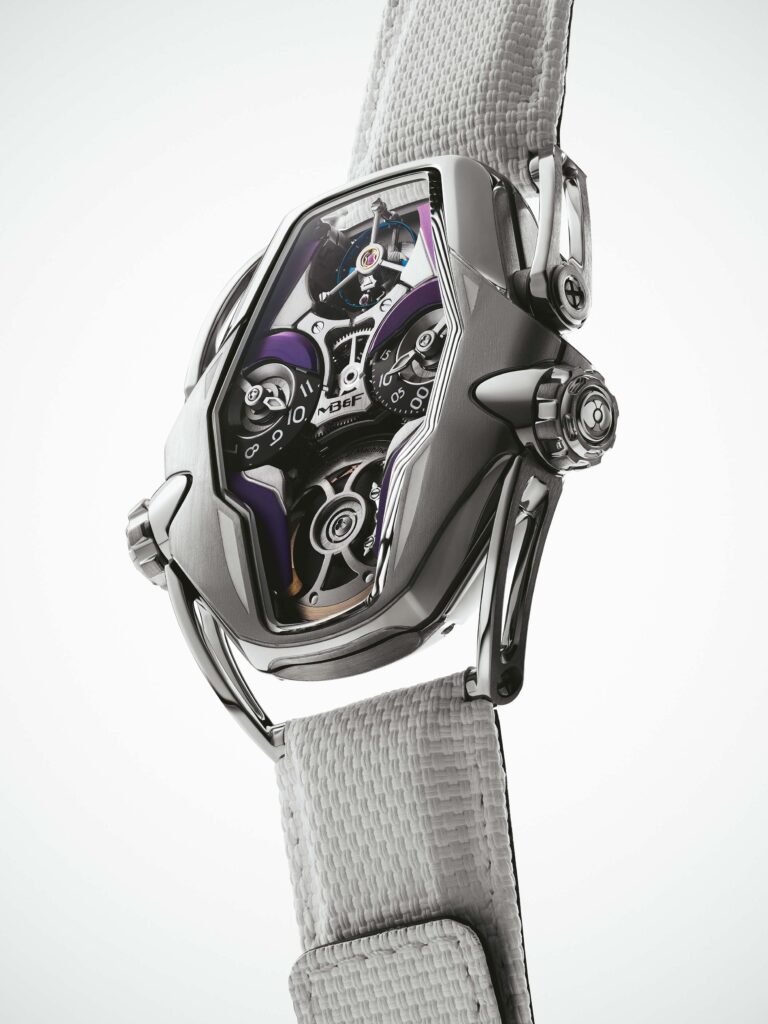
The display is arranged as a robotic face, with the jumping hours and trailing minutes forming the eyes on rotating discs while the reading point stays fixed.
Below them, MB&F’s battle-axe-shaped micro-rotor sits where a mouth might be, turning a functional winding system into part of the character.
At the top, the flying tourbillon is exposed beneath a sapphire structure that gives the watch the impression of a transparent mechanical skull.
The creative language draws from Maximilian Büsser’s childhood fascination with robots, toys and science-fiction imagery from the 1970s and 1980s.
Designer Maximilian Maertens, who co-developed HM12, brings a slightly younger pop-cultural memory bank to the project, including the world of Transformers and animated series.

The mechanical mask is more than theatre
One of HM12’s defining features is its sliding face shield, operated by the crown on the left side of the watch.
The shields can reveal or conceal the face in a smooth continuous motion, and the wearer can stop them at any point along the travel.
Once the system reaches its limit, the crown disengages to protect the mechanism from unnecessary strain.
More than 200 components are dedicated to this shield system alone, and it operates independently from the timekeeping calibre.
That separation matters because the complication isn’t merely decorative, it has to coexist with an already dense movement architecture without disturbing the core mechanics.
The detailing is treated with the seriousness expected from haute horlogerie, including polished wheels and chatons where many brands would have settled for hidden engineering.
A tourbillon calibre with a classical side
The HM12 calibre contains 646 components and 86 jewels, with an 84-hour power reserve.
Its main horological signatures include instantaneous jumping hours, trailing minutes, a flying tourbillon and the double-sided micro-rotor visible from the front.
From the dial side, the watch is pure MB&F theatre, mechanical, animated and unapologetically three-dimensional.
Turn it over and the mood changes.
The rear of the movement shows softer curved bridges, a grained mainplate and a domed rotor decorated with guilloché, developed with the involvement of Kari Voutilainen’s atelier.
That contrast gives HM12 much of its tension, with futuristic character on one side and traditional hand-finishing values on the other.
The Guardian gives the watch a body
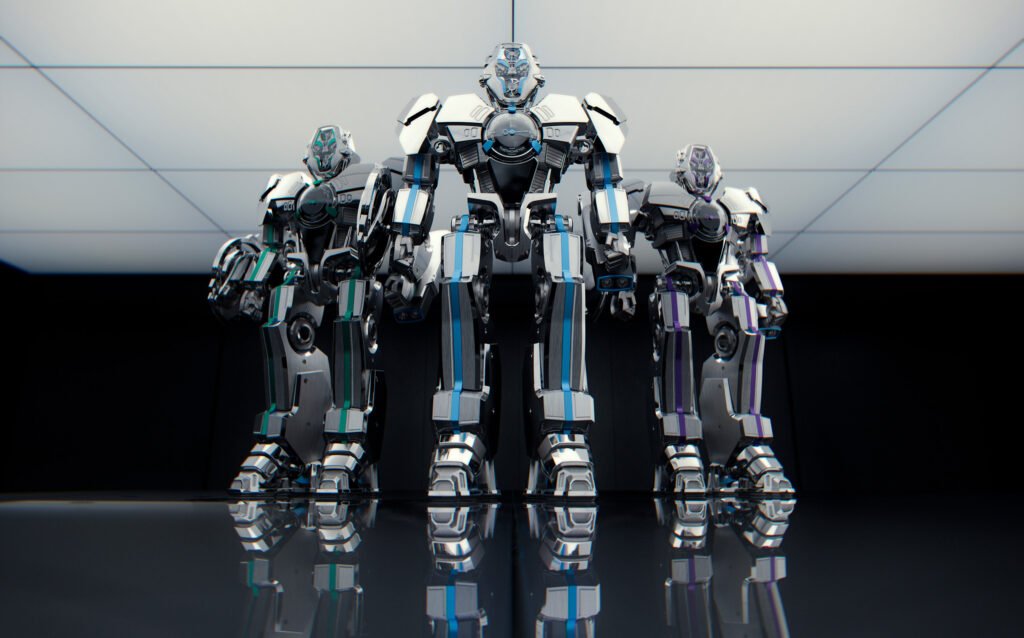
The wristwatch can be detached from its strap and mounted onto The Guardian, a 38 cm tall robot developed with L’Epée 1839.
This isn’t a passive presentation object, but a mechanical body designed around the watch.
The Guardian itself contains 755 components and includes a mechanical thermometer at the chest, positioned as the robot’s heart.
One arm carries a shield with an integrated loupe for inspecting the movement, while the other holds a detachable UV torch that charges the Super-LumiNova on both the robot and the watch.
The strap is stored inside a hidden drawer in the base, keeping the full concept together whether HM12 is worn or displayed.
Combined, the watch and robot comprise nearly 1,500 components, which explains why the project feels closer to a mechanical universe than a single object.
Details & Specifications
| Brand | MB&F |
|---|---|
| Model | HM12 The Guardian |
| Collection | Horological Machine |
| Time display | Instantaneous jumping hours and trailing minutes on rotating discs |
| Regulating organ | Flying tourbillon |
| Winding system | Double-sided battle-axe micro-rotor |
| Movement | 646 components, 86 jewels |
| Power reserve | 84 hours |
| Additional mechanism | Independent mechanical face shield operated by the left crown |
| Shield system | More than 200 components |
| Robot companion | The Guardian by L’Epée 1839 |
| Robot height | 38 cm |
| Robot components | 755 components |
| Robot functions | Mechanical thermometer, integrated loupe, detachable UV torch and hidden strap drawer |
| Total construction | Nearly 1,500 components across watch and robot |
| Editions | Blue, green and purple |
| Production | 12 pieces per colour, 36 pieces total |
HM12 The Guardian is very much an MB&F creation, but it also feels like a marker for the brand’s next chapter.
It keeps the collaborative spirit and mechanical playfulness that defined the company from the beginning, while giving the Horological Machine concept a stronger sense of character, ritual and physical presence.