MB&F has never treated watchmaking as a polite exercise in restraint, and the HM12 The Guardian makes that clear within seconds.
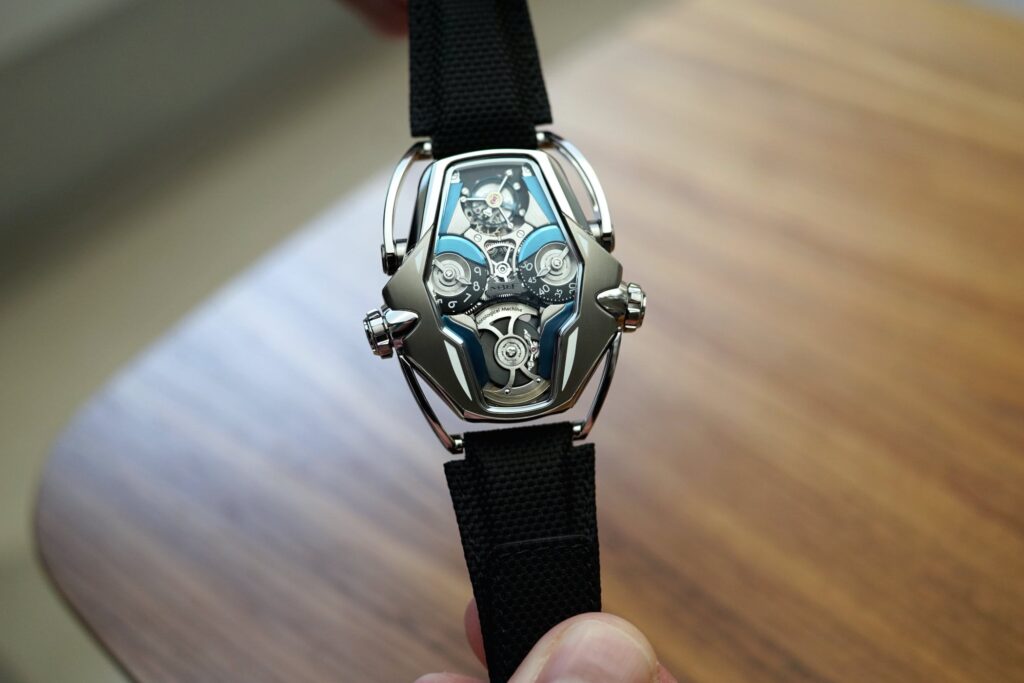
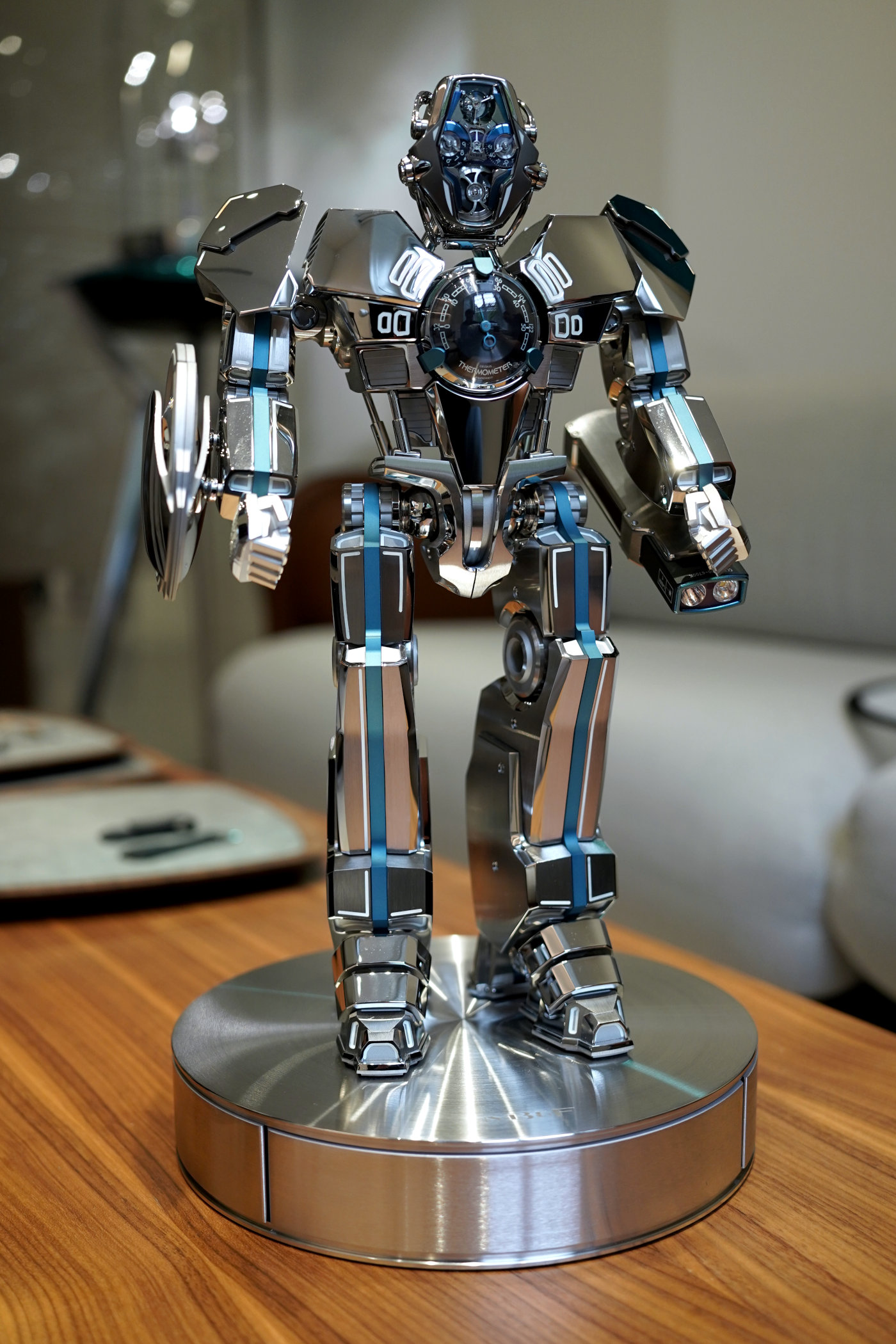
This is a flying tourbillon wristwatch conceived as the head and brain of a robot, complete with expressive mechanical shields, a micro-rotor mouth and a full-scale companion body built by L’Epée 1839.
It’s playful on the surface, but the engineering underneath is anything but casual.
At a glance
- MB&F has introduced the HM12 The Guardian, a new Horological Machine designed as the functional head of a robot companion.
- The titanium watch combines jumping hours, trailing minutes, a flying tourbillon, a double-sided micro-rotor and a mechanical face-shield system.
- Production is limited to 12 pieces each in green, blue and purple, priced at CHF 280,000 excluding VAT.
A robot face with a serious watch inside
The HM12 belongs firmly to the wilder side of MB&F’s catalogue, the side that gave the independent watchmaker its reputation for turning spacecraft, aircraft, machines and childhood sketches into wearable mechanics.
Here, the concept starts with a simple question that feels very MB&F in spirit.
What if a robot’s head were not merely inspired by a watch, but actually was the watch?
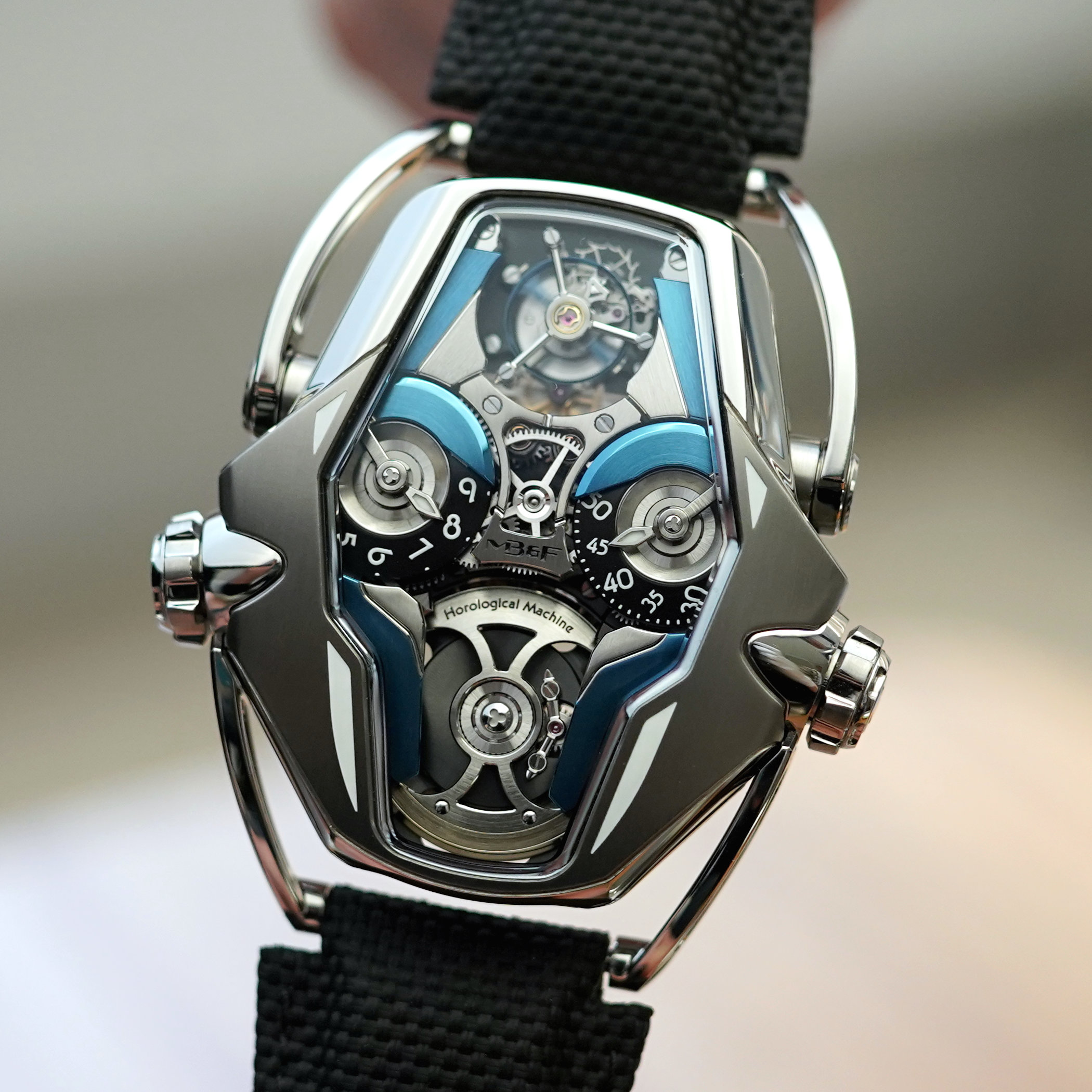
The answer is a Grade 5 titanium case measuring 49.3mm long, 43.6mm wide and 13.8mm thick, with an architecture dominated by sapphire crystal and mechanical theatre.
By MB&F standards, the case is relatively contained, though it’s still unmistakably an Horological Machine.
The upper section is flooded with light through sapphire, while a front aperture at 12 o’clock lets the flying tourbillon be seen laterally as well as from above.
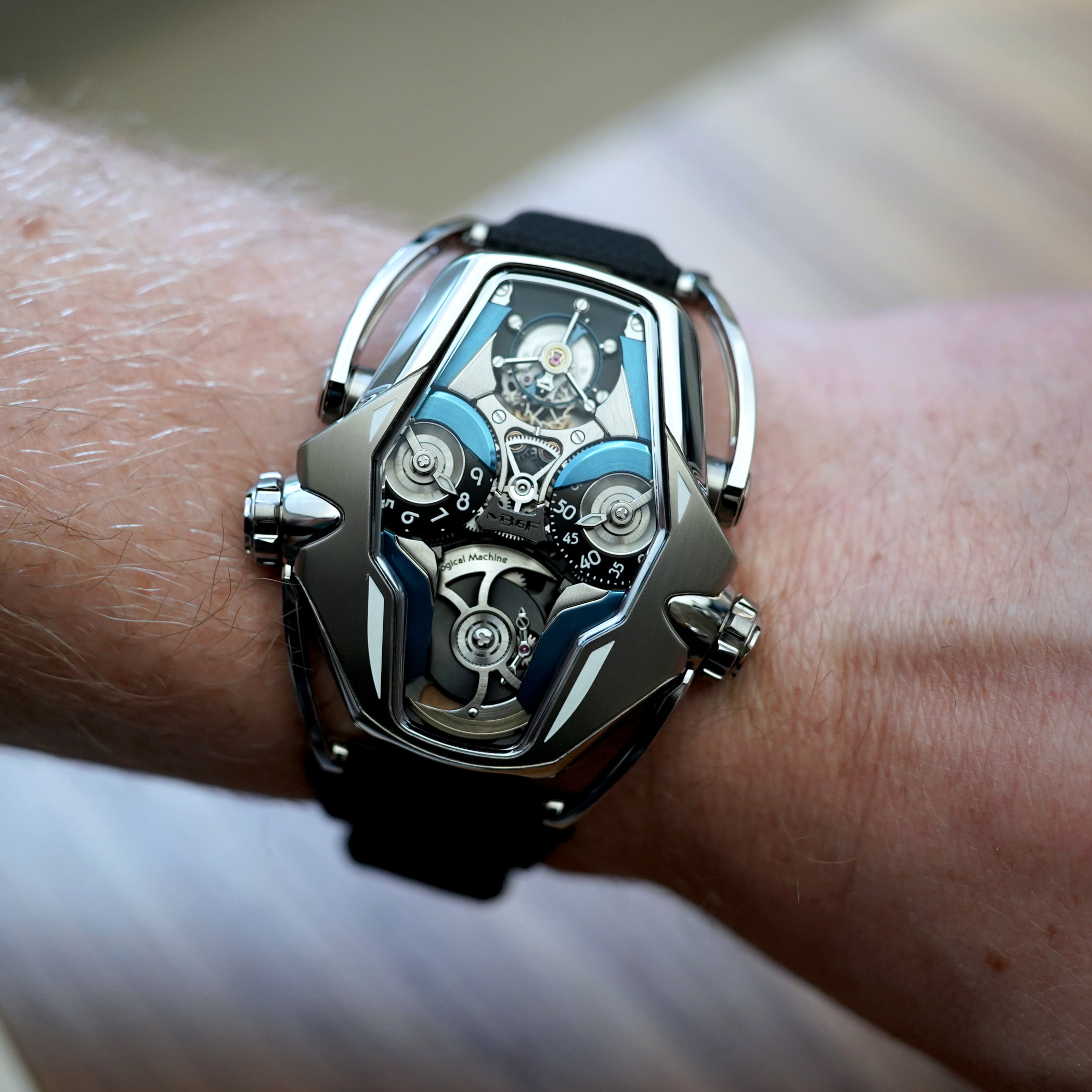
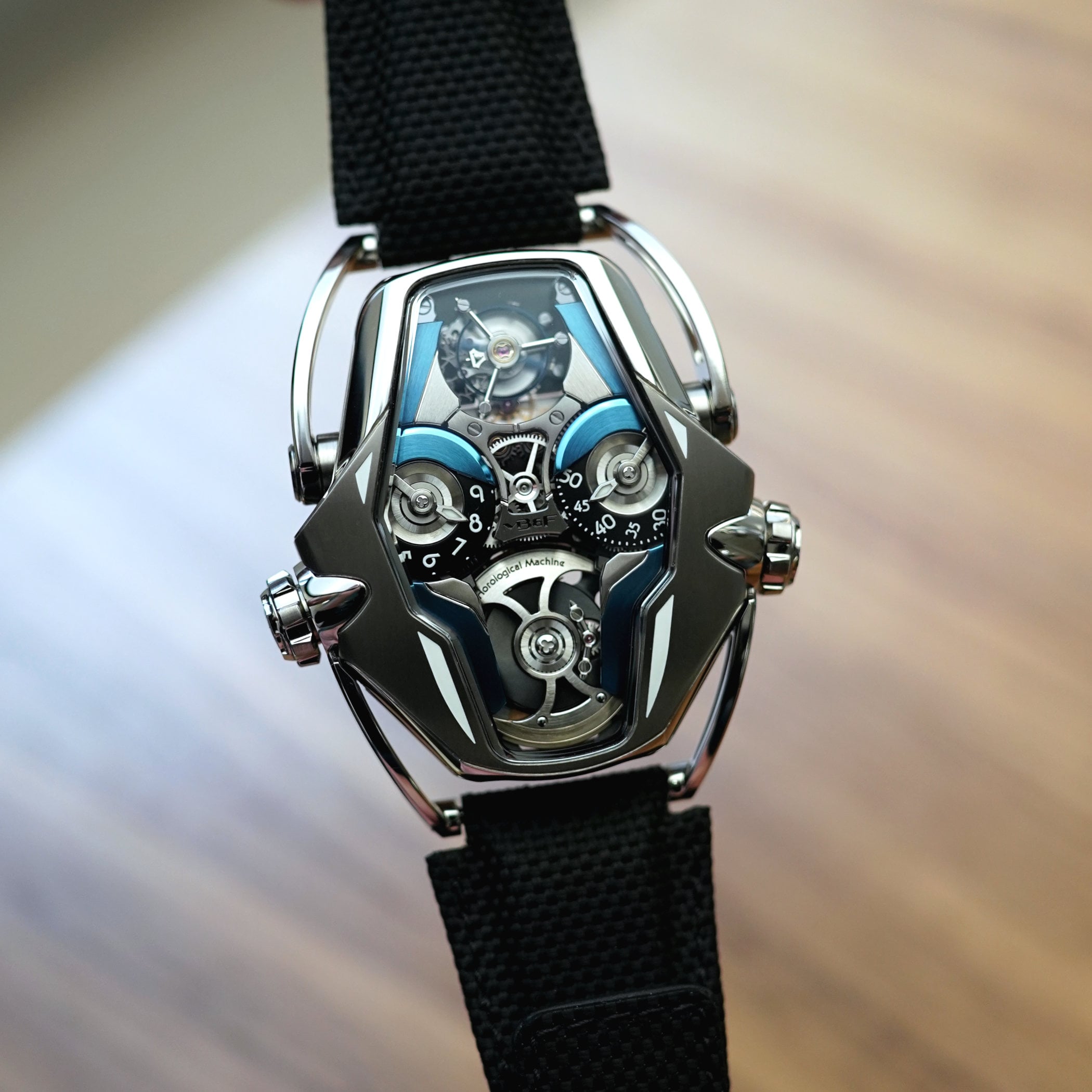
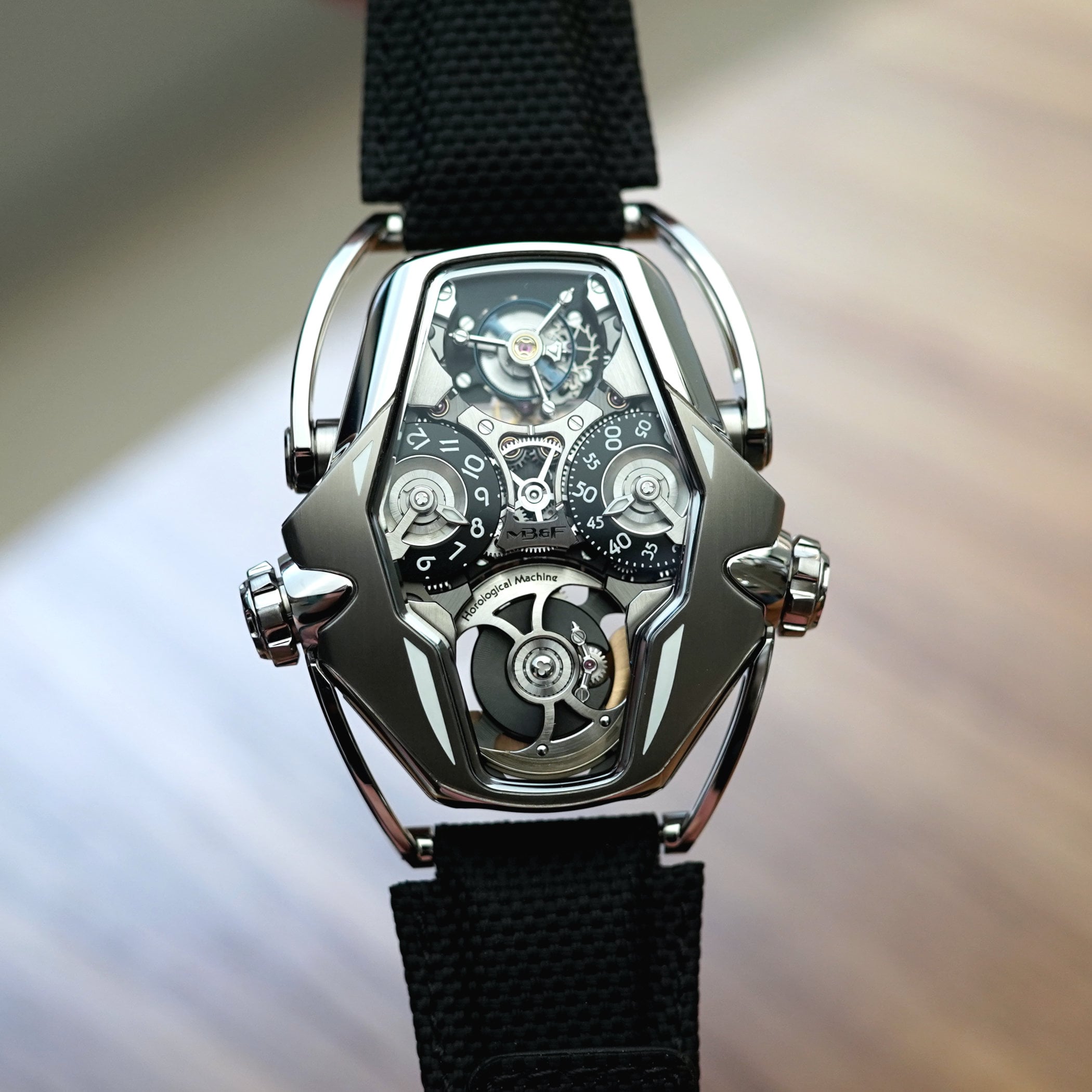
The robot’s eyes are the time display.
The left indication shows instantaneous jumping hours, while the right handles trailing minutes, creating a face that is both legible and animated.
Beneath them sits the open mouth, where one side of the double-sided micro-rotor is visible in the form of MB&F’s familiar battle-axe motif.
The face shield is more than a visual trick
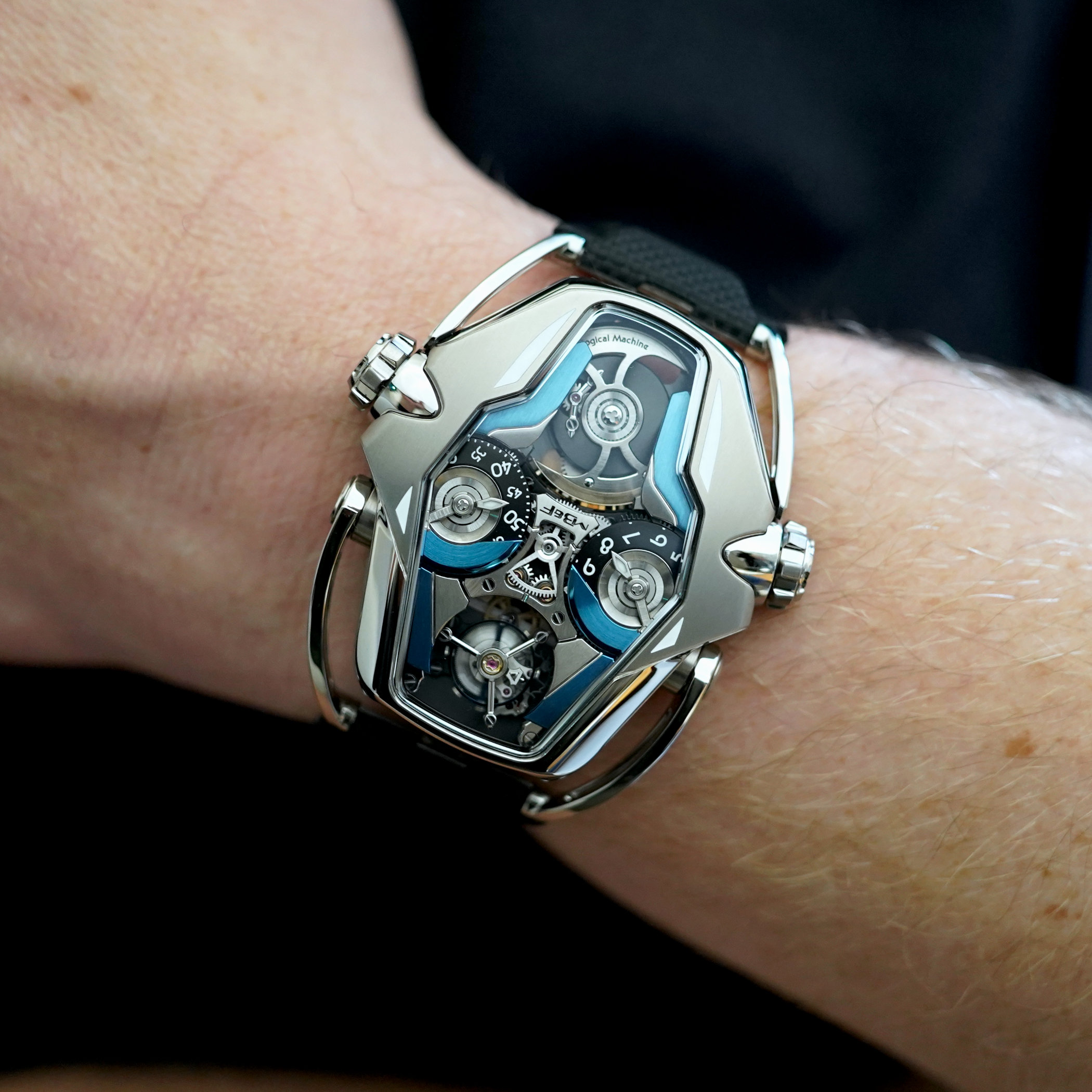
The defining flourish of the HM12 is its mechanical face-shield system.
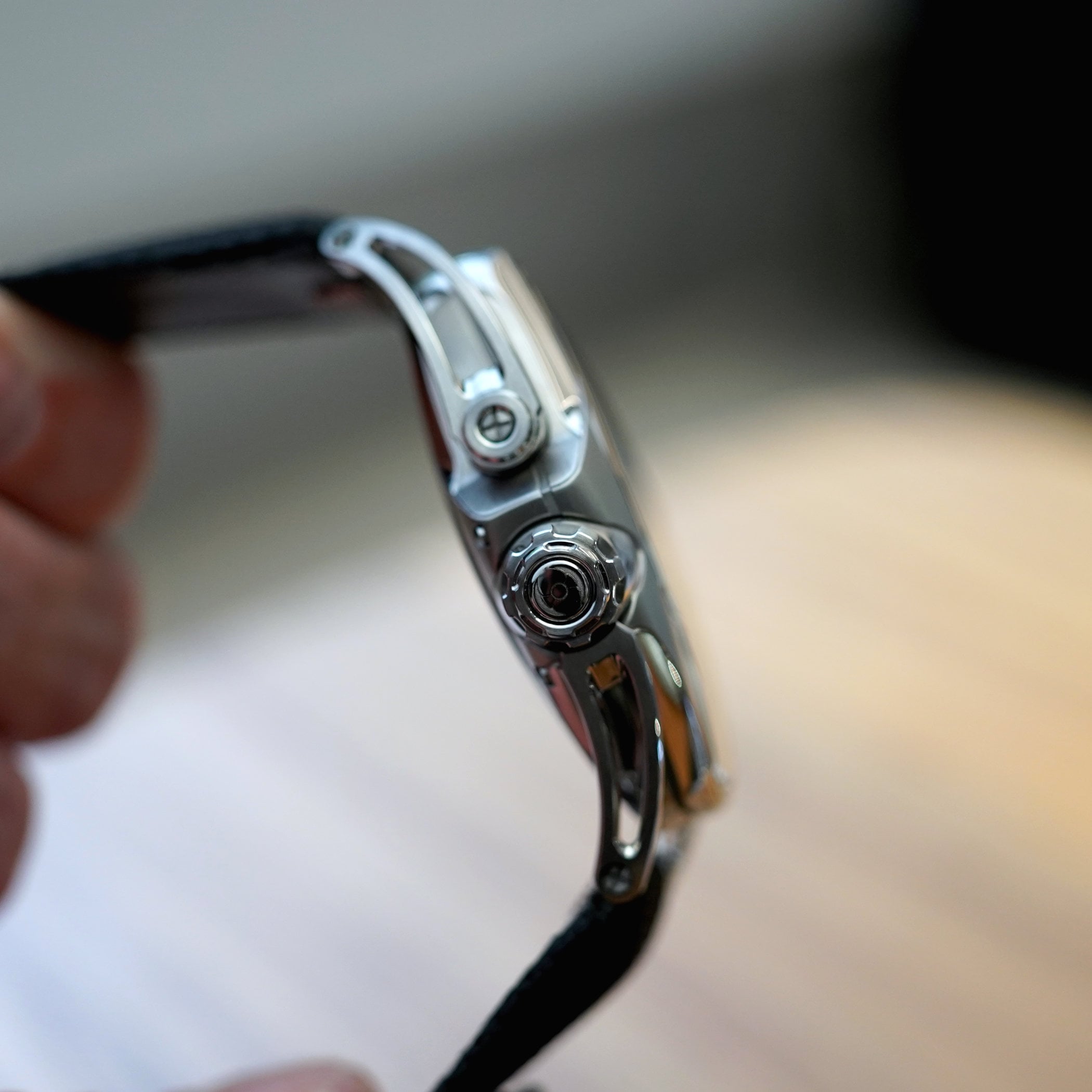
Operated by a crown on the left side of the case, two shields slide across the dial to cover or reveal the robot’s expression.
The wearer can stop the shields at different points, giving the watch a changing personality without interfering with the timekeeping mechanism.
That independence matters, because the shield system is not a decorative cover added at the end of development.
It uses more than 200 dedicated components, making the assembly more complex than many complete watches.
The result feels deliberately mischievous, but it’s built with the same seriousness MB&F applies to its more conventionally impressive complications.
It also gives the HM12 a tactile quality that many high-complication watches lack.
This isn’t just something to observe under glass, it’s a machine that invites interaction.
A new in-house calibre with two personalities
The HM12 is powered by a new in-house automatic calibre developed specifically for the project.
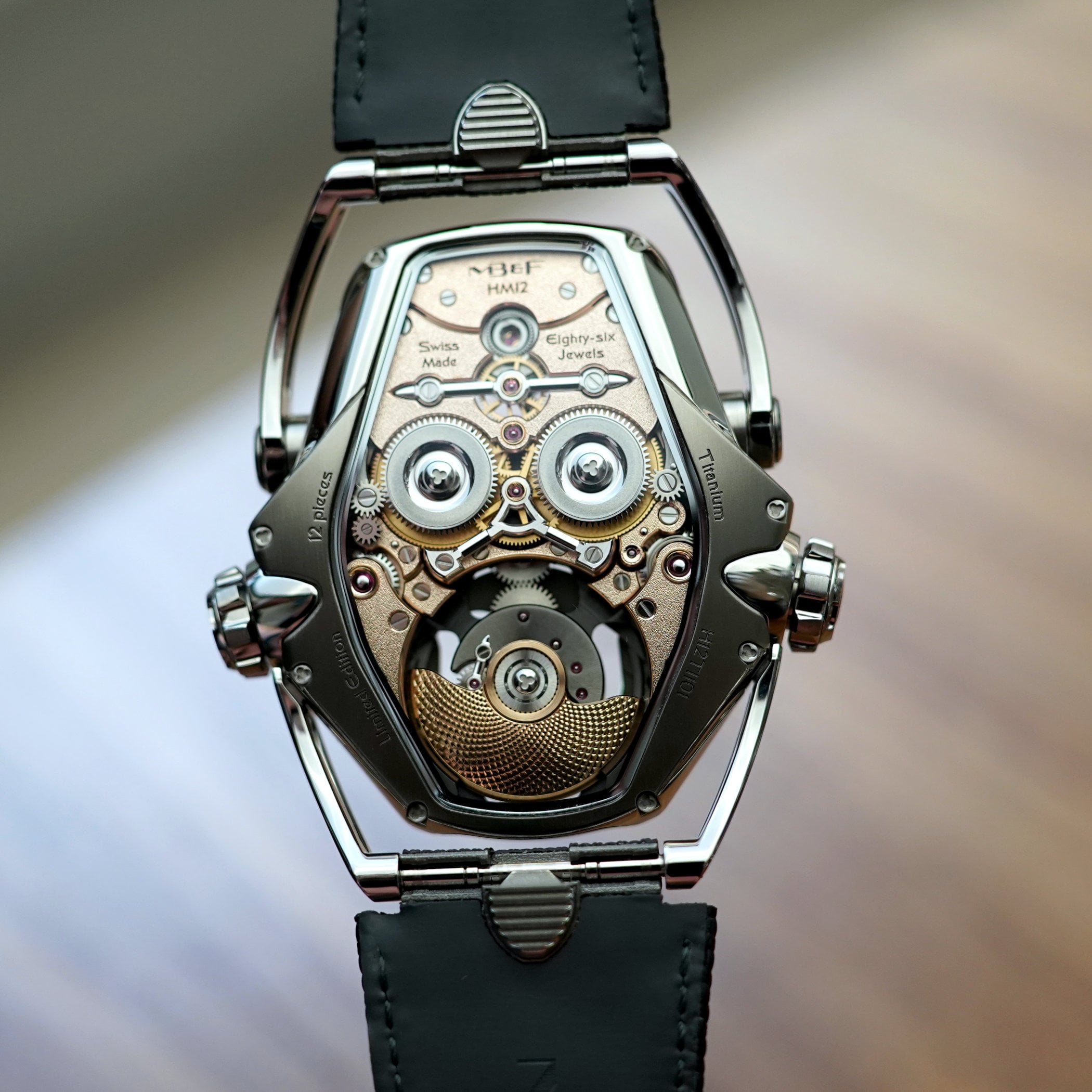
The movement contains 646 components and 86 jewels, and it brings together the jumping hour display, trailing minutes, flying tourbillon, double-sided micro-rotor and the integration required by the watch’s unusual architecture.
Power reserve is 84 hours.
From the front, the watch speaks the futuristic language of MB&F’s Horological Machines.
Turn it over and the mood changes.
The back reveals symmetrical bridges, soft curves and hand-finishing that lean closer to the spirit of the Legacy Machine family.
The domed rotor carries guilloché decoration executed with Kari Voutilainen and his team, a detail that neatly grounds the robot fantasy in traditional craft.
The HM12 is also notable as the first Horological Machine conceived entirely by Maximilian Büsser and Maximilian Maertens, without long-time design collaborator Eric Giroud.
That shift gives the watch a place in MB&F’s internal history as well as in its public mythology.
The Guardian body completes the idea
On the wrist, the HM12 is already a complete object, helped by a curved profile and articulated upper lugs that make the dimensions less intimidating than they read on paper.
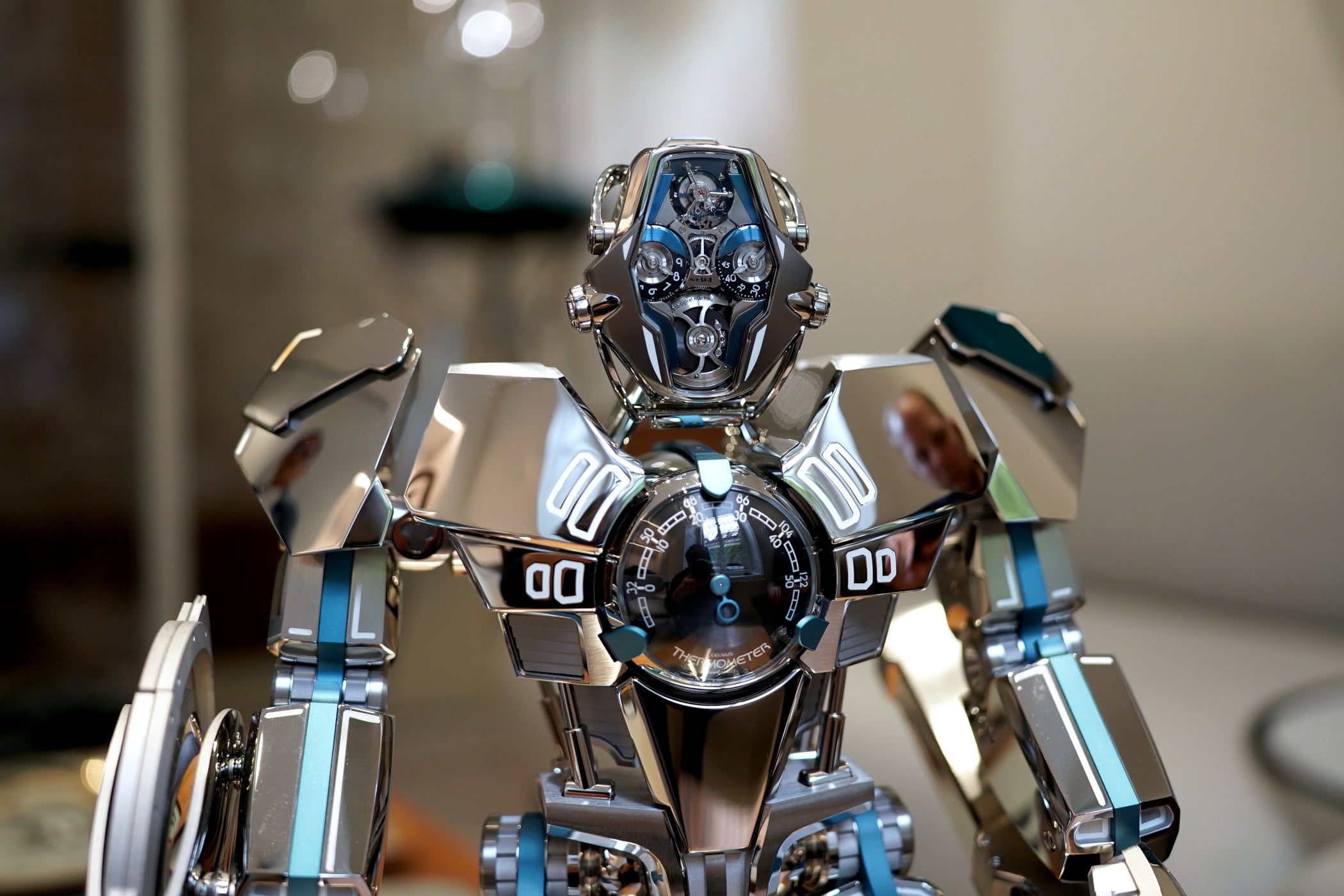
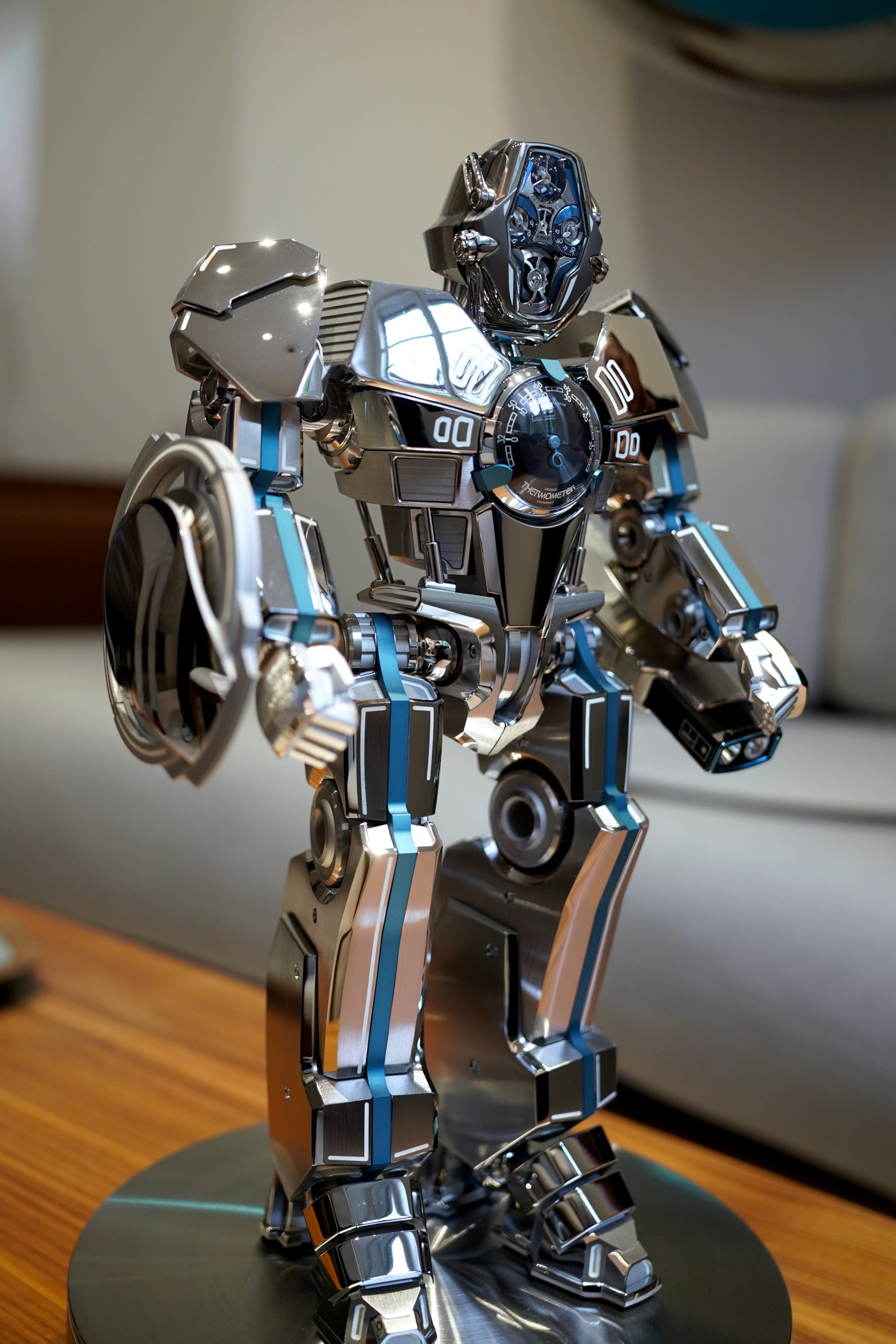
Yet the concept only fully clicks when the watch is attached to The Guardian, the robot body developed by L’Epée 1839.
The robot comprises 755 components and stands 38.2cm tall.
With its base, it weighs approximately 15kg, so this is closer to a mechanical sculpture than a simple presentation stand.
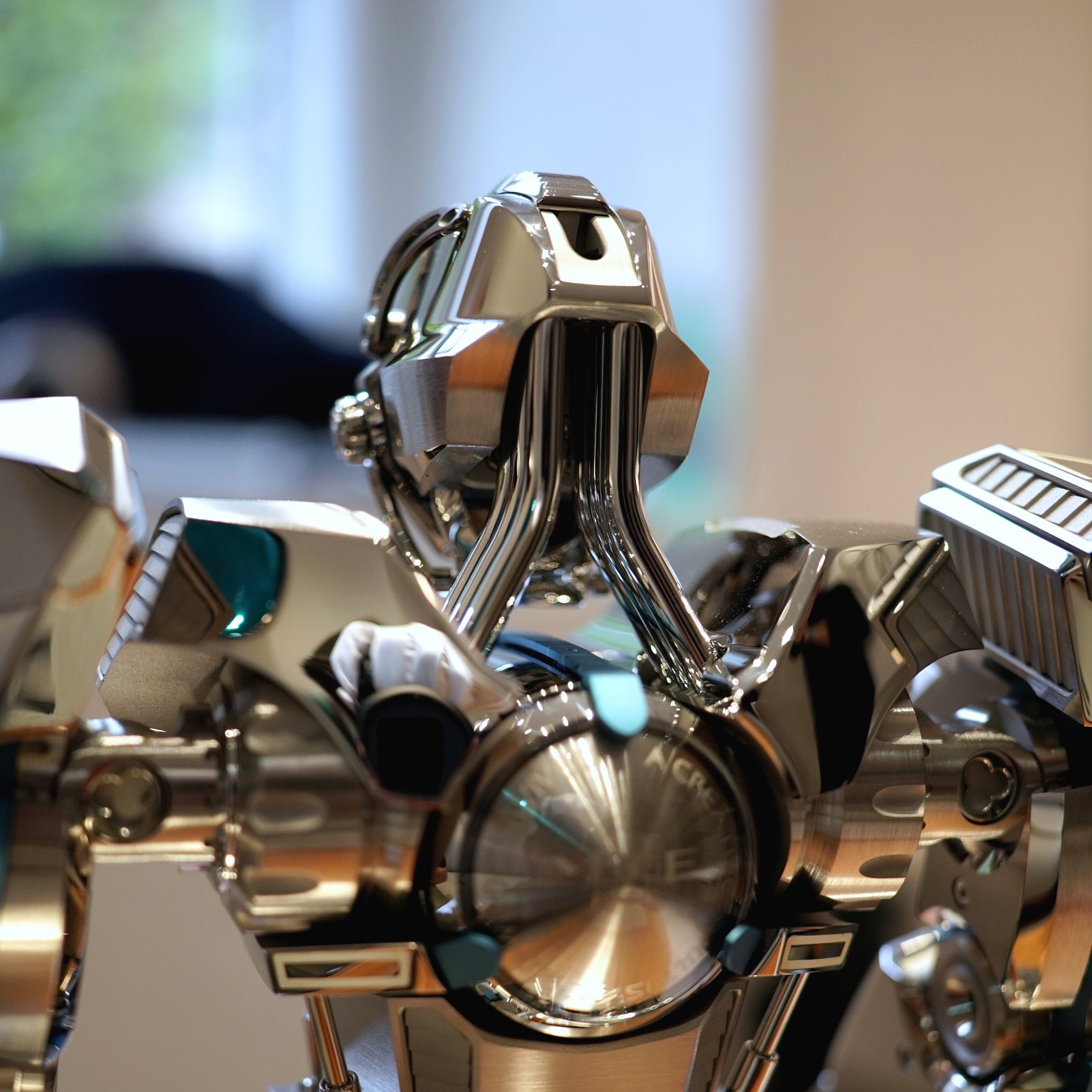
A quick-release system allows the watch to be removed from its Velcro strap and mounted directly onto the robot, turning it into the head of the companion figure.
The body has its own mechanical touches, including a thermometer positioned as the robot’s heart.
One arm incorporates a magnifying loupe for inspecting the movement, while the other contains a detachable UV torch that activates the Super-LumiNova on both the watch and the robot.
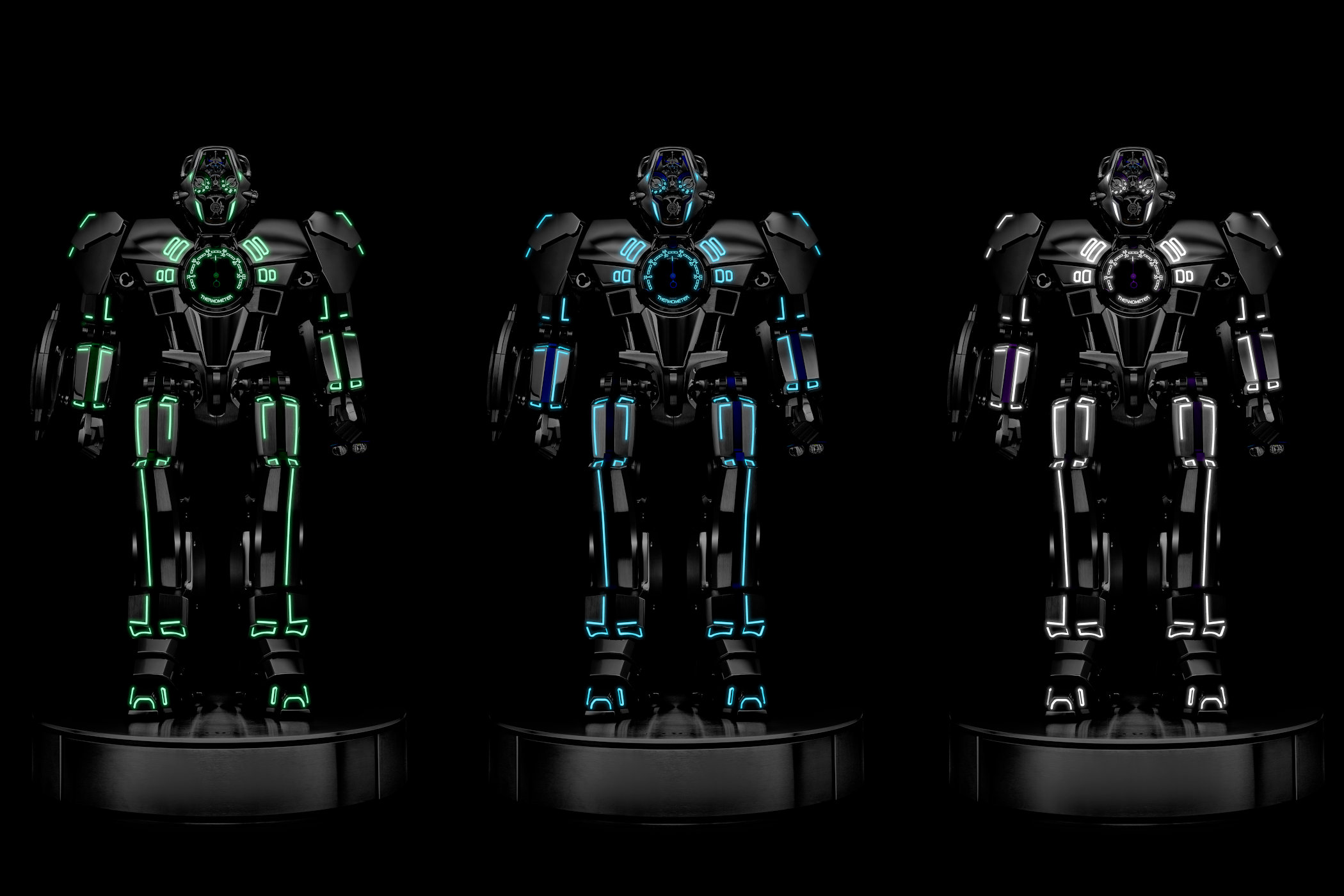
Even the strap has a designated home inside a concealed drawer built into the base.
Details & Specifications
| Brand | MB&F |
|---|---|
| Model | HM12 The Guardian |
| Case size | 49.3mm x 43.6mm x 13.8mm |
| Case material | Grade 5 titanium with three sapphire crystals |
| Dial display | Instantaneous jumping hours on the left, trailing minutes on the right |
| Movement | In-house automatic calibre HM12 |
| Movement components | 646 components and 86 jewels |
| Complications and features | Flying tourbillon, double-sided micro-rotor, mechanical face-shield system |
| Power reserve | 84 hours |
| Robot companion | L’Epée 1839 Guardian body with 755 components |
| Robot height | 38.2cm |
| Robot weight | Approximately 15kg with base |
| Editions | Green, blue and purple |
| Production | 12 pieces per colour |
| Price | CHF 280,000 excluding VAT |
The HM12 The Guardian is not trying to be discreet, universal or easily explained, and that’s precisely its charm.
For collectors drawn to MB&F’s most imaginative work, it brings the brand’s robot-clock lineage and wristwatch engineering into one unusually coherent mechanical character.