Mechanical watchmaking has survived quartz, smartphones and a culture that measures time with brutal efficiency.
For Maximilian Büsser, founder and CEO of MB&F, that survival isn’t guaranteed by nostalgia alone. It depends on whether watchmaking remains a place for human imagination, artisanal skill and technical daring.
His view cuts through the usual romance around mechanical watches. A watch only becomes irreplaceable when it carries the mark of a human mind and hand.
At a glance
- Maximilian Büsser sees mechanical watchmaking’s future in artisanal creativity rather than industrial repetition.
- The MB&F philosophy puts conceptual and technical invention ahead of marketing-led storytelling.
- Historical watchmaking remains a vital influence, but for Büsser it should nourish new ideas rather than confine them.
Craft over status
Büsser’s argument begins with a sharp distinction between the mechanical watch as object and the mechanical watch as signal.
If a watch is merely an industrial luxury product, endlessly iterated and polished into safe familiarity, it risks becoming little more than a social marker.
That’s a difficult idea in a market where recognisability often carries as much weight as horological merit.
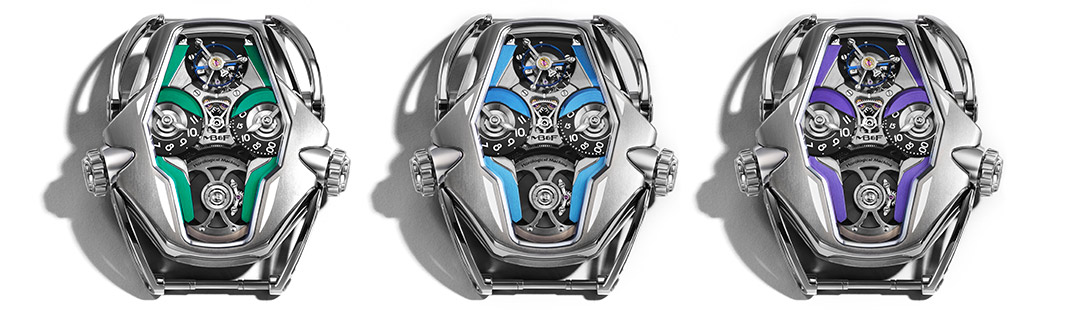
MB&F has always lived at the opposite end of that spectrum, where the watch is treated less as an accessory and more as a kinetic sculpture with a calibre inside.
For Büsser, mechanical watchmaking becomes meaningful when it is artisanal and visibly shaped by human creative genius.
In that reading, the point isn’t just that gears, springs and bridges can still tell time without electronics. The point is that they can express imagination in a way mass technology can’t easily flatten.

Storytelling cannot replace the object
Luxury watchmaking has become fluent in narrative.
Brands build worlds around collections, anniversaries, ambassadors, archives and invented codes, sometimes before the watch itself has had time to breathe.
Büsser’s stance is more demanding.

For a passion-driven craft, he sees progress coming from the conceptual and technical creativity of the pieces themselves, not from stories constructed after the fact.
That view feels especially relevant now, as watch buyers have become more visually literate and less patient with thin ideas wrapped in heavy language.
A compelling watch doesn’t need to be mute, of course. But its story should rise naturally from the design, the movement architecture, the way it was made and the risk involved in making it.
MB&F’s Horological Machines and Legacy Machines have often worked this way. Their emotional force comes from form and engineering first, with the narrative following rather than leading.
The past as fertile ground
Büsser does not reject vintage influence, and he doesn’t frame the past as a trap.
His position is closer to respect without obedience.
Historical watchmaking should influence any creator who genuinely loves the craft, because memory is part of creativity rather than its enemy.
He invokes Coco Chanel’s line that those who insist on their creativity have no memory, a neatly ruthless reminder that originality rarely appears from nowhere.
The past, in this view, is not a template to copy. It is fertile ground from which imagination grows.
That distinction matters in contemporary watchmaking, where vintage cues can be either a lazy shortcut or a deep well of proportion, finishing, mechanical logic and emotional resonance.
Knowing history helps creators avoid reinventing the wheel, but it also helps them understand which wheels are worth rebuilding entirely.
When timekeeping becomes emotion
The emotional role of the mechanical watch changed permanently once quartz made the traditional movement technically obsolete.
After that moment, a mechanical watch could no longer justify itself purely as the most practical way to tell the time.
It had to become something else.
For Büsser, that something else is not simply luxury or rarity. It is the charge that comes from an object imagined, designed and crafted by people with skill, patience and conviction.
He points to the power of holding an exceptional 18th- or 19th-century pocket watch, made by hand without the tools modern watchmakers take for granted.
That kind of object carries more than elapsed hours. It carries the intelligence and touch of its maker across centuries.
This is the territory where MB&F’s work feels most at home.
The brand’s watches are not trying to compete with technology on convenience. They are arguing for mechanical imagination as a cultural act.
That may be the clearest reason Büsser’s perspective resonates beyond MB&F itself.
Mechanical watchmaking still matters when it refuses to behave like a relic, a logo or a status token. At its best, it remains one of the few places where engineering, memory and emotion can occupy the same small space on the wrist.