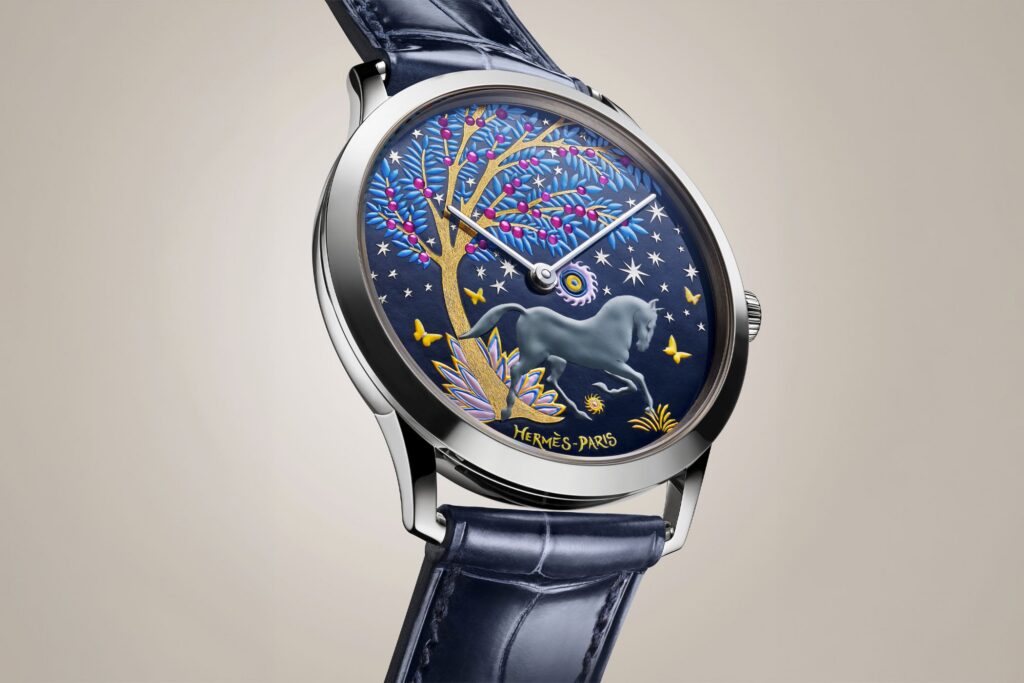
Hermès has a particular talent for making its own universe feel portable, whether it’s printed on silk, cut in leather or condensed onto a watch dial.
The Slim d’Hermès Sous le Charme d’Orphée continues that idea with a mythological scene adapted from a 2022 scarf by British artist Alice Shirley, reworked here as an intricate métiers d’art composition.
It’s a small-series watch, but it says a lot about how Hermès approaches watchmaking, with craft, illustration and mechanical restraint sharing the same space.
At a glance
- Hermès introduces the Slim d’Hermès Sous le Charme d’Orphée, a 12-piece limited-edition métiers d’art watch inspired by an Alice Shirley silk scarf.
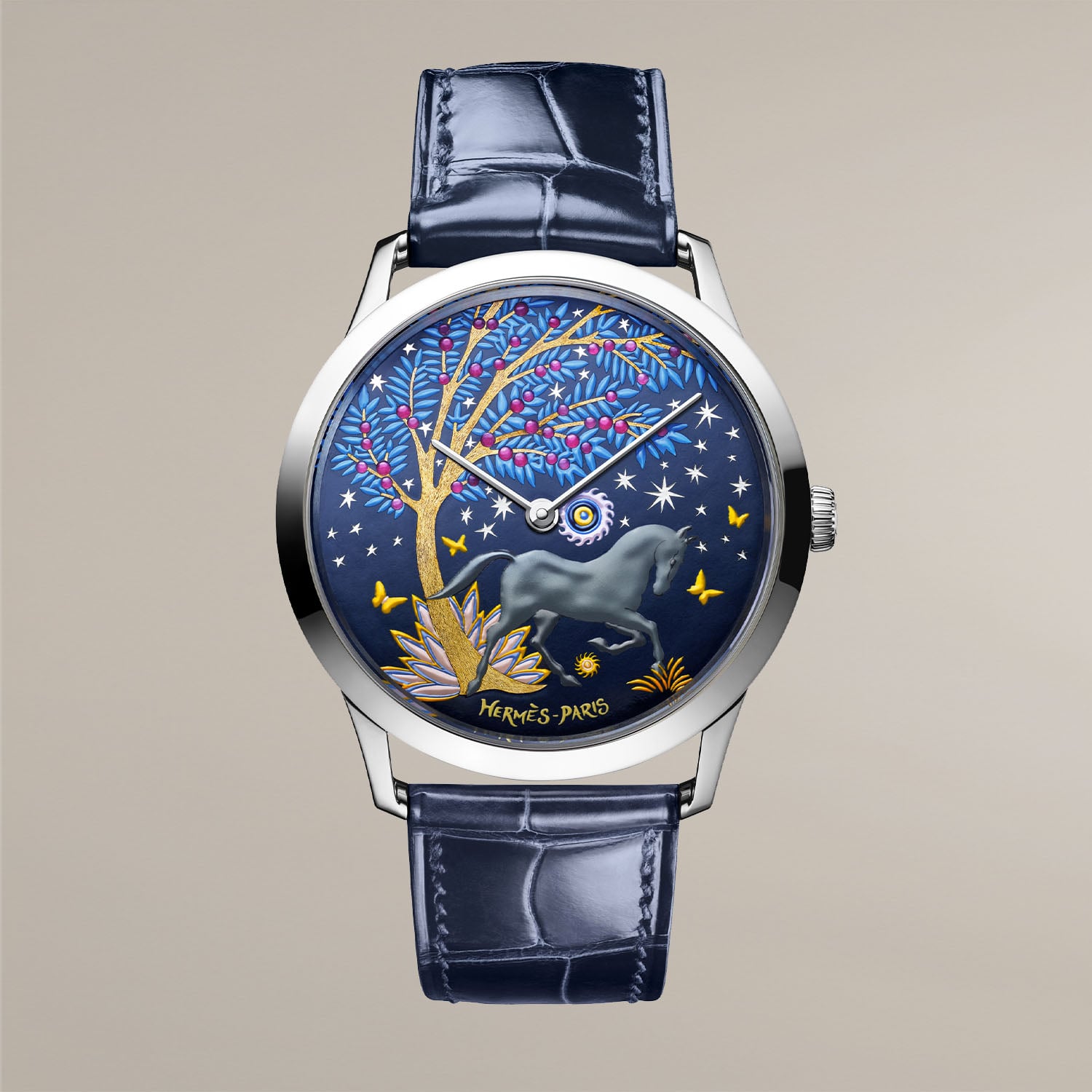
- The dial combines midnight-blue enamel, hand engraving, miniature painting and pink opal cabochons in a mythological scene led by a dancing horse.
- The watch is housed in a 39.5mm white gold Slim d’Hermès case and is priced upon request.
A silk scarf mythology in watch form
Hermès began in Paris in 1837 as a harness and saddlery workshop, and the horse still has a way of returning to the centre of its most elaborate watch creations.
That equestrian thread is especially visible in the house’s métiers d’art watches, where scarf illustrations and decorative craft often meet inside highly limited cases.
The Sous le Charme d’Orphée scarf, created by Alice Shirley in 2022, depicts Orpheus playing his golden lyre among mythological animals.
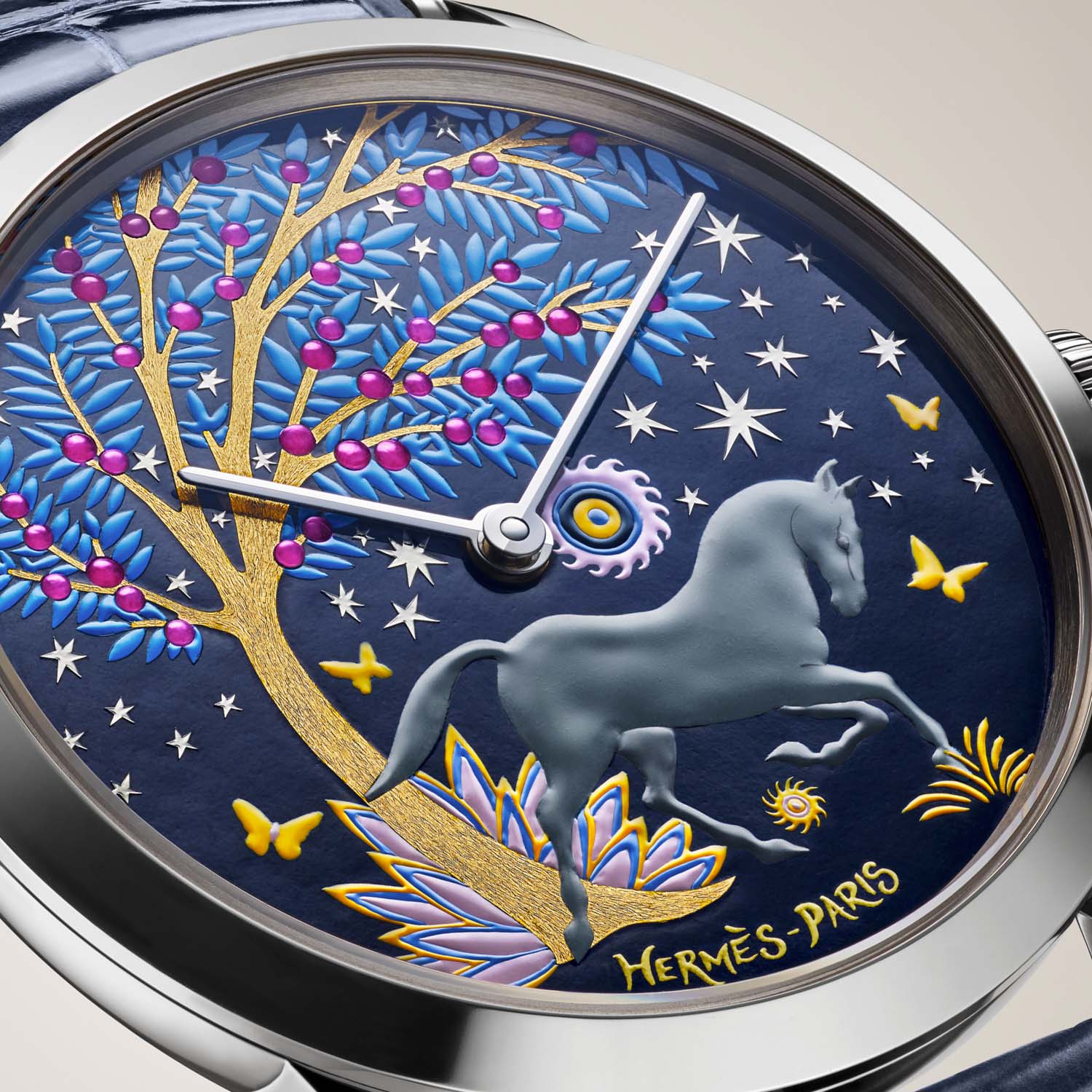
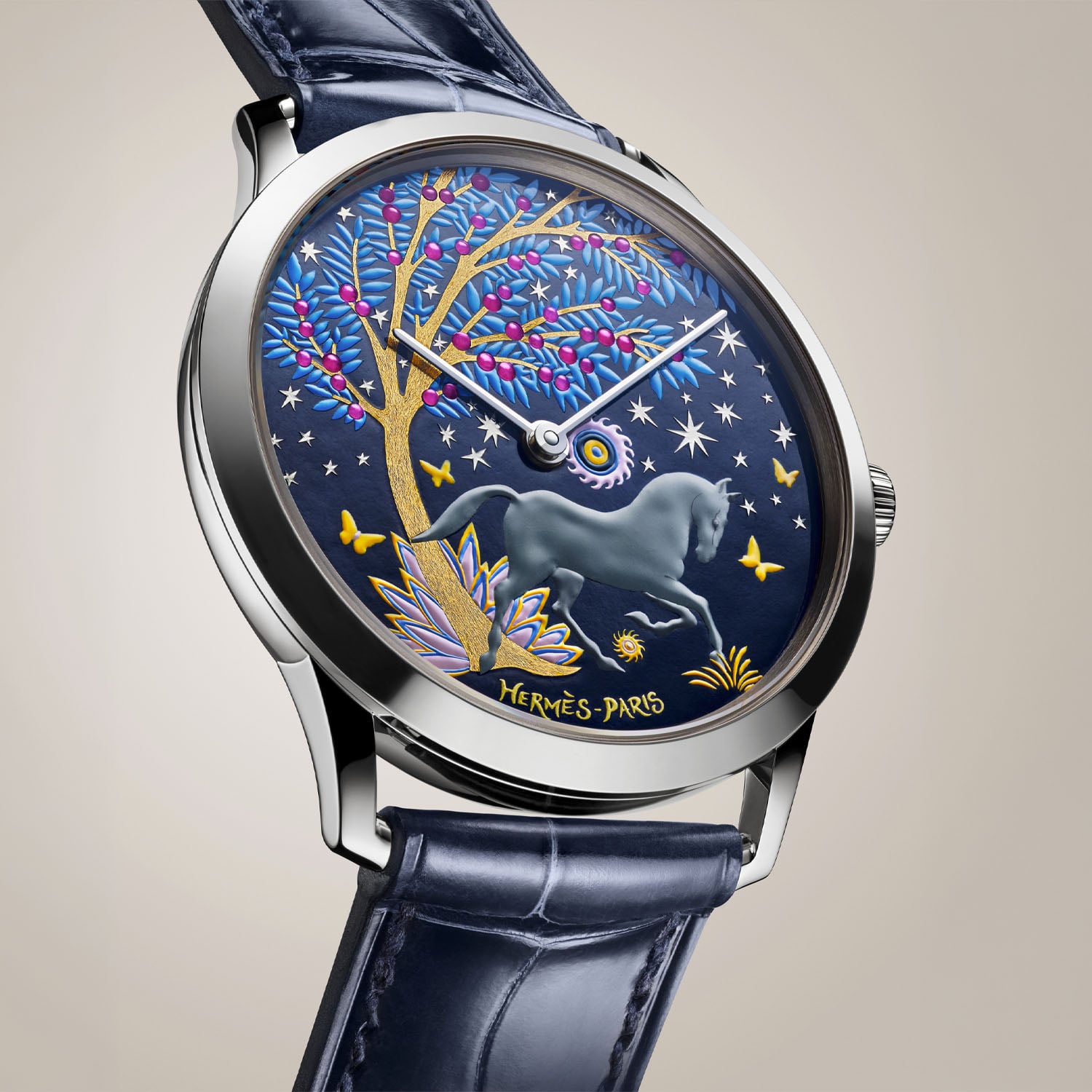
For the watch, Hermès shifts the focus away from Orpheus himself and gives the starring role to a dancing horse, a fitting choice for a maison whose visual language has long been shaped by saddlery, riding culture and silk.
The result isn’t a direct reduction of a scarf print, but a reinterpretation of it through materials and depth.
Enamel, engraving and pink opal fruit
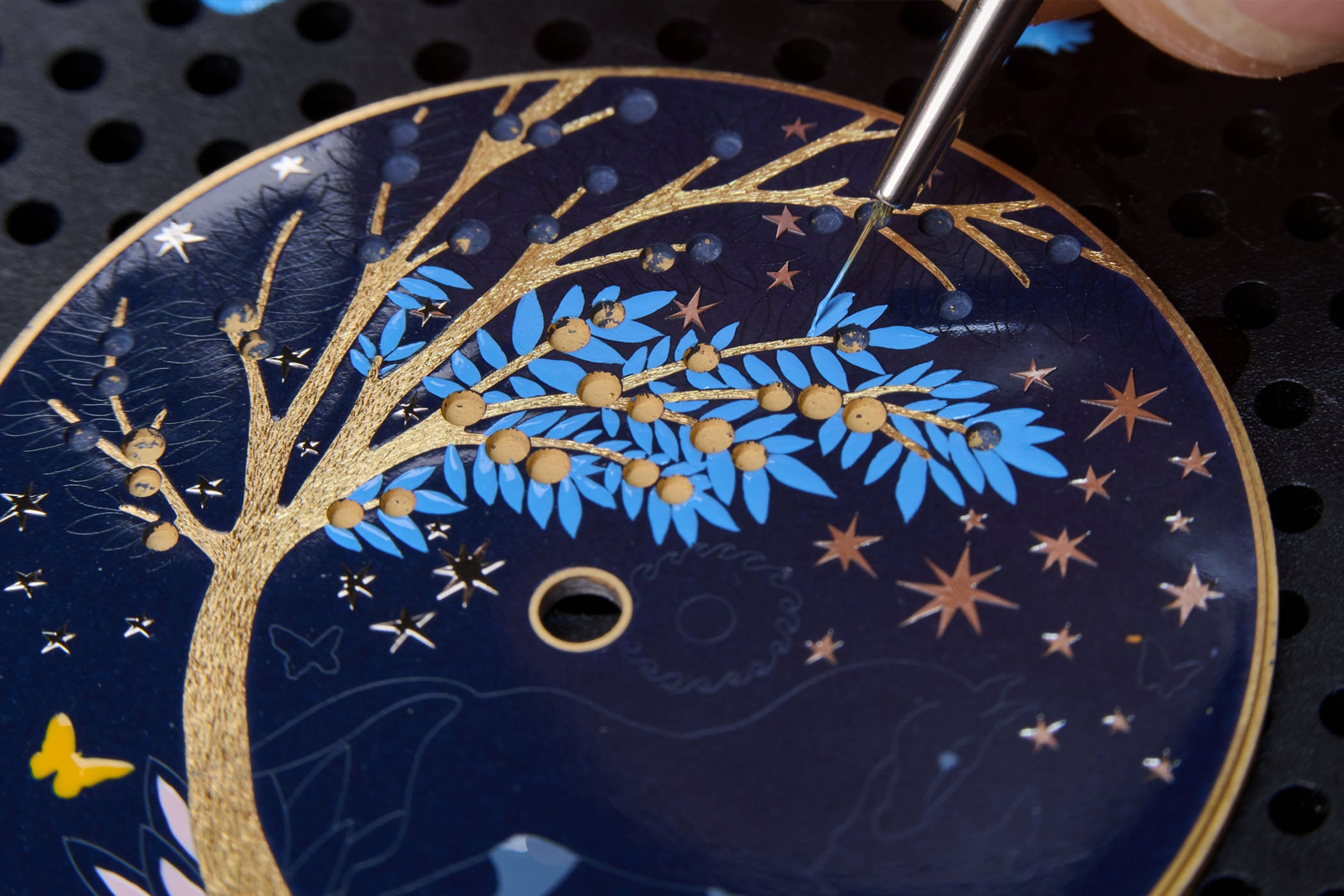
The dial is built around a midnight-blue enamel ground scattered with stars, suns, butterflies and a sacred pomegranate tree.
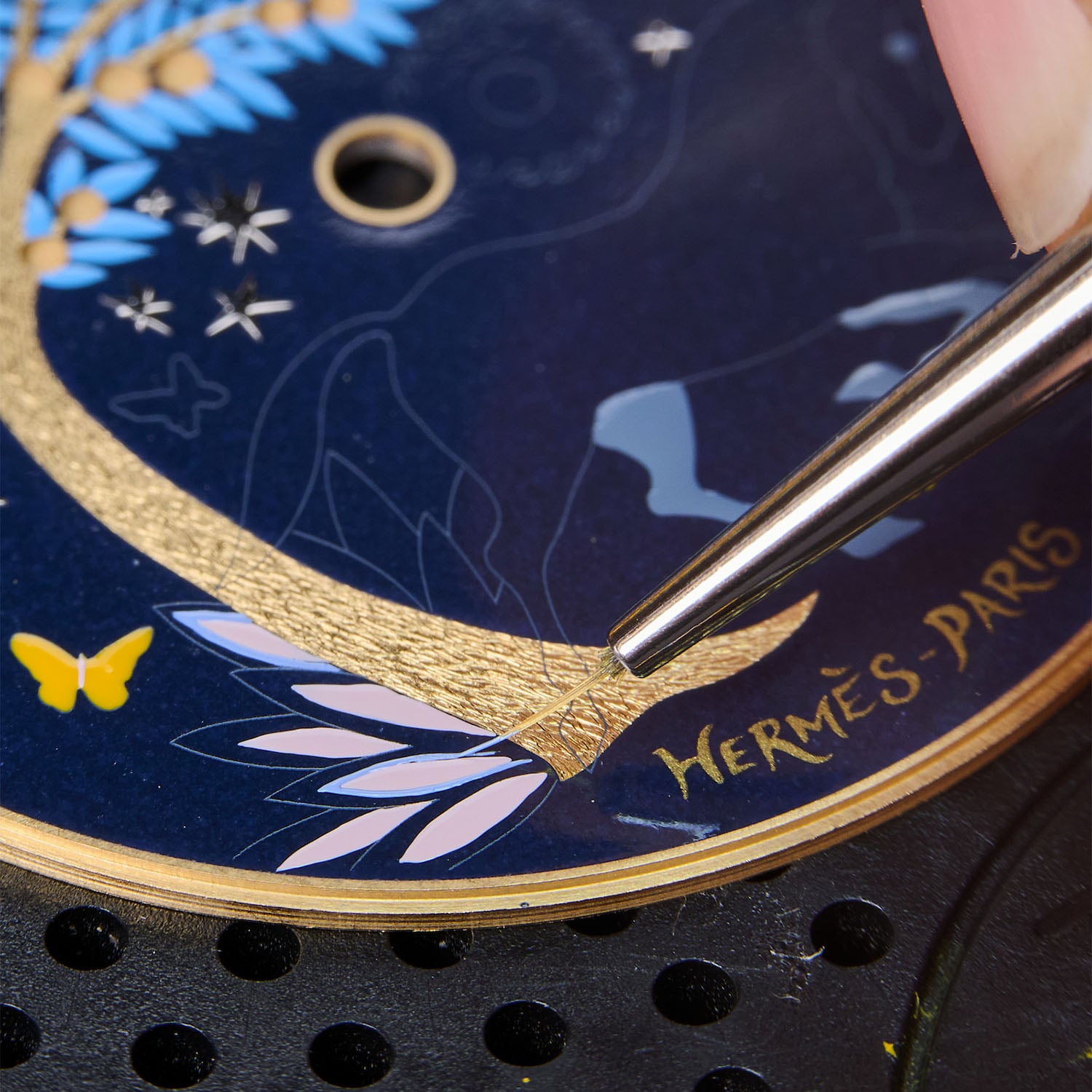
That dark enamel surface gives the scene its nocturnal atmosphere, while the raised decorative elements bring the illustration into relief.
The golden pomegranate tree is hand-engraved, with detail worked into the trunk to suggest the grain of the wood.
Its fruit is rendered with inset pink opal cabochons, a quietly expressive detail that adds colour and rounded volume without breaking the storybook mood.
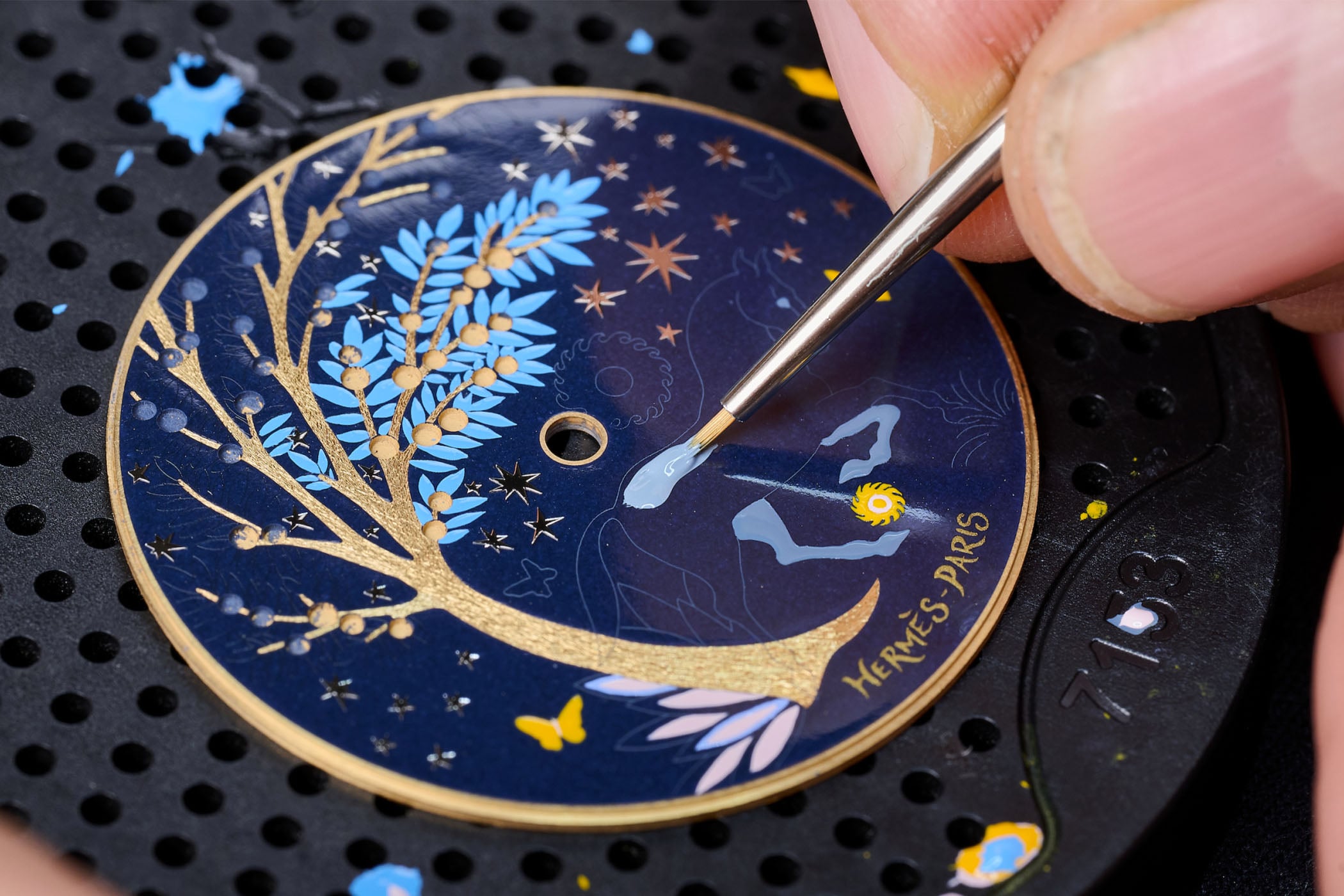
The horse, leaves, butterflies and flowers are treated in relief and finished with miniature painting, giving the composition a crafted tactility that a printed dial couldn’t achieve.
It’s the kind of watch where the technical interest sits in the handwork as much as in the movement, and where the dial is meant to reward close looking.
The Slim d’Hermès keeps the canvas restrained
The watch uses the Slim d’Hermès case, a design introduced in 2015 under Hermès creative director Philippe Delhotal.
Its 39.5mm white gold case gives the ornate dial a clean architectural frame rather than competing with it.
Inside is the Hermès calibre H1950, an ultra-slim automatic movement measuring 2.6mm thick and equipped with a micro-rotor.
The movement runs at 3Hz and offers a 48-hour power reserve.
It is produced by Vaucher, the Swiss movement maker in which Hermès holds a 25 percent stake.
The watch is paired with a smooth Hermès abyss blue alligator strap and a white gold pin buckle, keeping the palette close to the deep blue of the enamel dial.
Details & Specifications
| Brand | Hermès |
|---|---|
| Model | Slim d’Hermès Sous le Charme d’Orphée |
| Case size | 39.5mm |
| Case material | White gold |
| Dial | Midnight-blue enamel with hand engraving, miniature painting and pink opal cabochons |
| Movement | Hermès calibre H1950 automatic with micro-rotor |
| Movement thickness | 2.6mm |
| Frequency | 3Hz |
| Power reserve | 48 hours |
| Strap | Smooth Hermès abyss blue alligator |
| Buckle | White gold pin buckle |
| Production | Limited to 12 pieces |
| Price | Upon request |
The Slim d’Hermès Sous le Charme d’Orphée is clearly aimed at collectors drawn to Hermès’ most artistic watchmaking, where narrative, craft and mechanical elegance are inseparable.
It also shows why the maison’s scarf archive continues to be such fertile territory for watch design, especially when the translation from silk to dial is handled with this much patience and imagination.