The Mediterranean owns the European summer for good reason, but spring is a more complicated story.
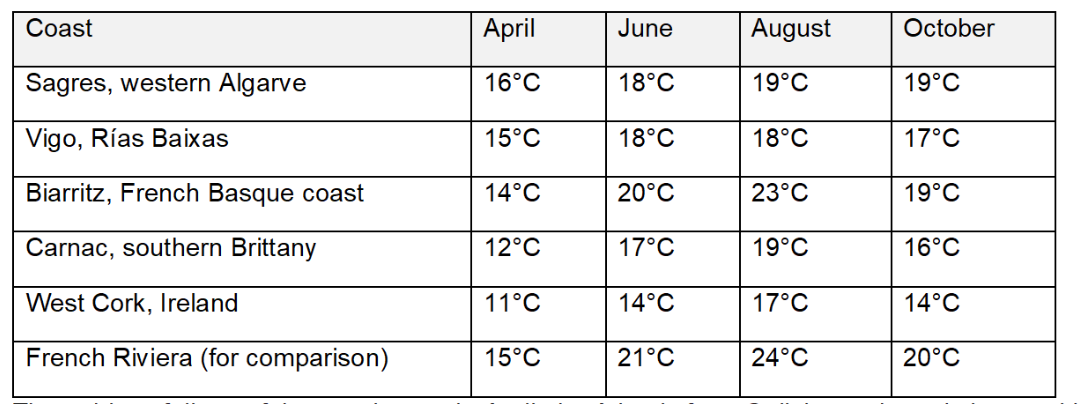
In late April, the sea along the French Riviera is about 15°C, while the water off Sagres in southwest Portugal is about 16°C, which is to say both are cold enough to demand either resolve or neoprene.
That’s where the Atlantic begins to make its case, not as the warmer choice, but as the quieter, greener and often more interesting one.
At a glance
- Europe’s Atlantic coast is often at its strongest in the shoulder season, especially from April to early June.
- The appeal lies in empty beaches, green landscapes, working coastal towns and west-facing evening light rather than warm swimming.
- The Mediterranean still wins from June to September for reliable heat and easy sea bathing.
The water tells the truth
The honest comparison between the Atlantic and the Mediterranean only really exists in the shoulder season.
By June, the Mediterranean starts to pull away decisively, and it holds that advantage into early autumn.
The Atlantic rarely gives you the easy bath-water confidence of a July beach day in Provence, Mallorca or southern Italy.
What it offers instead is a different rhythm, especially before the peak season turns the Mediterranean into a test of reservations, traffic and patience.
| Place | Confirmed seasonal marker |
|---|---|
| French Riviera | Sea around 15°C in the last week of April |
| Sagres, Portugal | Sea around 16°C in the last week of April |
| Biarritz | Water about 20°C in June and 23°C in August |
| West Cork | Water about 11°C in April and about 17°C in August |
Southwest Portugal is the strangest and most revealing case.
Around Sagres, the water changes very little across the season because northerly winds push surface water offshore and draw colder water up from below.
A comparative study of upwelling on the western and northern Iberian coasts published in Continental Shelf Research identified upwelling-favourable northerlies from April to September, with the coldest coastal anomaly in August and September.
The practical result is counter-intuitive, since a west-facing Portuguese beach can feel colder in August than in October.
Portugal’s green window before the nortada
The Atlantic coast between Sines and Cape St Vincent is the clearest example of the shoulder-season bargain.
Protected as the Parque Natural do Sudoeste Alentejano e Costa Vicentina, it has escaped the dense seafront development that defines much of Europe’s summer coastline.
Beaches sit below ravines rather than behind promenades, and the cliff tops remain largely unbuilt.
Milfontes, Almograve and Zambujeira do Mar still feel like small coastal towns with fishing harbours and a few dependable places to eat.
At Cabo Sardão, cliffs rise roughly 40 to 50 metres above the water, with offshore rock columns that become nesting sites for white storks in late winter and spring.
This part of Portugal is at its best before high summer, when the Alentejo cliffs are still green and the beaches of the western Algarve can be empty on a weekday.
By June, the nortada becomes the variable that shapes the day.
This north-northwesterly wind builds through the afternoon from roughly June to September, turning exposed beaches around Carrapateira, including Amado, Bordeira and Castelejo, from calm to sandblasted by mid-afternoon.
Surf schools and walkers tend to start early for a reason.
Around Sagres and east toward Lagos, the coastline turns south, and the same wind can become an offshore breeze rather than a problem.
From Galicia to Brittany, planning matters
North of Portugal, the Rías Baixas change the Atlantic mood completely.
These drowned river valleys behave more like sea lochs than open bays, with calmer and slightly warmer water inside them, mussel rafts across the inlets and Albariño from nearby vineyards on local wine lists.
The Cíes Islands show why Atlantic travel rewards advance planning.
They sit within a national park and require permission from the Xunta de Galicia before a ferry ticket can be bought.
During the main season, which includes Easter and then 15 May to 15 September, daily admission is roughly 1,600 to 1,800 people.
Outside that window, public ferries stop and access narrows to organised groups with an accredited guide, with numbers around 250 to 450 a day.
Further east, the Costa da Morte, Asturias and Cantabria replace the rías with sharper scenery.
Expect cliff-backed beaches, tidal coves that vanish twice a day and the Picos de Europa close enough behind the shore to be part of the view.
Cudillero, Llanes, Comillas and San Vicente de la Barquera are natural bases, though the weather asks for flexibility.
The French Basque coast is the Atlantic’s most Mediterranean moment.
Biarritz reaches about 20°C in June and about 23°C in August, while San Sebastián, Hondarribia and Biarritz offer urban coastal life with serious food, surf and hotel infrastructure.
Here, the shoulder-season argument is less about water temperature and more about avoiding August crowds and cost.
North of Biarritz, the Landes becomes a long line of sand and pine, interrupted notably by the Gouf de Capbreton, a submarine canyon that begins a few hundred metres offshore and drops to around 4,000 metres.
It helps focus swell into La Nord, one of the best-known waves on the French coast.
Southern Brittany is cooler and less predictable, but it has its own logic of granite islands, Neolithic alignments and intricate coastal walking.
The GR34, or sentier des douaniers, runs for more than 2,000 kilometres from Mont-Saint-Michel to the Saint-Nazaire bridge, and the Brittany tourist board recommends mid-April to late June for walking it, with September as the alternative.
Further north, the Côte de Granit Rose around Perros-Guirec and Ploumanac’h is exactly the kind of place that benefits from low spring sun.
How to travel the Atlantic shoulder season
The Atlantic works best when you stop asking it to behave like the Mediterranean.
Its better months aren’t necessarily the warmest ones, and its most rewarding places are often still doing ordinary local business when visitors arrive.
That matters in practical ways.
In Atlantic fishing towns, the bakery, fish market, chandlery and a few restaurants may be open because residents need them, not because the holiday season has started.
The reverse is also true.
A working harbour town isn’t always trying to charm guests, while a Mediterranean resort is usually better at making visitors feel looked after once the season begins.
- A 3/2 mm wetsuit suits 15°C to 17°C water, while a 4/3 is more sensible at 14°C and below.
- Lifeguards, beach cafés, island ferries and seasonal hotels often start in June and many close again in mid-September.
- Rain should be treated as part of the plan from Brittany northwards, and in Galicia and Asturias in any month.
- On Portugal’s west coast, calm mornings and windier afternoons should shape the itinerary from June onwards.
- Tides matter far more than they do on most Mediterranean trips, with some coves and causeways usable only at low water.
Ireland makes the weakest case on paper and one of the strongest in person.
West Cork water is about 11°C in April and only reaches around 17°C in August, but the Beara, Sheep’s Head and Mizen peninsulas, Baltimore and its islands, Dingle and the long strands of Kerry offer a type of coastal travel that doesn’t depend on conventional beach weather.
Infrastructure can lag behind the most beautiful weeks.
In West Cork, lifeguard cover runs weekends only through June, daily in July and August, and finishes in the first days of September.
Portugal designates several hundred official bathing waters each year, though not all open at once, with some municipalities beginning in early May and much of the coast following in June.
The Mediterranean still wins cleanly for a holiday built around warm swimming, reliable sun and the simple pleasure of not thinking before getting into the sea.
But for travellers happy to carry a wetsuit, watch the tides, book carefully and let weather shape the day, the Atlantic shoulder season has a rarer reward.
It gives you Europe’s coast before it becomes a product, when the cliffs are green, the beaches are empty and the towns still belong mainly to themselves.