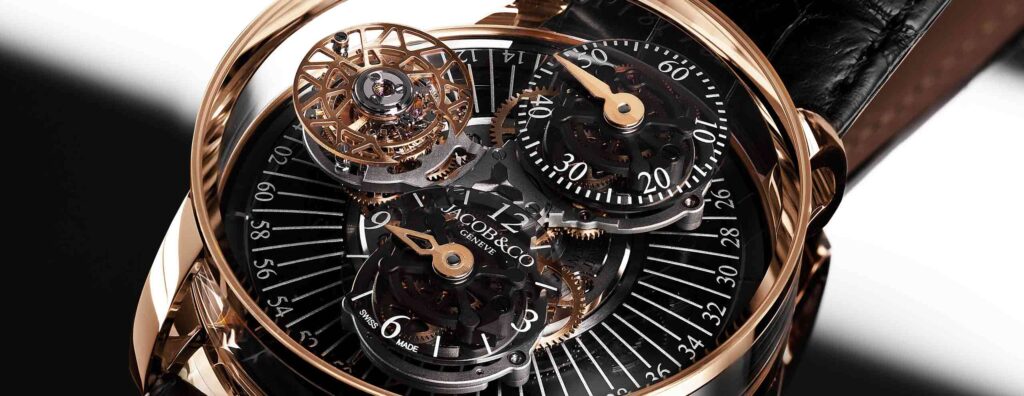
Jacob & Co.’s Astronomia has never been a quiet watch, but the Astronomia Régulateur shows how much drama can remain when the decorative theatre is stripped away.
The latest black-dial execution in rose gold keeps the collection’s signature orbital mechanics, then frames them with a far more restrained visual language.
It’s still unmistakably an Astronomia, just one that trades celestial ornament for mechanical choreography.
At a glance
- Jacob & Co. has given the Astronomia Régulateur a more understated black-dial treatment in an 18k rose gold case.
- The watch uses separate orbiting displays for hours, minutes and seconds, alongside a double-axis flying tourbillon and a high-speed remontoir d’égalité.
- The 43 mm watch is limited to 18 pieces and represents the smallest Astronomia case format to date.
An Astronomia reduced to its moving architecture
The Astronomia line built its reputation on exposed orbital motion, with rotating arms carrying displays, tourbillons and, in many editions, miniature cosmic sculptures.
The Astronomia Régulateur takes a different route.
Instead of adding more objects to the dial, Jacob & Co. has reduced the display to the essential moving parts of timekeeping.
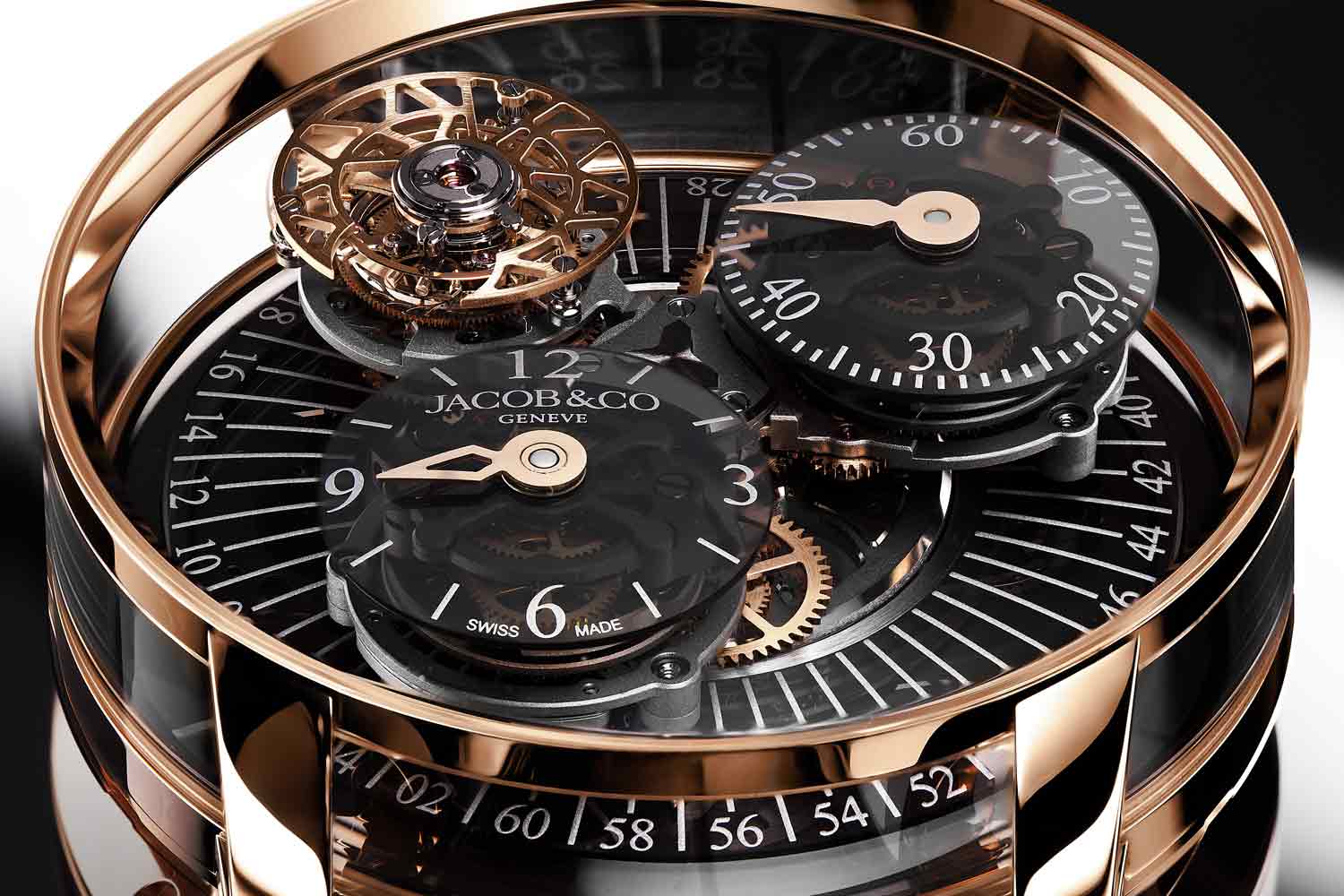
The result is not minimal in the traditional dress-watch sense, but it is remarkably clean by Astronomia standards.
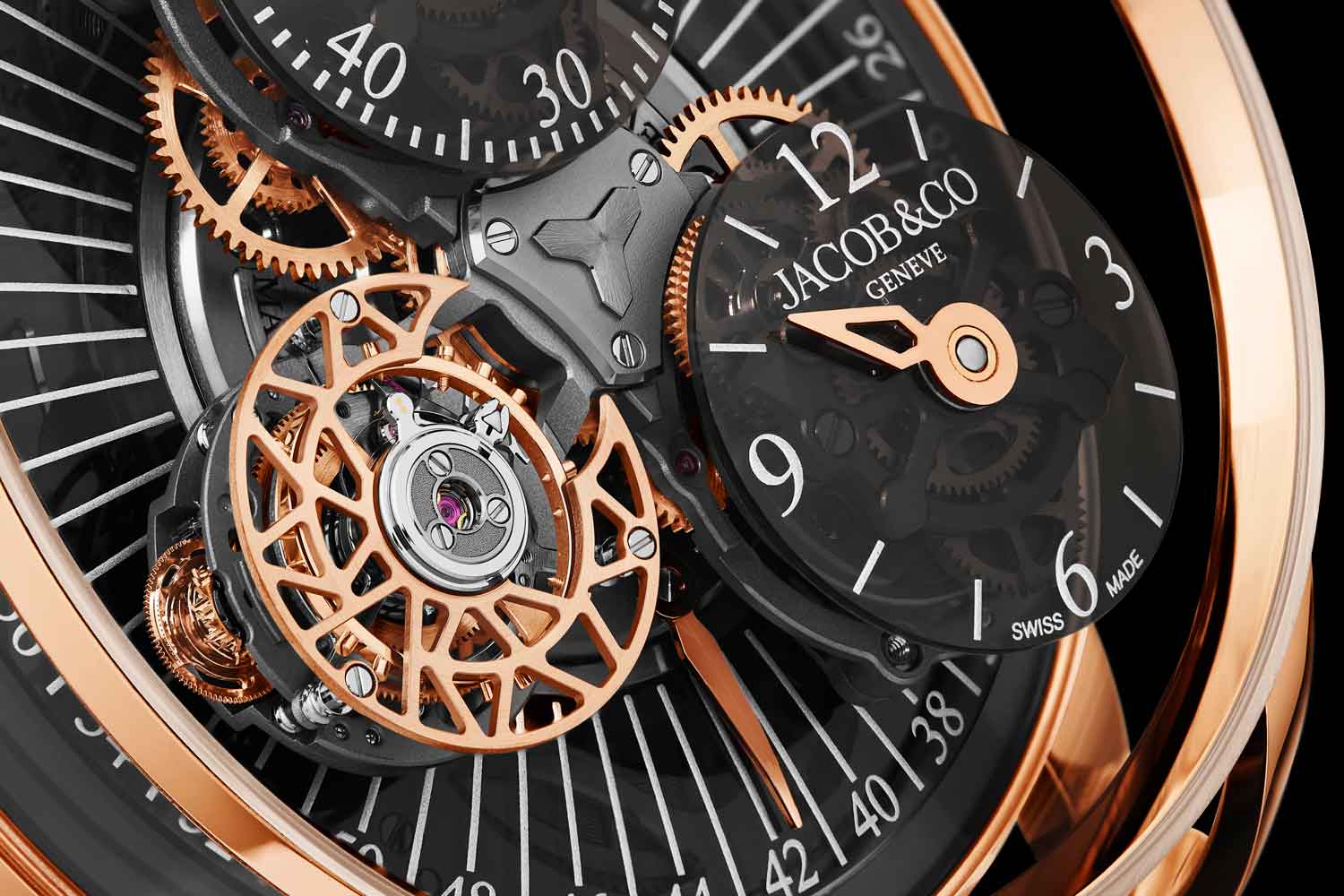
Hours, minutes and seconds are separated, while the tourbillon remains part of the kinetic structure rather than a static flourish.
That change gives the watch a more technical personality, where the eye follows function rather than decoration.
Regulator timekeeping in constant motion
The Régulateur name points to traditional regulator clocks, which separated hours, minutes and seconds to make each indication easier to read in workshops.
Jacob & Co.’s interpretation keeps the separated indications but places them on a moving orbital system.
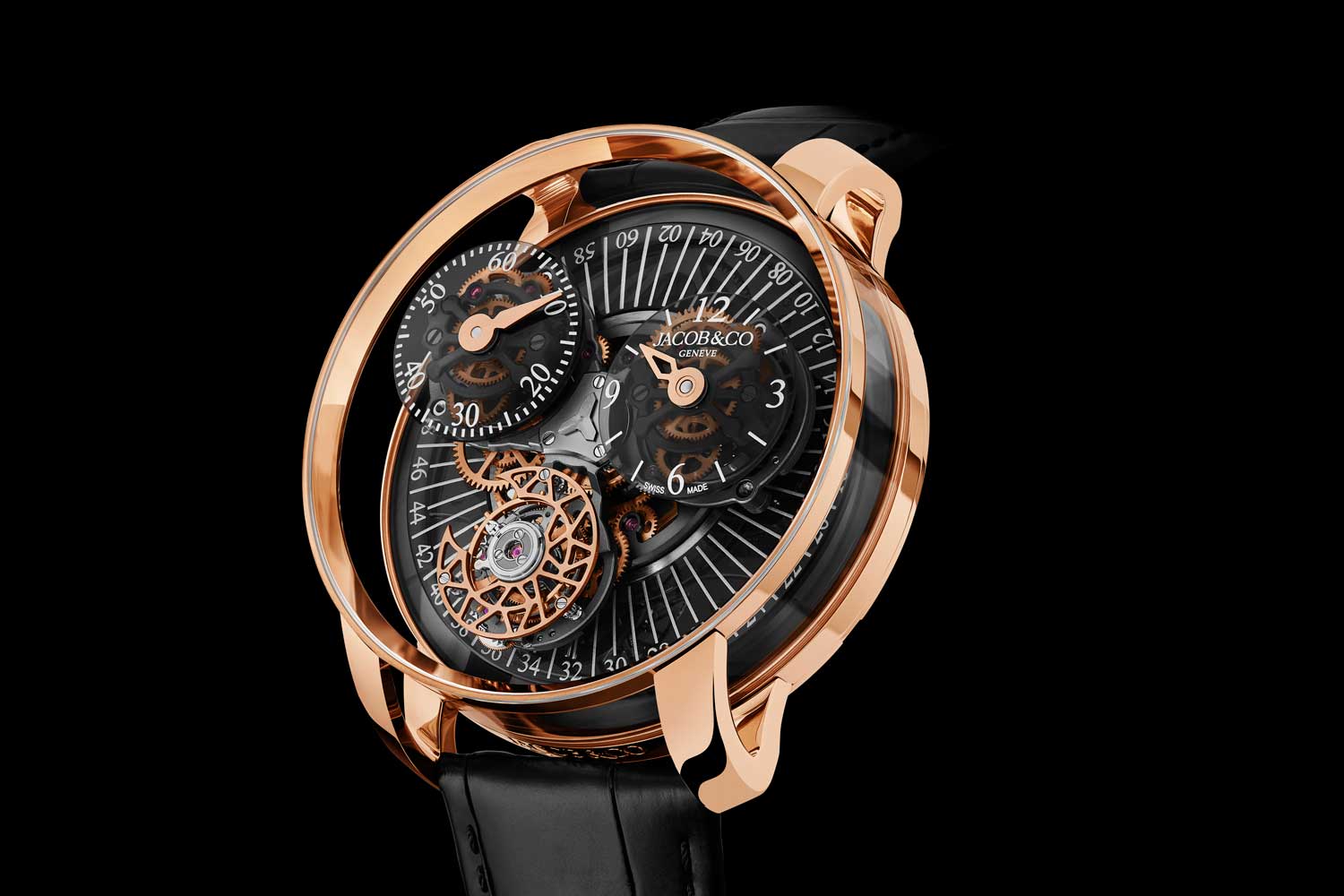
The hours and minutes sit on translucent sub-dials mounted to a three-arm carrier.
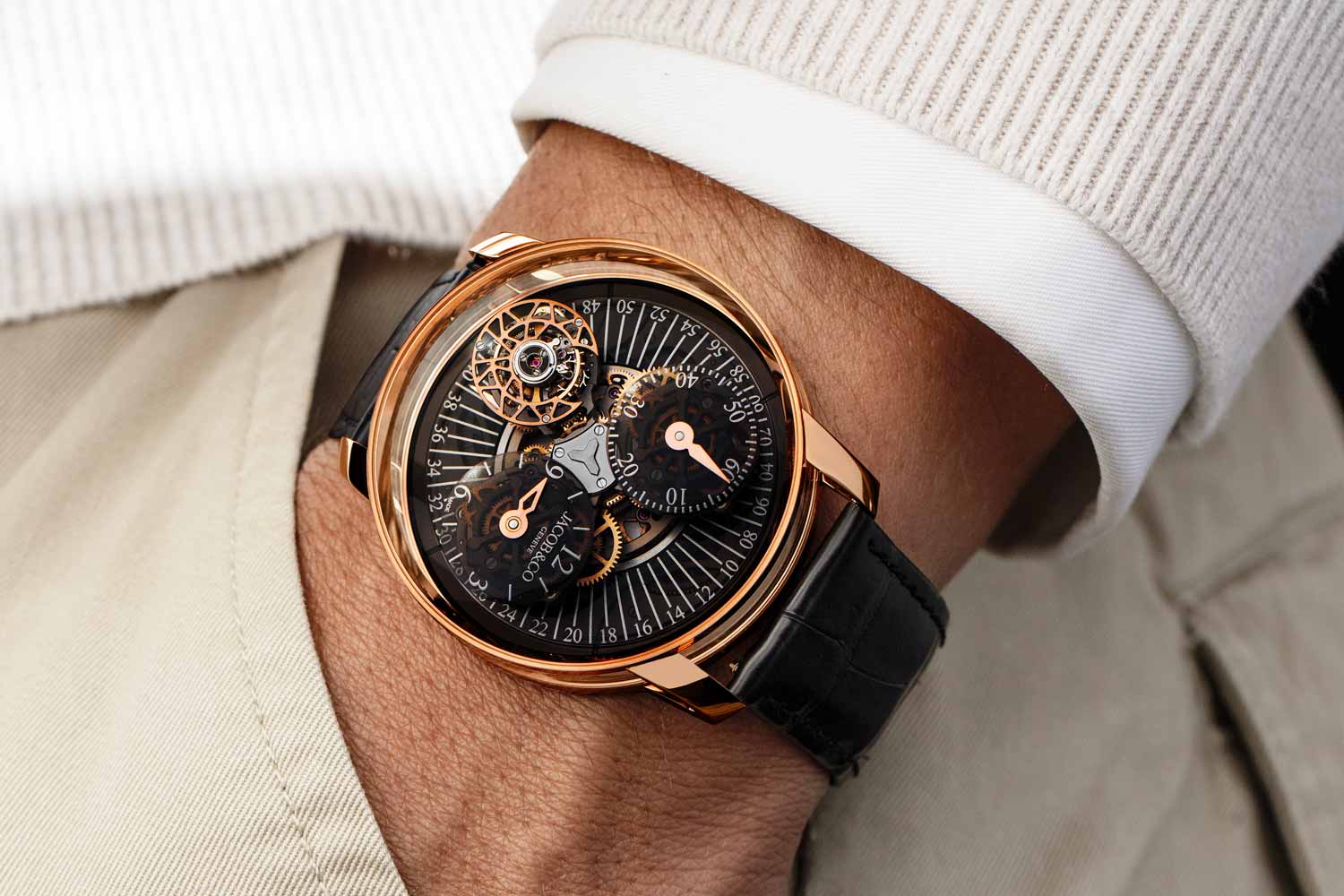
The third arm carries the double-axis flying tourbillon, making the entire upper assembly feel like a compact mechanical mobile.
The seconds display is even more visually assertive, using a disc that stretches across almost the full diameter beneath the carrier.
The main carrier completes a full clockwise revolution every minute, making it the fastest orbital display used in the Astronomia family.
At the same time, the large seconds disc turns in the opposite direction, creating a display that is constantly changing but still organised around three distinct time indications.
A fast remontoir for a demanding movement
The cleaner layout doesn’t mean a simpler watch.
Moving the displays at this speed requires considerably more energy than earlier Astronomia constructions, so the movement uses twin mainspring barrels.
That brings its own complication, because the torque from the barrels is too strong to be passed directly to the escapement.
Jacob & Co.’s answer is a remontoir d’égalité, a constant-force mechanism that meters energy before it reaches the regulating organ.
Here, the remontoir operates six times per second, matching the 3 Hz frequency of the movement.
Rather than storing and releasing power once per second, it replenishes and releases energy at every beat.
The aim is steadier amplitude at the balance, even as the available torque changes during the 28-hour power reserve.
There is another layer of engineering at work in the time displays.
Although the hour and minute sub-dials are continually orbiting, a differential mechanism keeps them upright, preserving legibility as the architecture rotates beneath the sapphire.
Black dial and rose gold bring the concept into focus
Earlier Astronomia Régulateur versions leaned into vivid blue, green and red treatments.
The black version feels more resolved, partly because it lets the rose gold case and the movement’s layered construction carry the visual weight.
The 43 mm diameter is notable for this collection, as it makes the Régulateur the smallest Astronomia to date.
At 18 mm thick, it remains a substantial object on the wrist, but it is much slimmer than the roughly 25 mm height associated with earlier Astronomia models.
That reduction matters.
The Astronomia has always been about spectacle, but this version makes the spectacle easier to imagine outside a display case.
The sapphire-heavy architecture still provides the sense of depth that defines the line, while the black dial gives the whole composition a stronger frame.
Details & Specifications
| Brand | Jacob & Co. |
|---|---|
| Model | Astronomia Régulateur |
| Case size | 43 mm x 18 mm |
| Case material | 18k rose gold |
| Dial | Black with translucent hour and minute sub-dials |
| Movement | JCAM56 manual-winding |
| Functions | Hours, minutes, seconds and tourbillon |
| Tourbillon | Double-axis flying tourbillon |
| Frequency | 21,600 vibrations per hour, 3 Hz |
| Power reserve | 28 hours |
| Water resistance | 30 metres |
| Strap | Alligator leather strap |
| Buckle | 18k rose gold folding buckle |
| Limited edition | 18 pieces |
The Astronomia Régulateur is compelling because it proves restraint can sharpen a complicated watch rather than dilute it.
For collectors who like Jacob & Co.’s mechanical extroversion but prefer a tighter visual edit, this black and rose gold edition is the clearest expression of the Astronomia idea yet.