Chinese watchmaking is often discussed through the lens of today’s affordable microbrands, but the story is older, stranger and more industrial than that suggests.
It begins in Tianjin in 1955 with a small team, limited tools and a state-backed mandate to prove that China could build a wristwatch of its own.
Seventy years later, Chinese factories, movements and Chinese-founded brands sit at the centre of a global enthusiast market that once treated the country mainly as a supplier behind someone else’s logo.

At a glance
- China’s first wristwatch, the Five Star, was completed in Tianjin on March 24, 1955, according to Seagull’s museum.
- The industry expanded through state factories, the Tongji standard movement and later a vast southern manufacturing base around Shenzhen and Guangdong.
- Modern Chinese watchmaking now spans Seagull complications, widely used movements and direct-to-collector brands such as San Martin, Pagani Design, Addiesdive and Baltany.
Tianjin and the Five Star
China arrived late to watchmaking by international standards.
Swiss watchmaking had a head start measured in centuries, while Japan produced its first domestic pocket watch in 1895 and followed with the Seiko Laurel wristwatch in 1913.
China’s first wristwatch did not arrive until 1955, when the government ordered the creation of a watch industry in the north of the country.
The Tianjin Watch Factory was formed in January that year, and a small group of craftsmen was tasked with building a wristwatch using very limited equipment.
According to Seagull’s museum, the Five Star was completed on March 24, 1955.
The name referred to the five-pointed star on the dial, a direct echo of the national flag, but the symbolism reached beyond decoration.
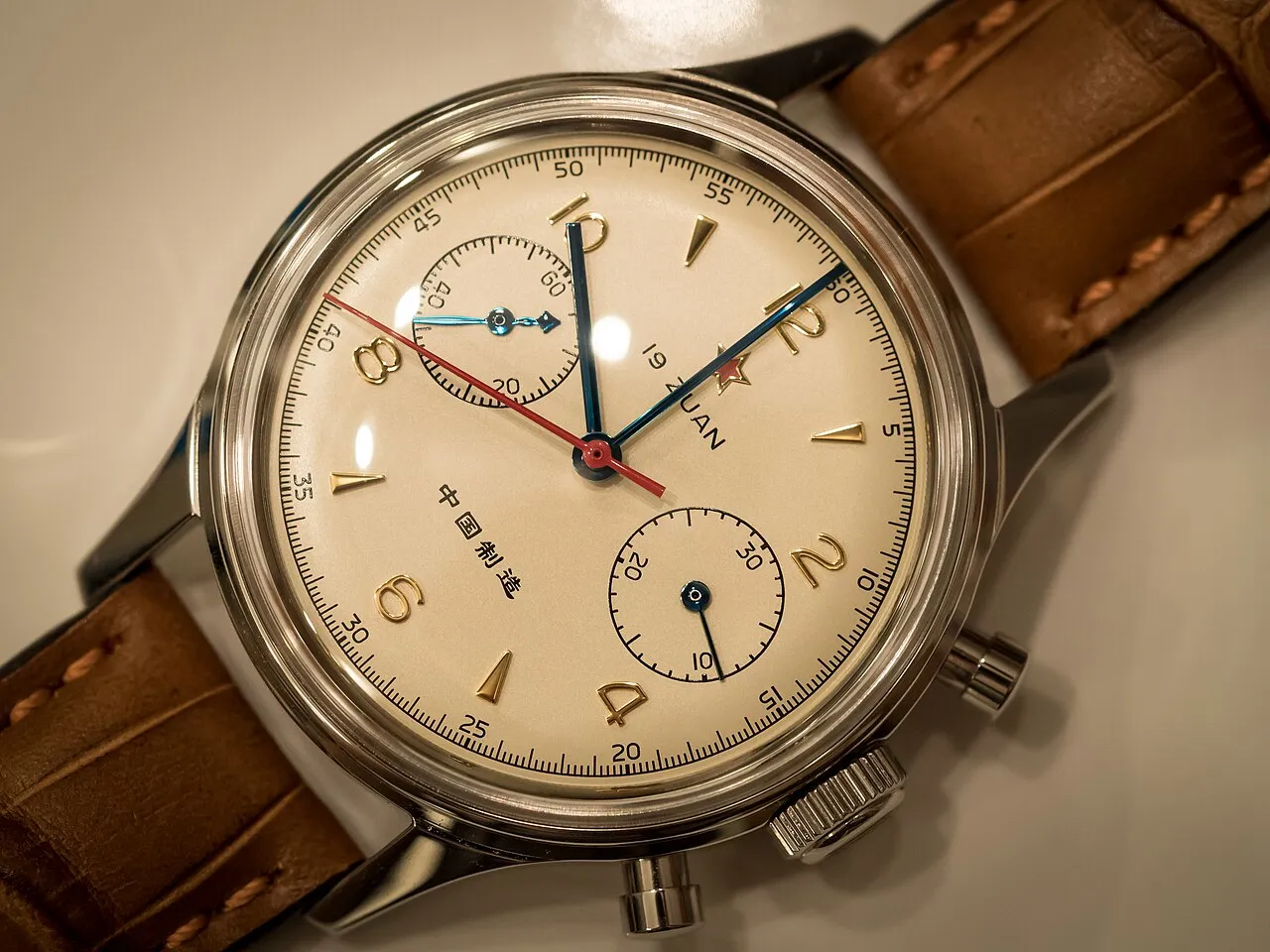
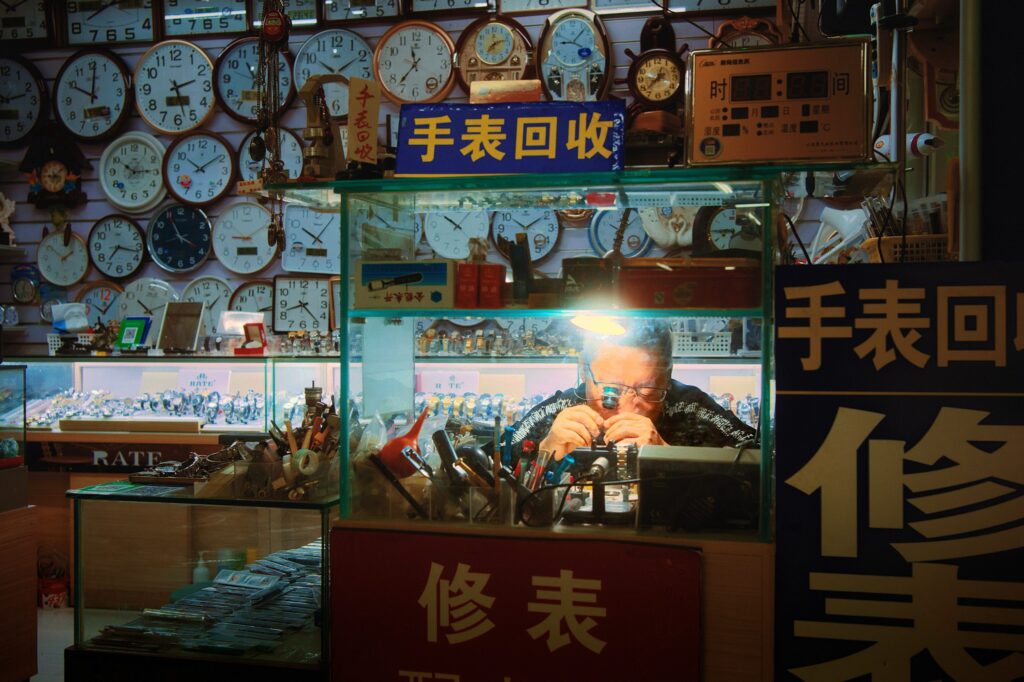
Until then, China could repair watches, but it had not yet made one.
The state factory years and the Tongji movement
By 1958, China had its first eight watch factories operating, with Beijing, Shanghai and Tianjin emerging as the leading centres.
Early Chinese movements were often copies or close adaptations of Swiss designs, which gave factories a practical route into skills that established watchmaking countries had developed over generations.
The defining shift came in 1969, when engineers from several factories began work under the Ministry of Light Industry on a single standard movement.
Known as the Tongji, it became mandatory for many factories, which were required to stop producing their own designs and build the standard calibre instead.
The approach created scale, consistency and an entire period of Chinese watchmaking shaped by one shared mechanical architecture.
China produced about 6.6 million watches in 1974, rising to roughly 33 million by 1982.
By the end of the 1970s, at least 30 factories were building complete watches, and in 1983 about 82 percent of watches made in China used a Standard movement.
Seagull and the chronograph that became a cult watch
Tianjin remained the most important name in the story, eventually becoming Tianjin Seagull Watch Group in 1992 after the quartz era had reshaped the industry.
Its significance rests partly on continuity, but also on several milestones that still matter to collectors.
In 1966, Tianjin produced the Dongfeng, or East Wind, described in the supplied historical timeline as the first wristwatch designed and built entirely in China.
The factory was also behind Project 304, a chronograph developed from 1961 to 1966 for Chinese Air Force pilots.
Tianjin used a Venus 175 design acquired from Switzerland as the base, then added jewels and increased the beat rate before delivering a first batch of 1,400 watches in 1966.
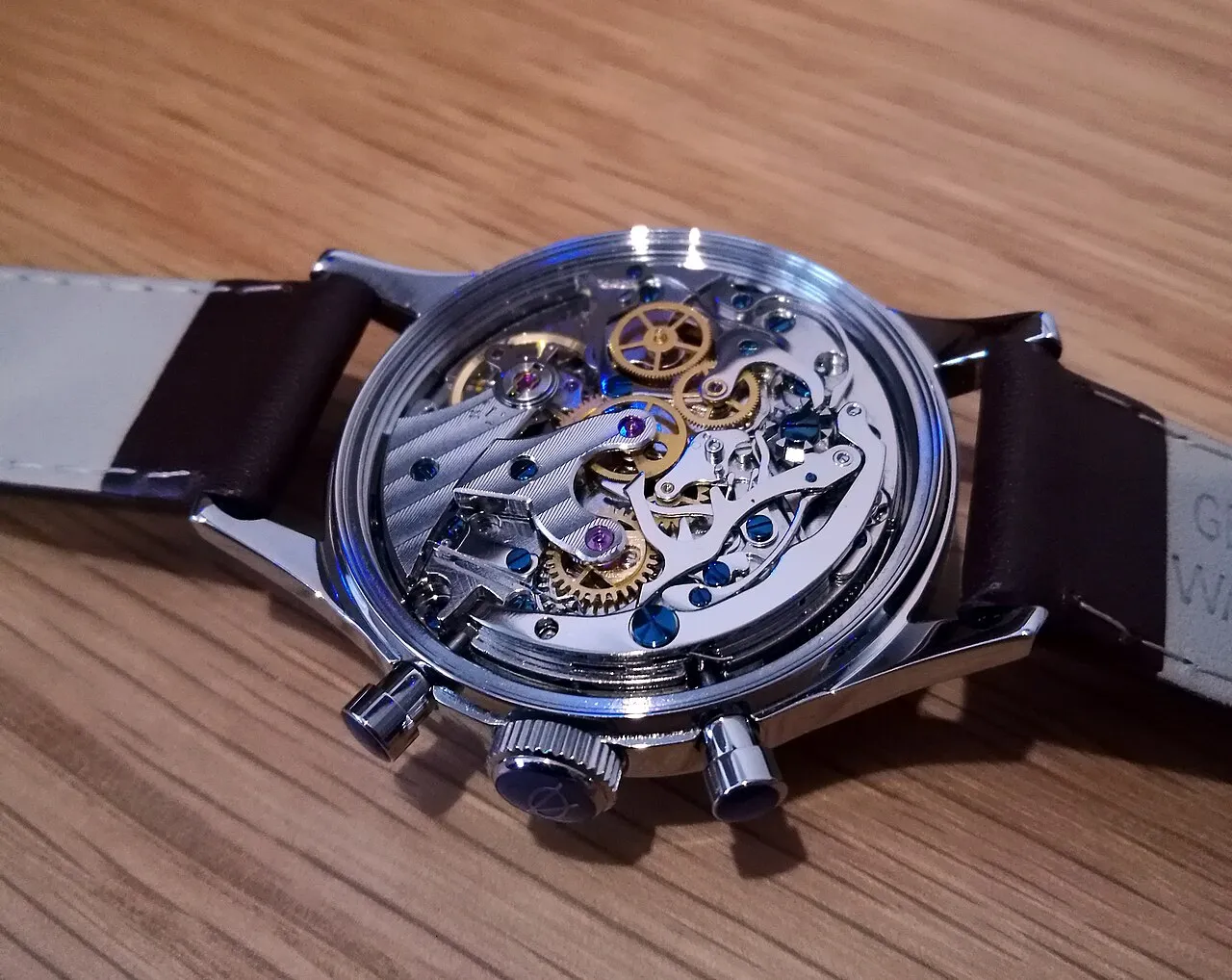
That movement lineage became the ST19 family, which is why the Seagull 1963 holds such a specific place among affordable mechanical chronographs.
It connects a modern enthusiast watch to a Cold War-era aviation project rather than simply offering retro styling.
In 1973, the Dongfeng reached overseas markets under the Seagull trademark, becoming the first Chinese watch exported internationally under that name.
Seagull later marked a series of Chinese high-complication milestones, including a tourbillon in 2005, a minute repeater in 2006 and a split-seconds chronograph for its 70th anniversary in late 2024.
In 2025, Seagull launched its first official global online store, giving collectors a more direct route to the brand.
Quartz disruption and the Shenzhen supply chain
The 1980s and 1990s were a severe test for China’s state watch factories.
Cheap quartz movements from across Asia changed the market quickly, and many factories could not adapt fast enough.
Some developed quartz calibres, some shifted toward automatics, some sold movements abroad and many closed.
By the end of the 1990s, only the stronger names remained, including Tianjin.
At the same time, southern China was becoming the manufacturing engine behind a different kind of watch industry.
In Shenzhen and across Guangdong, suppliers built dense networks for cases, dials, hands, straps and full assembly, working for brands around the world, including Swiss companies.
Industry data referenced in the historical record points to Guangdong and Fujian together as the source of the vast majority of China’s watch and clock output.
That infrastructure helped make the modern microbrand boom possible.
Small batches, shorter lead times and more accessible production minimums allowed small brands to bring mechanical watches to market without the capital base of a traditional luxury house.
Movements collectors are likely to encounter
Chinese watchmaking today is not one thing, and movement choice remains one of the clearest ways to understand the difference between brands and price points.
| Movement | Maker | Where it appears |
|---|---|---|
| ST1901, ST19 family | Seagull, Tianjin | Hand-wound column-wheel chronographs descended from the Venus 175, including the Seagull 1963 and related models |
| ST2130 | Seagull, Tianjin | Automatic movement listed at 28,800 bph with about 42 hours of power reserve, used in Seagull reissues and by other brands |
| PT5000 | HK Precision Technology | Automatic movement built to the same dimensions as the ETA 2824-2 and Sellita SW200, often used by Chinese microbrands as a lower-priced option |
| NH35 | Seiko | Japanese automatic widely used by global microbrands, especially divers and field watches |
The old assumption that a Chinese movement is automatically the cautious choice no longer holds up cleanly.
Seagull and HK Precision Technology have earned serious attention, while the PT5000 has been sent to Germany for chronometer-level testing.
Quality control still varies by brand, so the movement name is only part of the buying decision.
Chinese brands now want the name on the dial
For years, China’s role in watches was often invisible to the final buyer.
A factory might make the case, dial, hands, strap, movement or complete watch, while another company’s name appeared on the dial.
That balance is changing as Chinese-founded brands such as San Martin, Pagani Design, Addiesdive and Baltany sell their own watches directly to global enthusiasts through websites and social channels.
The path is familiar in industrial history.
Manufacturers copy to learn, scale production, build design confidence and eventually seek recognition under their own names.
Japan followed that arc earlier, while China is now moving through it at a larger scale and at a faster pace.
For collectors, the practical question is less about a broad country-of-origin label and more about specifics.
The exact movement, the design’s originality, the warranty route outside China and independent owner feedback all matter more than a simple assumption about where a watch was made.
Chinese watchmaking began as a national industrial project, survived the quartz shock and then became one of the hidden foundations of modern enthusiast watch culture.
Its next chapter is no longer just about supplying the world’s watches, but about convincing collectors to value the names coming from China itself.