BYD has turned the aircraft-towing publicity stunt into something rather more theatrical.
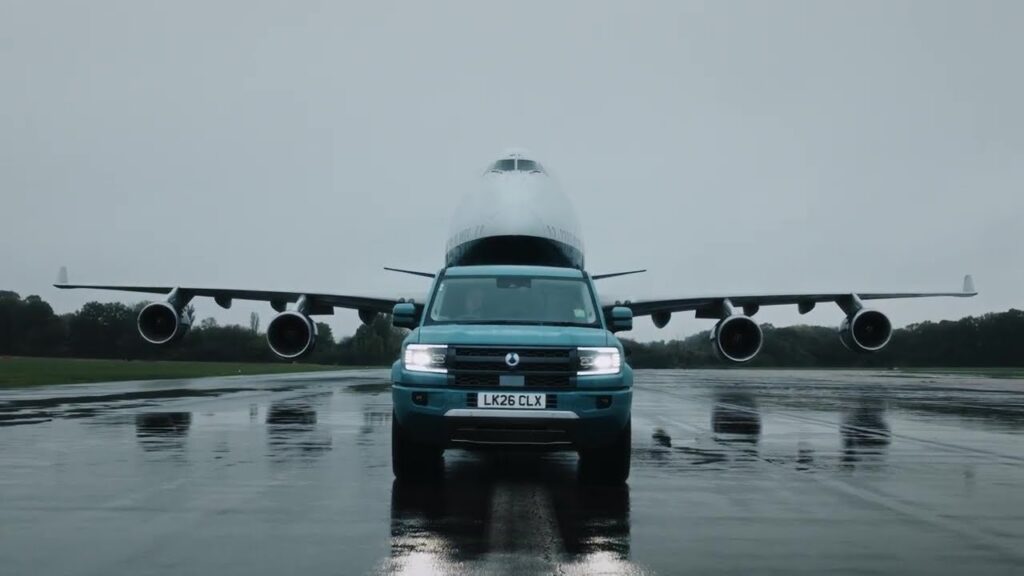
Its Denza B5 plug-in hybrid SUV has pulled a 180-tonne Boeing 747 at a UK test track while running on just two wheels, a demonstration that inevitably recalls Volkswagen’s famous Touareg aircraft tow but adds a stranger engineering challenge.
The point is simple enough: show traction, torque delivery and structural confidence in a way people will remember.
At a glance
- BYD’s Denza B5 plug-in hybrid SUV towed a 180-tonne Boeing 747 at a UK test track.
- The most unusual run was completed with both right-side wheels removed and 4,500 kg of extra weight inside the SUV.
- BYD says the vehicle was an unmodified production-spec model with DiSus-P hydraulic suspension and a reinforced cell-to-chassis structure.
A towing stunt with a familiar echo
The Volkswagen Touareg’s aircraft-towing demonstration remains one of the more memorable SUV durability set pieces of the modern era.
BYD’s version follows that broad formula, but the Denza B5 added a complication by completing the feat without all four wheels in place.
The SUV was connected to the Boeing 747 by a rigid tow bar, which kept the task controlled while still leaving the vehicle to generate the necessary pull.
During the initial attempt, the B5 towed the aircraft with three wheels fitted and 2,000 kg of additional weight inside.
Engineers then removed both wheels on the right-hand side and raised the added ballast to 4,500 kg.
Across three attempts, the SUV managed to pull the aircraft for a total of 1,600 metres.
What BYD wanted to prove
Beyond the spectacle, the demonstration puts focus on the B5’s plug-in hybrid drivetrain and chassis hardware.
BYD says the Denza B5 used for the stunt was an unmodified production-spec vehicle.
Its plug-in hybrid powertrain produces 536 hp and 760 Nm of torque, or 560 lb ft, figures that explain why the brand chose a tow test rather than a conventional acceleration run.
The SUV is also equipped with DiSus-P hydraulic suspension, a system BYD highlighted as part of the vehicle’s technical make-up for the demonstration.
The reinforced cell-to-chassis structure was another stated element, relevant in a stunt where load transfer, body control and drivetrain stress are all part of the story.
The Denza B5’s attention play
This kind of display is less about day-to-day towing and more about brand positioning.
For BYD, the B5 stunt puts a Chinese plug-in hybrid SUV into a conversation historically dominated by established European nameplates.
It also gives Denza a memorable identity marker at a time when electrified SUVs are competing not only on efficiency and performance, but on perceived toughness.
The aircraft itself does plenty of visual work, yet the two-wheel element is what separates this from a straightforward heavy tow.
It turns a brute-force demonstration into a balance, traction and structural confidence exercise.
Details & Specifications
| Brand | BYD / Denza |
|---|---|
| Model | Denza B5 |
| Vehicle type | Plug-in hybrid SUV |
| Power | 536 hp |
| Torque | 760 Nm / 560 lb ft |
| Suspension | DiSus-P hydraulic suspension |
| Structure | Reinforced cell-to-chassis structure |
| Demonstration vehicle | Unmodified production-spec model, according to BYD |
| Towed object | 180-tonne Boeing 747 |
| Test location | UK test track |
| Additional weight | 2,000 kg for the three-wheel attempt, then 4,500 kg for the two-wheel setup |
| Tow distance | 1,600 metres over three attempts |
As a real-world ownership metric, towing a jumbo jet on two wheels is obviously academic.
As a piece of automotive theatre, though, it gives the Denza B5 a clear message: this is a plug-in hybrid SUV BYD wants associated with torque, hardware strength and a willingness to make the point the hard way.