Starting a watch brand often sounds like a romantic act of design, but the hard part usually begins before a logo or case drawing exists.
The stronger projects tend to start with a precise absence, a watch the founder has wanted to buy and couldn’t find.
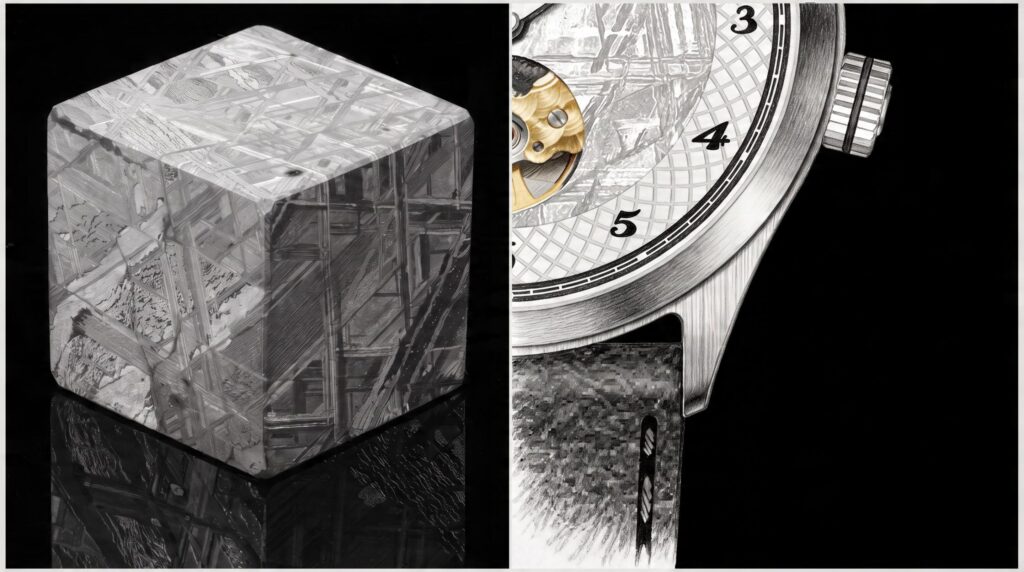
For Tektora founder Alex I., that absence was a compact mechanical watch pairing a genuine meteorite dial with a carefully integrated open heart.

At a glance
- Tektora is being developed around a compact 38mm meteorite open-heart mechanical watch.
- The design combines a meteorite centre, guilloché chapter ring, matte black outer ring and Miyota 90S5 calibre.
- The project highlights the early microbrand blueprint, from market gap and CAD work to rejected samples and prototype refinement.
The market gap has to be more than taste
A credible microbrand rarely begins with a mood board alone.
The first filter is market research, and in Tektora’s case that meant months spent looking at enthusiast brands, established makers and the conversations happening inside the watch community.
The interesting gap wasn’t meteorite itself, since meteorite dials already exist across the market.

The gap was more specific, with a genuine meteorite dial, a properly executed open-heart display and a compact unisex case size in the same watch.
That distinction matters because microbrands can’t survive on novelty alone.
A new watch needs a reason to exist beyond another dial colour, another diver silhouette or another spec sheet built around familiar formulas.

In this case, the challenge was also practical.
Meteorite is brittle when sliced thin, and cutting an open-heart aperture through a natural dial material raises the risk of cracking or visual imbalance.
Many brands choose the meteorite dial or the exposed balance, but combining both in a smaller case leaves far less room for error.

A movement that earns the aperture
An open-heart watch can easily become decoration for decoration’s sake.
The movement needs to be worth seeing, otherwise the dial cutout feels like a gimmick rather than part of the design.
Tektora’s choice of the Miyota 90S5 is central to the concept.

The calibre beats at 28,800 bph, measures 3.90mm thick and is engineered for open-heart watches, with gilt decoration that gives the visible mechanics more warmth than a plain industrial finish.
The display caseback continues the same idea, making mechanical transparency part of the watch rather than a single dial-side gesture.
The more difficult work is integration.

Placing the open heart at 6 o’clock gives the dial a grounded symmetry, but it also requires the surrounding details to frame the aperture cleanly instead of making it look like a hole punched through a finished design.
Layering meteorite without swelling the watch
The dial architecture is where the watch’s identity comes into focus.
Tektora uses a meteorite centre, a guilloché chapter ring and a matte black outer ring with matching rehaut to reduce the visual drop between crystal and dial.

The contrast is deliberate.
Meteorite brings an irregular Widmanstätten pattern that changes from dial to dial, while guilloché adds a more disciplined, classical texture around it.
The matte black perimeter gives the composition a cleaner frame, helping the more expressive materials sit inside a modern case rather than overwhelming it.

That is a lot of visual information to manage in a 38mm watch.
The confirmed dimensions of 11.10mm in height and 45mm lug-to-lug suggest a project aimed at everyday wearability rather than the oversized theatre often associated with complex dial layouts.
The hands continue that restraint, using a mid-century syringe profile in polished silver with white fill for legibility.

Applied black Breguet numerals add depth without turning the dial into a vintage pastiche.
Prototype discipline before production
The first sample didn’t make the cut.
The proportions were wrong, the open-heart placement was off and the quality wasn’t where it needed to be.

For anyone trying to start a microbrand, that moment is more important than it sounds.
A factory sample can validate a concept, but it can also reveal that the design, finishing or execution isn’t ready for a paying customer.
Rejecting a weak prototype costs time, but accepting one can cost a young brand its credibility.

This is where a sketch starts becoming a business decision.
The founder has to decide which compromises are harmless and which ones would dilute the entire reason the watch exists.
Details & Specifications
| Brand | Tektora |
|---|---|
| Project | Compact meteorite open-heart mechanical watch |
| Case size | 38mm |
| Case height | 11.10mm |
| Lug-to-lug | 45mm |
| Dial | Meteorite centre, guilloché chapter ring, matte black outer ring and rehaut |
| Movement | Miyota 90S5 mechanical calibre |
| Frequency | 28,800 bph |
| Movement thickness | 3.90mm |
| Open-heart position | 6 o’clock |
| Caseback | Display caseback |
| Hands | Polished silver syringe-style hands with white fill |
| Numerals | Applied black Breguet numerals |
The lesson from Tektora’s starting point is simple without being easy.

A microbrand needs a reason to exist, and that reason has to survive movement selection, dial making, samples, cost pressure and the temptation to compromise too early.
If the final watch lands with the same clarity as the blueprint, it should speak to collectors who want rare material, visible mechanics and proportions they can actually wear.