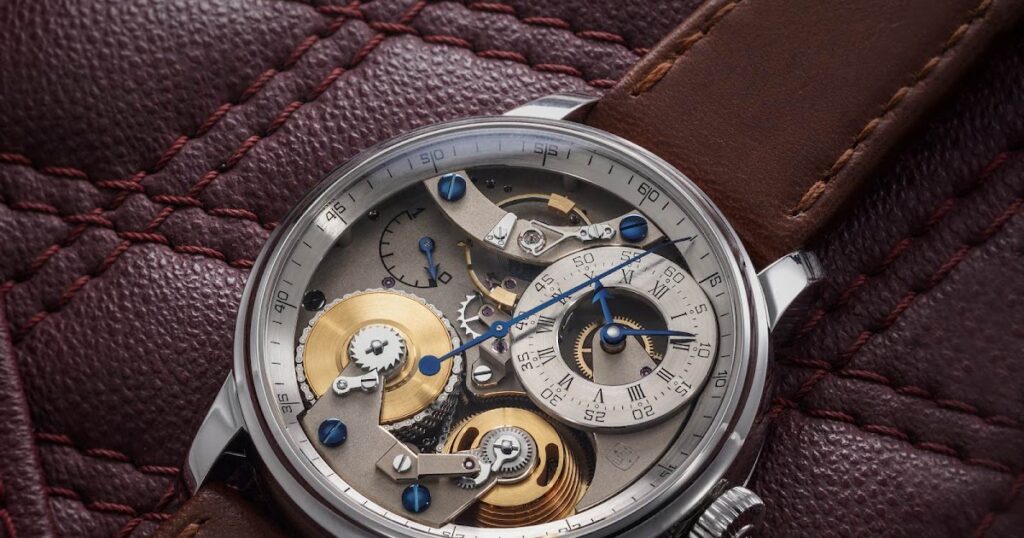
Naissance d’une Montre 3 is not a conventional anniversary watch, even by the standards of high complications.
Unveiled in 2025 for the tenth anniversary of Chronométrie Ferdinand Berthoud, it’s a preservation project in wristwatch form, built around the kind of hand skills and mechanical reasoning that can’t be learned from drawings alone.
The first unique example has already made its mark at auction, and the project now moves toward a ten-piece series scheduled to begin delivery in 2026.

At a glance
- Ferdinand Berthoud’s Naissance d’une Montre 3 continues a long-running initiative dedicated to preserving traditional watchmaking skills.
- The watch uses a hand-wound calibre with a fusee-and-chain transmission, Guillaume-type bimetallic balance and extensive traditional finishing.
- The ten-watch series is priced at CHF 850,000 per watch, with production limited to two pieces per year from 2026.
A continuation of Naissance d’une Montre
The wider Naissance d’une Montre initiative began in 2009 with a clear aim: to protect practical horological knowledge by putting it directly into the hands of working watchmakers.
Its first chapter brought together Robert Greubel, Stephen Forsey, Philippe Dufour and Michel Boulanger between 2009 and 2015, resulting in a ten-watch series whose first example sold at Christie’s in 2016 for more than US$1 million.
The second chapter followed between 2015 and 2021, involving Greubel Forsey, Felix Baumgartner, Martin Frei, Dominique Buser and Cyrano Devanthey, and culminated in a unique timepiece.

Naissance d’une Montre 3 extends that philosophy through a collaboration between the artisans of Chronométrie Ferdinand Berthoud and Chopard, with the Time Æon Foundation documenting the initiative it has supported since the beginning.
More than 80 artisans and specialists contributed over five years, combining old-world technique with the technical and organisational resources of the two manufactures.
Mechanical ideas from another age
The calibre at the centre of Naissance d’une Montre 3 is designed around traditional mechanical solutions rather than contemporary shortcuts.

Its fusee-and-chain transmission is the most visible expression of that approach, using a 172 mm chain assembled from 477 individual steel components to help maintain more consistent torque as the mainspring unwinds.
A Breguet-type stopwork limits the useful winding range to around four of the mainspring’s 8.5 turns, while an auxiliary spring maintains energy transmission during winding.
The watch also uses a Guillaume-type bimetallic balance made from Invar and brass, a construction developed to compensate for temperature effects on the balance spring and balance.

That choice gives the project a local and historical resonance, as Charles-Édouard Guillaume was born in Fleurier, the Swiss village also associated with Ferdinand Berthoud, and received the Nobel Prize in Physics in 1920 for his work on nickel-steel alloys.
Chronometric performance is part of the brief rather than a decorative afterthought.
The first watch achieved an average daily rate across positions of 0.91 seconds per day during COSC testing, with a rate variation of 0.01 seconds per day per degree Celsius and a rate correction of 0.69 seconds per day.

Each movement in the series is individually certified by COSC.
Details & Specifications
| Brand | Chronométrie Ferdinand Berthoud |
|---|---|
| Model | Naissance d’une Montre 3 |
| Case size | 44.3 mm diameter, 13 mm height |
| Case material | 18-carat white gold |
| Dial | White gold with Roman hour numerals, Arabic minute numerals, seconds ring and power-reserve indicator |
| Hands | Blued steel, finished using traditional techniques |
| Movement | Hand-wound calibre FB-BTC.FC |
| Movement dimensions | 37.5 mm diameter, 8.35 mm thickness |
| Components | 747 components including the chain |
| Mainplate and bridges | Nickel-silver mainplate with 13 bridges |
| Escapement | Swiss lever escapement |
| Balance | Guillaume-type bimetallic balance in Invar and brass |
| Frequency | 21,600 vibrations per hour, 3 Hz |
| Jewels | 37 jewels with diamond endstones |
| Power reserve | 50 hours |
| Complications and mechanisms | Fusee-and-chain transmission, Breguet-type stopwork, auxiliary spring during winding, balance-stop mechanism, power-reserve display |
| Water resistance | 30 metres |
| Certification | Each movement individually certified by COSC |
| Series production | 10 watches in 18-carat ethical gold |
| Production rate | Two watches per year from 2026 |
| Price | CHF 850,000 each |
Scarcity with a purpose
The first Naissance d’une Montre 3 was a unique stainless-steel example produced exclusively for Phillips in association with Bacs & Russo.
It sold in Geneva on 8 November 2025 for CHF 1,270,000, an emphatic signal that collectors understand the cultural weight of the project.

The following ten watches are made in 18-carat ethical gold certified under the Responsible Jewellery Council’s Chain of Custody standard.
Production is capped at just two watches per year, not as a marketing gesture but as a consequence of the work involved.
That pace matters because the watch is also a teaching instrument, preserving knowledge in metallurgy, balance adjustment, complex movement construction, engraving and finishing.

Its finalist position in the Mechanical Exception category at the Grand Prix d’Horlogerie de Genève 2026 underlines the technical ambition, but the deeper point is continuity.
Naissance d’une Montre 3 will appeal to collectors who see watchmaking as a living craft rather than a catalogue of complications, and who understand that the rarest thing here may be the knowledge required to make another one.