Fortis has been steadily rebuilding its core collections around tougher cases, clearer instrument design and movements with a serious technical brief.
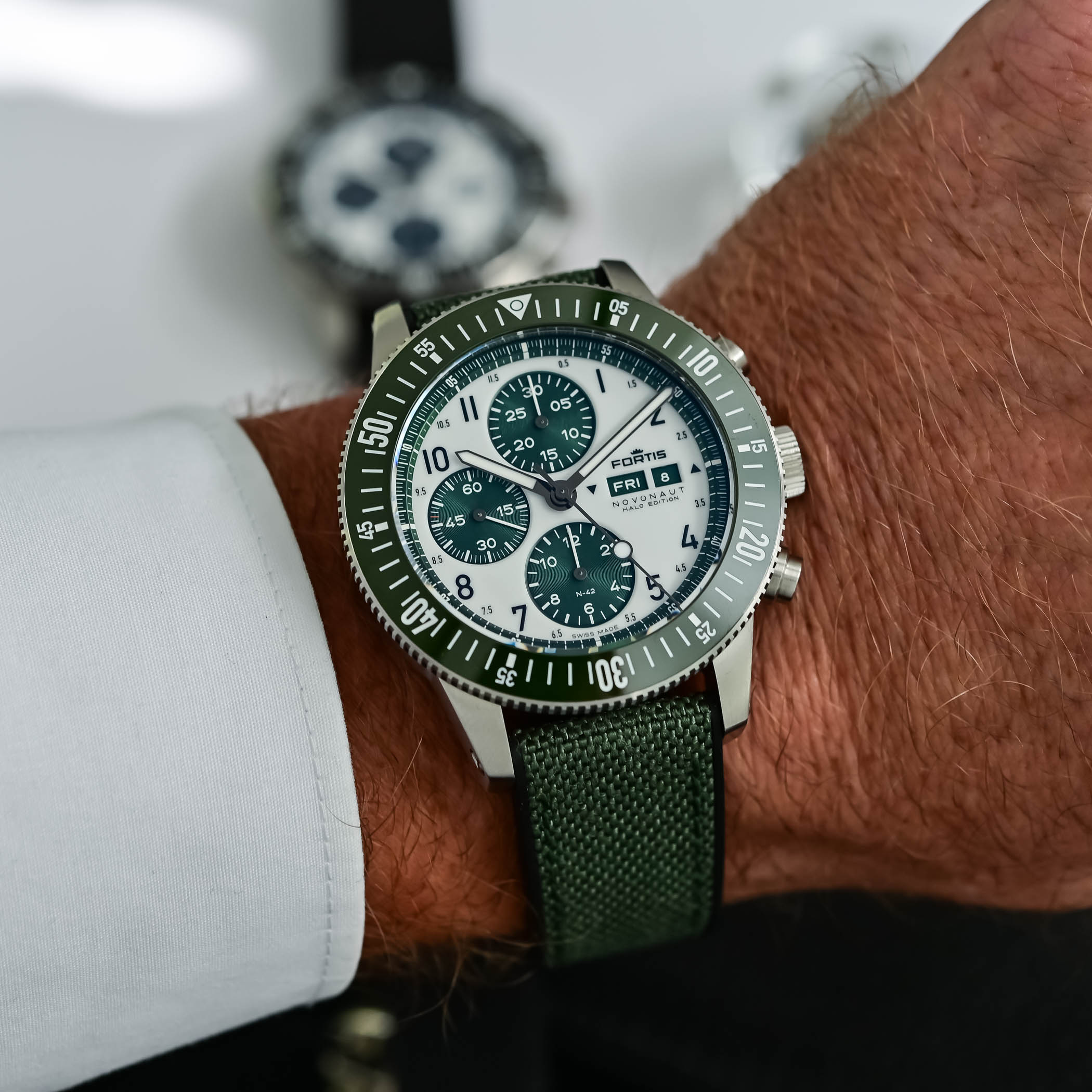
The latest step is the Novonaut N-42 Halo Edition, a more visually assertive take on the brand’s space chronograph with a dial that changes character completely after dark.
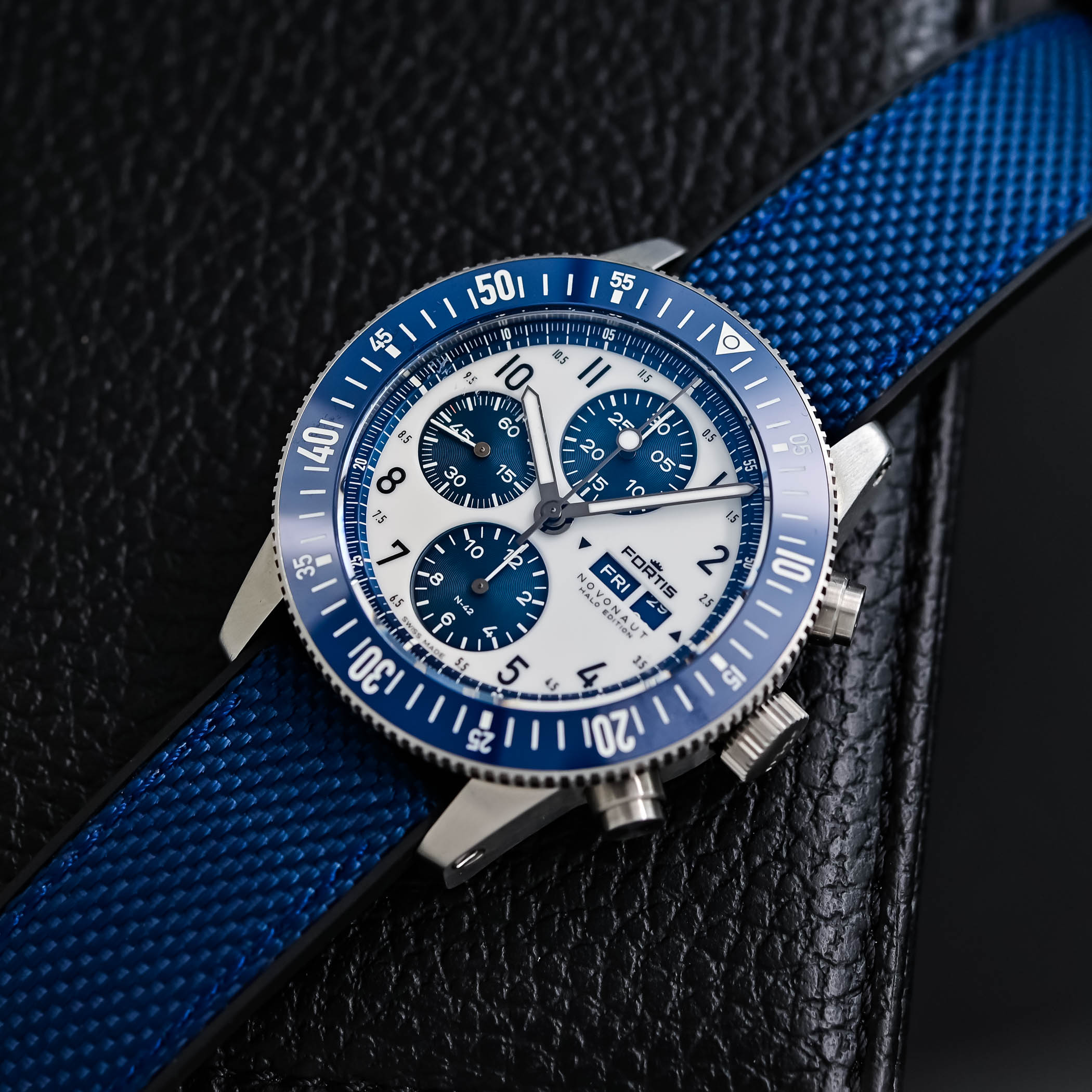
Available in black, blue and green executions, the new Halo models bring fully luminous Lumicast dials, coloured ceramic bezels and an upgraded Werk 17 TR chronograph movement.
At a glance
- Fortis has added three Novonaut N-42 Halo Editions to its permanent collection.
- Each model uses a full Lumicast X1 dial with panda-style contrast and a matching ceramic Sirius bezel.
- The watches are available now, priced at EUR 5,950, CHF 5,450 or USD 5,950.
A space chronograph with a tougher visual edge
The Novonaut N-42 sits in a line that traces back to one of Fortis’s defining modern tool watches, the B-42 Official Cosmonauts Chronograph.
Fortis’s first Cosmonaut watch flew in 1994 during the MIR space station era, and the concept later continued in a second generation connected with ISS use.
The Novonaut name arrived in 2023 as a fresh chapter for the space chronograph, combining cues from the earlier B-42 with the more recent engineering language seen in the brand’s Flieger and Stratoliner collections.
The Halo Editions don’t change the basic architecture, and that’s largely the point.
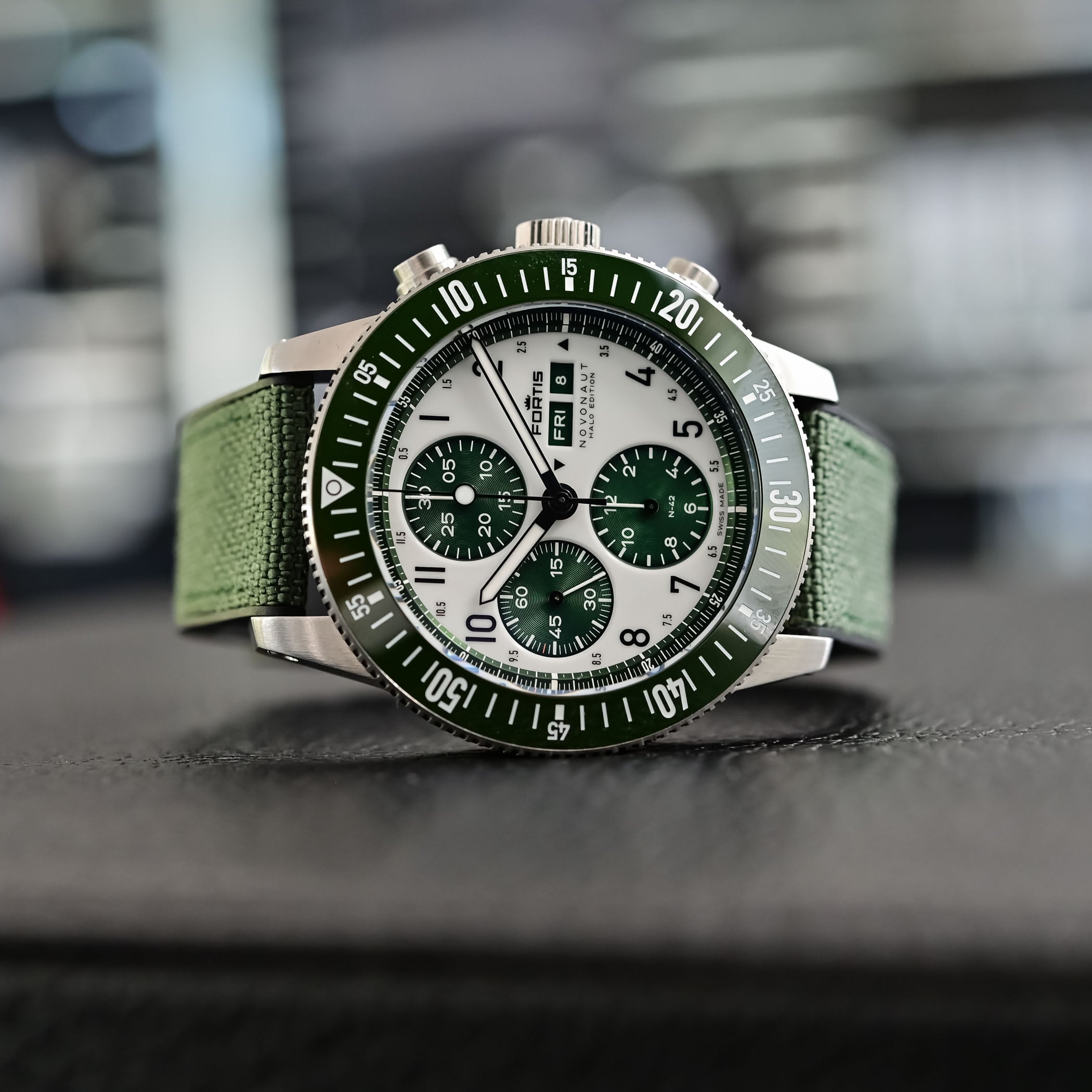
The case remains a large, purposeful 42mm design in recycled stainless steel, with a 15mm profile, a 51mm lug-to-lug length and a fully brushed finish.
It’s a substantial watch by any normal measure, but the proportions fit the brief of a chronograph designed as an instrument rather than a dress object.

Practical durability remains central, with 200 metres of water resistance, a screw-down crown with a triple-gasket system, reinforced FKM gaskets, a sapphire crystal and a screw-pin strap mounting system.
The watch head alone weighs 115 grams, which reinforces the impression that Fortis is still building the Novonaut as a physically robust tool.
The Halo dial turns lume into the main event
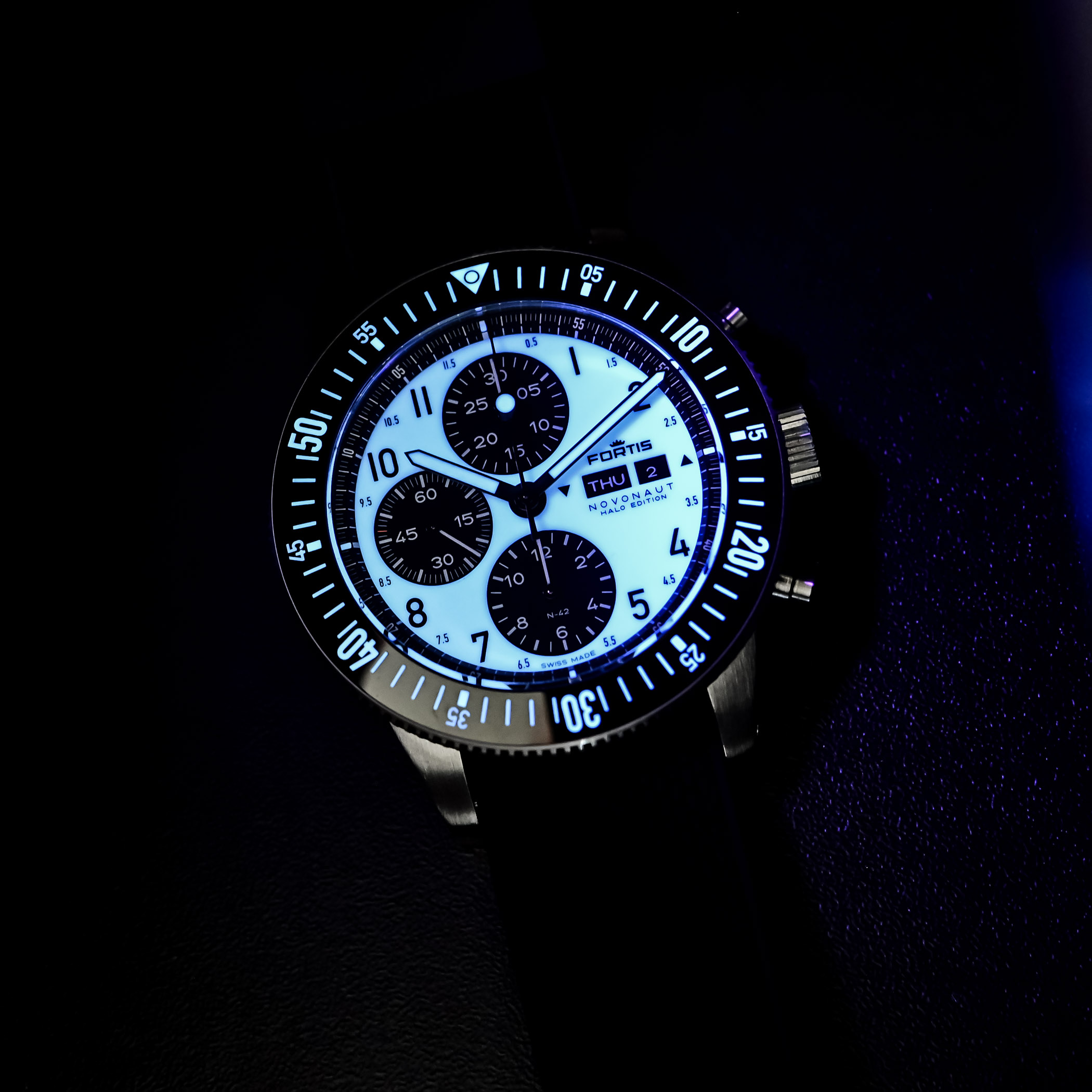
The defining feature is the dial, which uses Lumicast X1 for the entire white dial base.
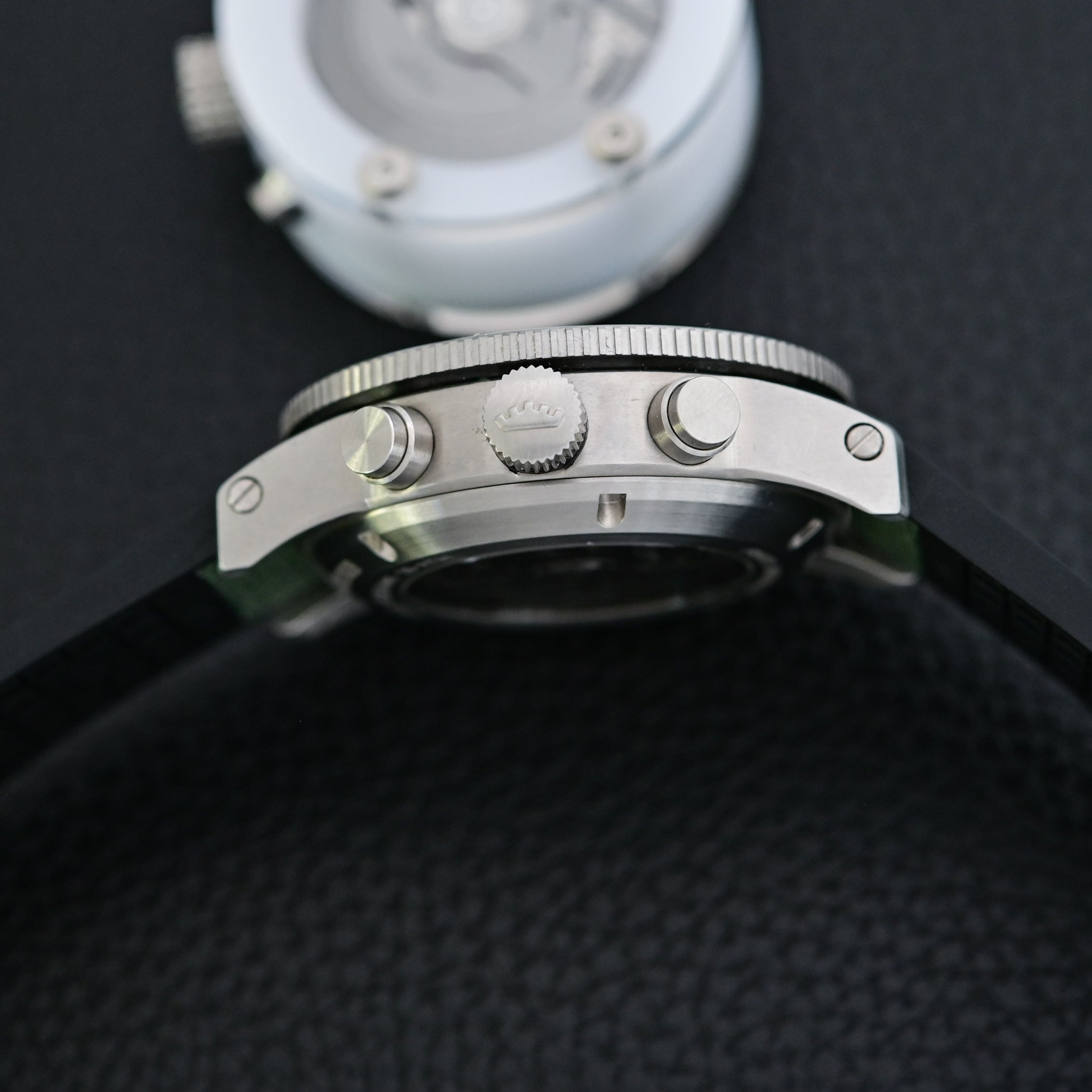
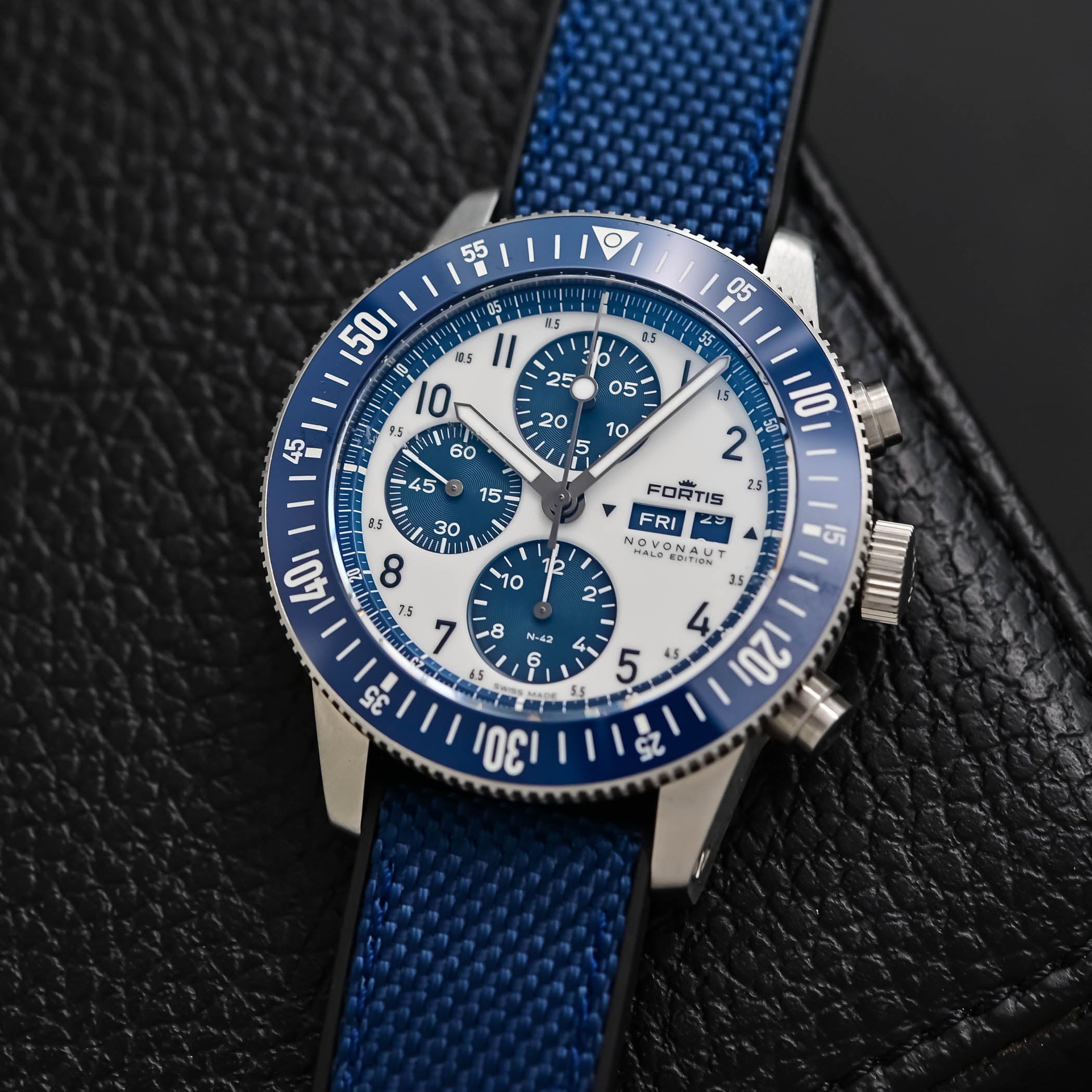
In daylight, the watch reads as a sharp panda-style chronograph with coloured accents in black, blue or green across the sub-dials, day-date discs, Arabic numerals and inner countdown flange.
At night, the pale dial base becomes the luminous field, leaving the coloured elements in stronger negative contrast.
Fortis says this is its strongest luminous watch to date, which is a notable claim from a brand that has spent years leaning into functional legibility.
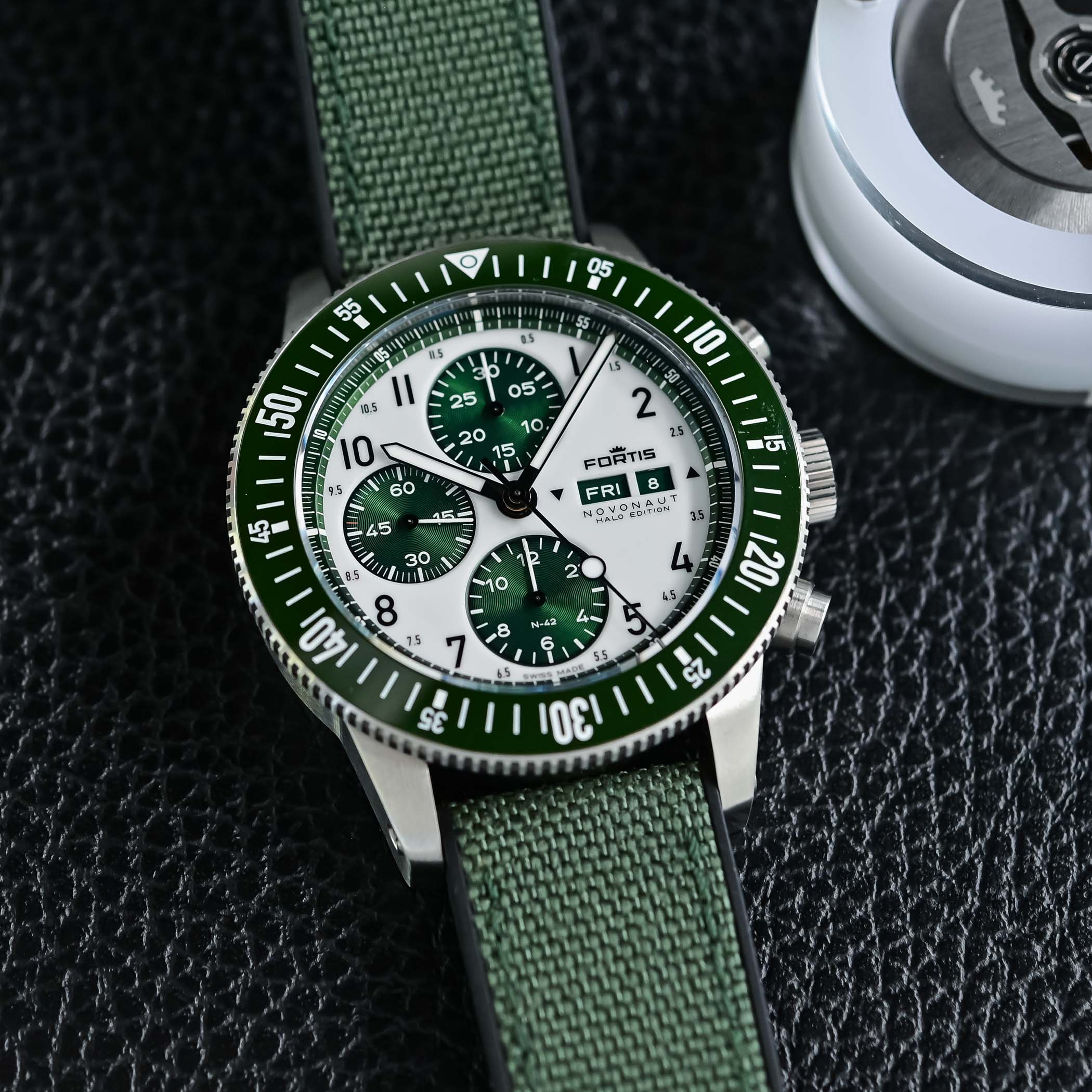
The blackened hands, including the chronograph seconds hand with its bull’s-eye detail, are also filled with Super-LumiNova X1.
The bezel adds another layer of utility and character.
Fortis uses its bi-directional Sirius bezel with a fully scaled 60-minute track, pairing luminous markings with a polished ceramic insert matched to the dial accents.
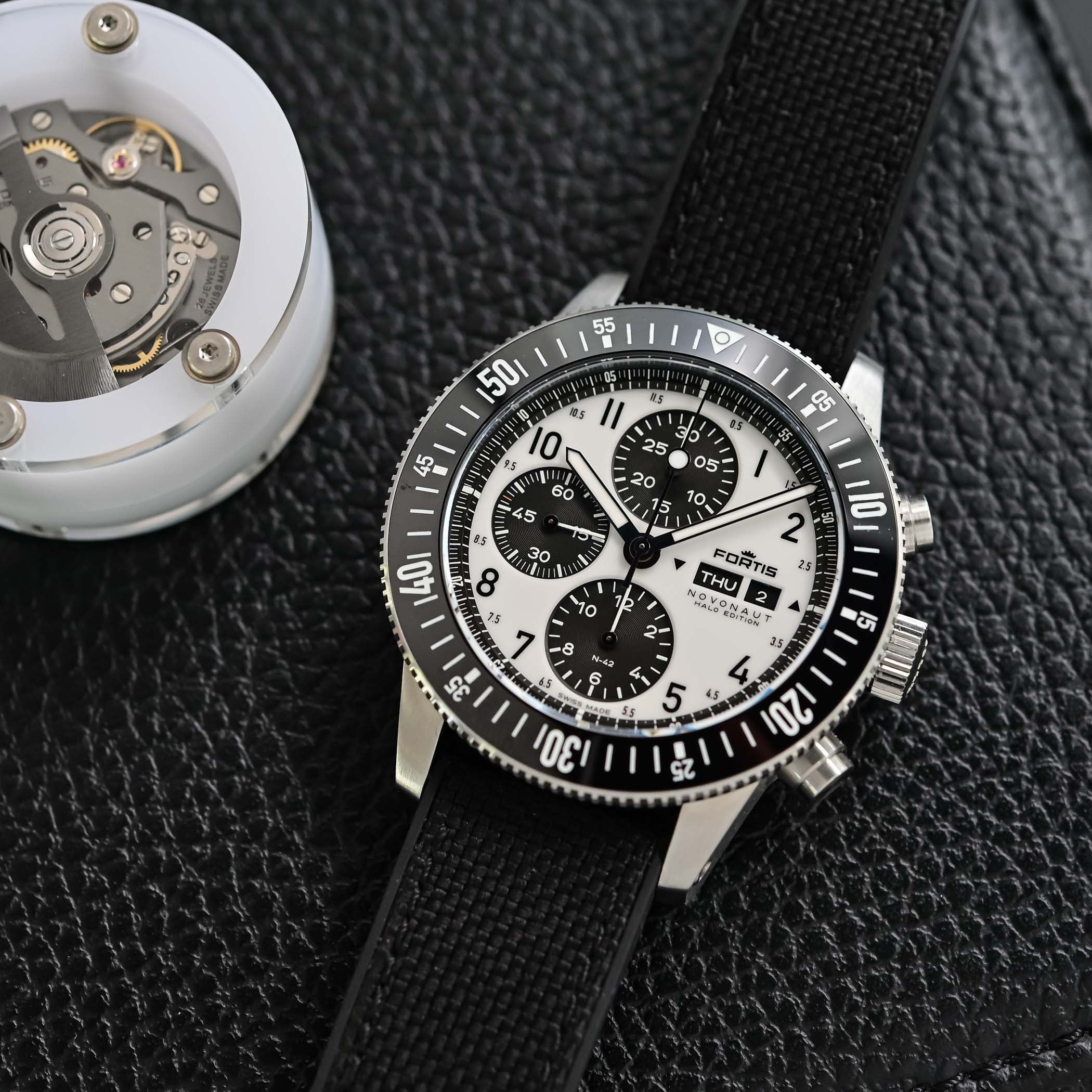
The three colourways are deliberately straightforward, with black, blue and green each carried through the bezel insert, dial details and hybrid FKM rubber and textile strap.
That strap gives the Halo Editions a more casual stance than the classic bracelet versions, while keeping the hardware suitably secure with a steel pin buckle.
Werk 17 TR adds more stability and reserve
The movement update is just as important as the dial treatment.
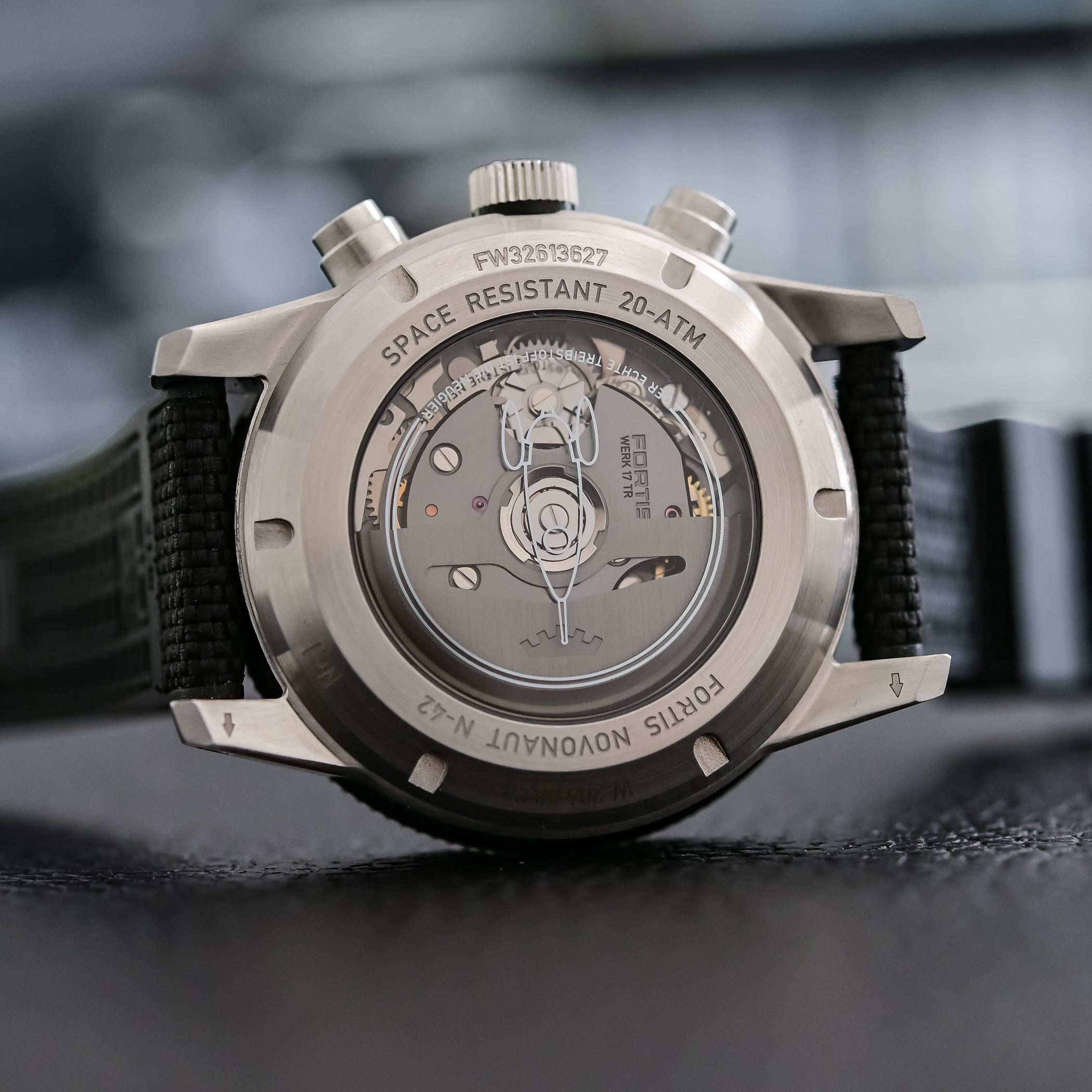
Inside is the Fortis Werk 17 TR, a newer evolution of the Werk 17 automatic chronograph developed with La Joux-Perret.
The calibre uses the architecture of the Valjoux 7750 as its foundation, but Fortis has pushed it into more specialised territory.
It is an integrated automatic chronograph with a column wheel, and this TR version has been strengthened further for shock resistance.
The bridges have been redesigned and reinforced, while the balance bridge is secured at two points to improve stability around the regulating organ.
Fortis has also moved to a free-sprung variable inertia balance, adjusted by mass screws on the balance rather than a conventional index regulator.
That setup is intended to reduce sensitivity to shocks and positional variation, which makes sense for a watch whose identity is built around resilience.
The power reserve also rises from 60 hours to 70 hours, giving the Novonaut a useful weekend-proof running time.
Details & Specifications
| Brand | Fortis |
|---|---|
| Model | Novonaut N-42 Halo Edition |
| References | F2040021 black, F2040022 blue, F2040023 green |
| Case size | 42mm diameter, 15mm thickness, 51mm lug-to-lug |
| Case material | Brushed recycled stainless steel |
| Bezel | Bi-directional Sirius bezel with polished black, blue or green ceramic insert and Super-LumiNova 60-minute scale |
| Crystal | Sapphire crystal with anti-reflective coating |
| Caseback | Sapphire caseback with metallised logo |
| Water resistance | 200 metres |
| Dial | Lumicast X1 full luminous dial base with black, blue or green accents |
| Movement | Fortis Werk 17 TR, automatic integrated column-wheel chronograph |
| Movement maker | La Joux-Perret for Fortis |
| Frequency | 28,800 vibrations per hour |
| Power reserve | 70 hours |
| Functions | Hours, minutes, small seconds, chronograph, day-date |
| Regulation | Free-sprung variable inertia balance with two-point secured balance bridge |
| Strap | Hybrid FKM rubber and textile strap in black, blue or green with steel pin buckle |
| Weight | 115 grams for the watch head |
| Availability | Available now as part of the permanent collection |
| Price | EUR 5,950, CHF 5,450 or USD 5,950 |
The Novonaut N-42 Halo Editions are not subtle additions to the Fortis catalogue, but they are coherent ones.
They take the brand’s space chronograph formula and sharpen it where Fortis tends to be most convincing, with stronger legibility, tougher mechanics and a visual idea that actually serves the watch after dark.