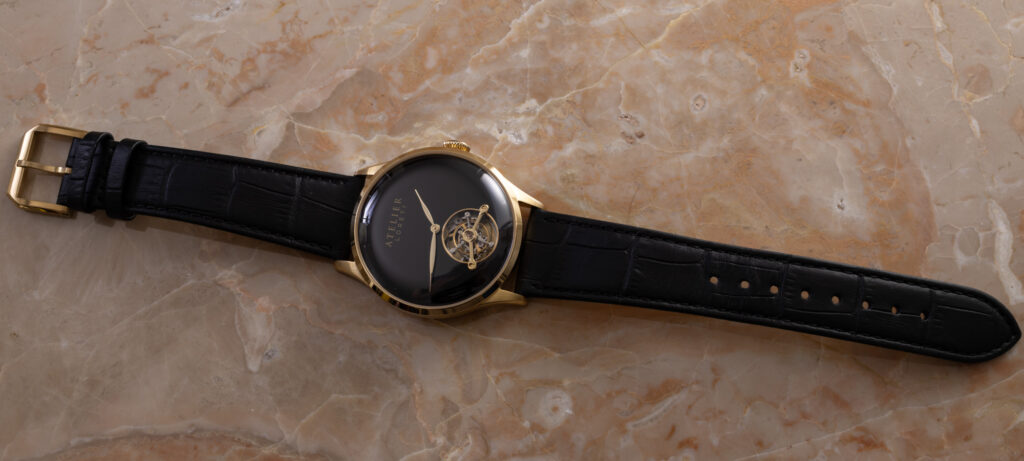
The Filippo Loreti Atelier Loreti Celestial Tourbillon is a new kind of entry point into a complication that used to live almost exclusively in six-figure showcases.
Priced from around $850 for most versions, it is not trying to pretend the tourbillon still guarantees old-world exclusivity; instead, it treats the mechanism as kinetic watchmaking theater for buyers who simply want to see the machine at work.

Atelier Loreti Gives Filippo Loreti A More Serious Mechanical Lane
Atelier Loreti arrives as a new label under Filippo Loreti, created to separate this more ambitious mechanical project from the brand’s lower-priced mainstream watches.
That distinction matters, because the Celestial Tourbillon sits in a strange but interesting position: inexpensive by tourbillon standards, yet expensive enough for the brand that it needed its own identity.
Filippo Loreti is now part of the Montrichard Group, which also owns names such as Nivada Grenchen and Vulcain, giving this release a different backdrop than the brand’s earlier crowd-funded era.

A Real Tourbillon Built Around A Familiar Automatic Heart
The key detail is the L.1T automatic movement, developed for Atelier Loreti with the widely used Miyota 8215 serving as its starting architecture.
That is an unusual and rather entertaining choice: one of the most common affordable automatic movements has been transformed into the foundation for one of watchmaking’s most visually recognizable high complications.
The L.1T runs at 4Hz rather than the 3Hz rate associated with the standard Miyota 8215, measures 5.67mm thick, and displays hours and minutes with the tourbillon visible at 6 o’clock.

There is no claim here of haute horlogerie hand-finishing, but the movement side has been dressed up with decorative bridge work and a gold-tone automatic rotor visible through the sapphire display back.
Stone Dials Put The Animation Front And Center
The Celestial Tourbillon is offered in four versions, each using a natural stone dial rather than a conventional painted or stamped surface.
In the gold-tone PVD-coated steel case, the watch can be had with blue aventurine for a starry effect or black onyx for a cleaner, deeper look.

The dial layout is intentionally sparse, which gives the tourbillon plenty of visual room, though the lack of hour markers does limit practical time-reading precision.
That trade-off says a lot about the watch: this is less a precision instrument than an affordable mechanical object meant to be watched as much as worn.
A 42mm Case With Everyday-Watch Ambitions
The steel case measures 42mm across with a roughly 49mm lug-to-lug span, making it wearable for many wrists without feeling tiny or delicate.

Thickness is the main compromise, as the watch is listed at 10.85mm without the domed box-style sapphire crystal but wears closer to about 14mm once that crystal is included.
The upside is a surprisingly practical 100 meters of water resistance, which gives the Celestial Tourbillon more daily-wear credibility than many watches built around a more fragile image of the complication.
For collectors who expect anglage, black polishing and chronometer-level regulation, this will not replace a traditional luxury tourbillon.

For enthusiasts who have always wanted the visual experience of a real tourbillon without treating the purchase like a major life event, the Atelier Loreti Celestial Tourbillon makes a persuasive and unusually approachable case.