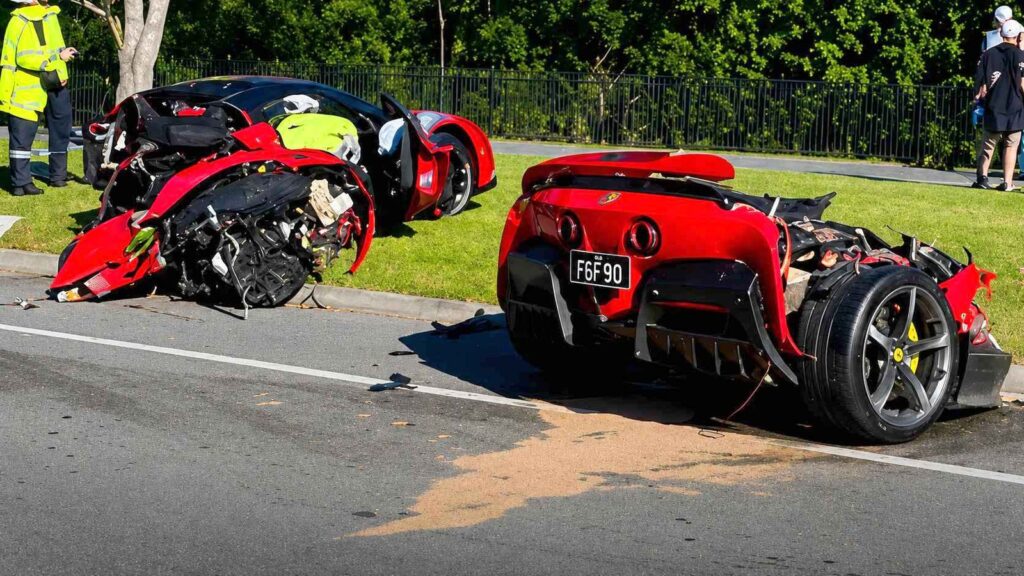
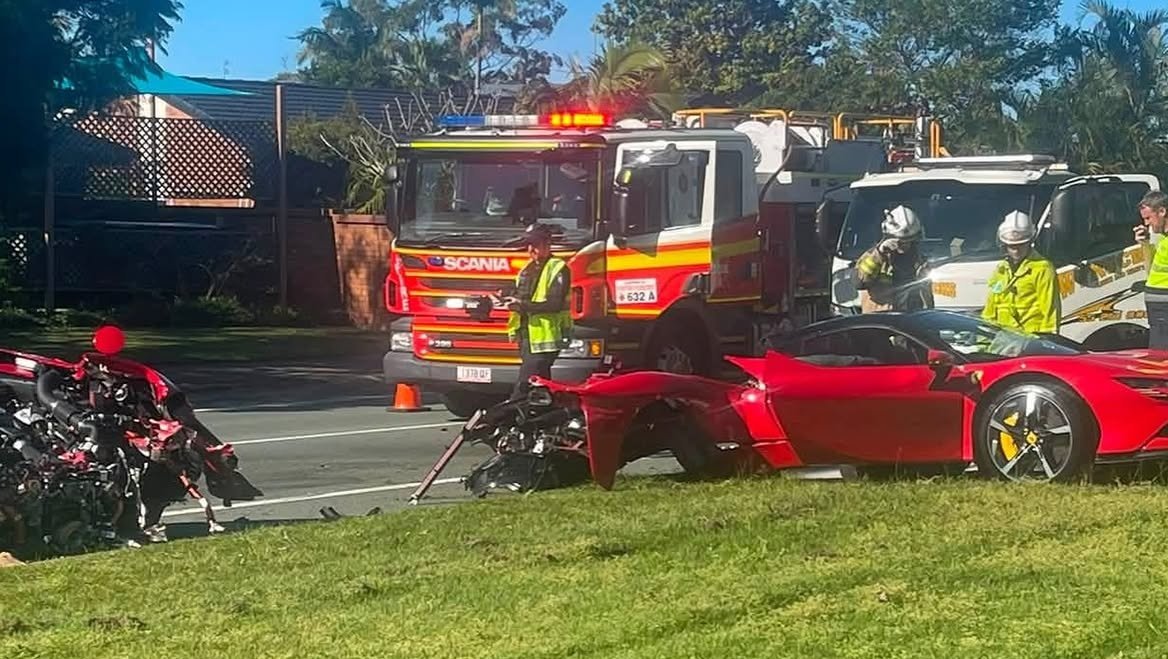
A Ferrari SF90 Spider has been left in pieces after a severe crash on Australia’s Gold Coast, yet the driver reportedly walked away uninjured.
The images are difficult to look at, but the outcome says something important about how today’s most extreme performance cars are built beneath the drama of their bodywork.
In a car as fast and complex as the SF90 Spider, safety engineering is not an afterthought; it’s fundamental to the architecture.
At a glance
- A Ferrari SF90 Spider was heavily destroyed in a crash on Australia’s Gold Coast, with the driver reportedly escaping injury.
- The car is said to have left a roundabout, mounted a curb and hit a tree, leaving major damage to the front and rear sections.
- The incident highlights the role of rigid passenger cells and engineered crumple zones in modern high-performance cars.
The Gold Coast impact
The Ferrari, reportedly driven by property developer Sam Gordon, is said to have left a roundabout before mounting a curb and colliding with a tree.
The aftermath shows a car that appears to have broken into distinct sections, with heavy destruction visible at both ends.
On first impression, the damage looks catastrophic.
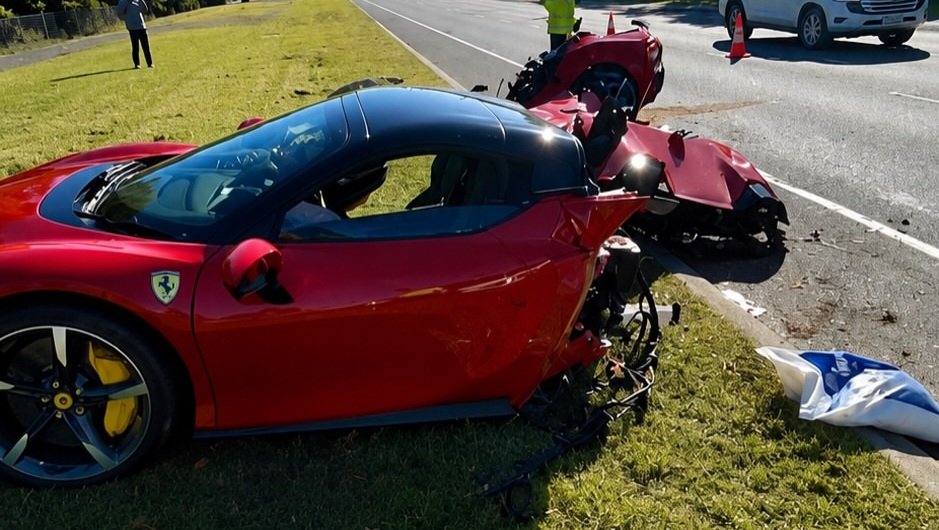
Yet the key detail is that the central occupant area appears to have done the job it was designed to do, preserving survival space around the driver.
How the SF90 Spider is built to fail safely
Modern supercars can look fragile after a large crash because their outer structures are designed to sacrifice themselves.
Ferrari’s high-performance models use a very strong central passenger structure, with energy-absorbing sections around it to help manage crash forces.

In a violent impact, the front and rear portions can deform heavily, tear away or separate from the main cell.
That can be unsettling to see, but it is often the visible result of a controlled energy-management strategy rather than a simple structural failure.
The aim is to reduce the forces that reach the person inside the car.
For a vehicle capable of extreme performance, that separation between the sacrificial structures and the protected occupant cell is crucial.
Why the damage looks so dramatic
The SF90 Spider is a highly engineered machine, and its safety systems are designed around the same principle as many advanced racing and road-car structures.
The strongest part is the area surrounding the occupants, while the areas ahead of and behind that cell are allowed to absorb energy through deformation.

That is why a crash scene can show body panels, mechanical components and structural sections scattered while the passenger compartment remains comparatively intact.
It does not make the crash any less serious, but it helps explain how a driver can survive an impact that leaves the car looking beyond recognition.
Details & Specifications
| Brand | Ferrari |
|---|---|
| Model | SF90 Spider |
| Body style | Open-top supercar |
| Crash location | Gold Coast, Australia |
| Reported incident | Left a roundabout, mounted a curb and hit a tree |
| Safety structure | Rigid central passenger cell with energy-absorbing front and rear zones |
| Reported outcome | Driver escaped without injury |
The SF90 Spider’s destruction is a sobering reminder of the risks attached to very powerful road cars, but it also shows why serious engineering matters long after the acceleration figures have stopped being the headline.