Delma has built much of its modern appeal around straightforward watchmaking, fair pricing and a habit of putting interesting materials within reach.
The Midland Meteorite Automatic fits that pattern neatly, taking one of watchmaking’s most visually distinctive dial materials and placing it in a limited-edition steel automatic that doesn’t wander into five-figure territory.
Unveiled at Geneva Watch Days, the new model is limited to 100 pieces and priced at £1,500, which immediately makes it one of the more approachable meteorite-dial watches in the current market.

At a glance
- Delma has introduced the Midland Meteorite Automatic as a 100-piece limited edition.
- The watch uses a Muonionalusta meteorite dial with luminous applied indexes, faceted hands and a red-tipped central seconds hand.
- It is priced at £1,500 and powered by a Sellita SW200-1 automatic movement.
A meteorite dial without the usual barrier to entry
Meteorite dials have a particular pull because they combine natural rarity with a pattern that can’t be duplicated from one watch to the next.
The Midland Meteorite Automatic uses Muonionalusta meteorite, a material discovered in Sweden around 1906 and believed to be roughly 4.5 billion years old.
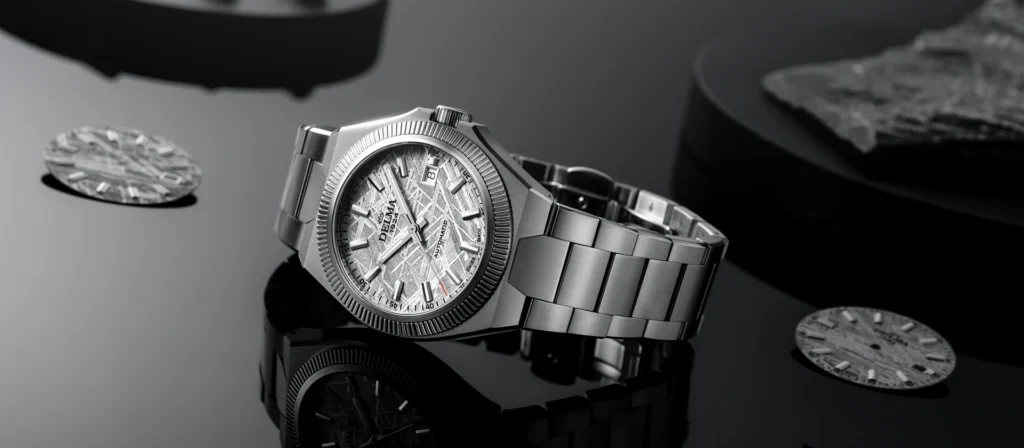
Its composition is largely iron and nickel, with traces of cobalt, and its signature appearance comes from cutting, polishing and acid treating the material to reveal crystalline Widmanstätten patterns.
Those crossing geometric lines are the point of the watch.
They give each dial its own visual fingerprint, adding individuality without requiring heavy decoration or overt branding.
Delma keeps the layout disciplined, using applied rectangular hour markers filled with Super-LumiNova and broad faceted hour and minute hands with the same practical treatment.
A fine central seconds hand adds a small flash of colour via its pillar-box red tip, while the date sits at 3 o’clock and a clean minute track frames the dial.
The Midland case gives it a sharper everyday profile
The watch is housed in a 40.5 mm stainless steel case with a tonneau shape, crisp angular lines and a fluted bezel.
It’s a more architectural setting than a simple round case, and that matters here because the monochrome meteorite dial could easily feel too restrained without a strong surrounding form.
The crown is protected by substantial shoulders, while the integrated three-row bracelet gives the watch a cohesive profile on the wrist.
Both the case and bracelet are satin-brushed, with polished bevelled edges adding contrast without pushing the design into dress-watch territory.
A folding clasp with pushers completes the bracelet, giving the watch the practicality expected from an everyday automatic rather than a precious occasional piece.
A proven Swiss automatic behind the display back
Inside the Midland Meteorite Automatic is the Sellita SW200-1, a widely used self-winding Swiss movement with a reputation for serviceability and dependable performance.
Delma fits the movement with a customised rotor, visible through the sapphire crystal caseback.
That movement choice is part of the watch’s appeal, not because it is exotic, but because it supports the broader idea of a mechanically credible, sensibly priced watch built around a special dial.
For buyers who want the visual depth of meteorite without paying for an elaborate complication, the Midland’s balance of material, case finishing and mechanical simplicity is the point.
Details & Specifications
| Brand | Delma |
|---|---|
| Model | Midland Meteorite Automatic |
| Reference | 41701.740.6.731 |
| Case size | 40.5 mm |
| Case material | Stainless steel |
| Case shape | Tonneau with fluted bezel |
| Dial | Muonionalusta meteorite |
| Hands and markers | Faceted hands and applied rectangular indexes with Super-LumiNova |
| Movement | Sellita SW200-1 automatic |
| Caseback | Sapphire crystal display back |
| Bracelet | Integrated stainless steel three-row bracelet |
| Clasp | Folding clasp with pushers |
| Production | Limited to 100 pieces |
| Price | £1,500 |
The Midland Meteorite Automatic is most compelling because it doesn’t treat the meteorite dial as an excuse for excess.
It places a genuinely captivating material inside a sharp, wearable steel watch with a proven Swiss movement, then prices it in a way that should interest collectors who care more about substance than spectacle.