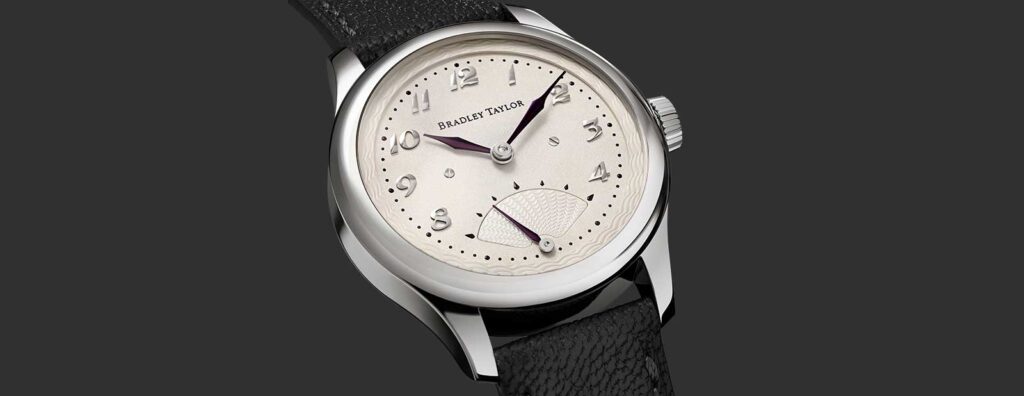
Bradley Taylor has introduced the Ardea, a new 37.8mm hand-wound watch that pairs restrained classical design with an unusually deep level of one-man watchmaking.
The Canadian watchmaker works from a 1,000 sq ft workshop in North Vancouver, where the Ardea follows his earlier Paragon and Lutria models with a stronger technical statement: a handmade retrograde seconds movement developed over four years.
A 37.8mm Case in Steel or Platinum
The Ardea is offered in stainless steel or platinum, measuring 37.8mm across and 10.9mm thick, with water resistance rated to 50 metres.
It is a compact, traditionally proportioned watch, but not a nostalgic exercise; the interest is in how much craft Taylor has concentrated into a clean time-only format.
The prototype case was made by Taylor himself, while the production cases will be made by a small specialist casemaker.
Calibre 475RS and the Retrograde Seconds Display
Inside is the manual-winding Calibre 475RS, named for its 4.75mm thickness and built around a movement architecture inspired by the durability and serviceability of the Omega 30T2 family.
Taylor manufactures much of the calibre himself, including the mainplate, bridges, train wheels and free-sprung balance wheel.
The defining feature is a 60-second retrograde display, using a snail cam, rack and return spring to send the seconds hand smoothly across its scale before snapping it back to zero once per minute.
That reset happens 1,440 times per day, which makes reliability more than a visual concern; Taylor spent a year testing the system to keep wear under control.
The movement runs at 18,000vph, offers a 40-hour power reserve and includes hacking seconds, a useful detail on a watch with this level of mechanical seriousness.
Gold Wheels, Square Screws and Hand-Finished Bridges
The Calibre 475RS is finished with the kind of labour-intensive details usually associated with the smallest tier of independent watchmaking.
The train wheels are made from solid 14k gold and finished by hand, with polished bevels on the spokes and sharp internal angles.
The bridges receive frosted surfaces, gold plating and polished anglage shaped by file, abrasive paper and gentian wood charged with diamond paste.
Taylor also uses square-head screws for the caseback and ratchet wheel, a nod to the Robertson screw design patented in Canada in 1908 and a detail made with EDM machining for crisp geometry.
A Sterling Silver Dial With Platinum Numerals
The dial is made from 925 sterling silver and divided into three main elements: the central dial, an engine-turned outer border and an engine-turned retrograde seconds sector.
The guilloché work is cut on a restored 120-year-old rose engine, while the silver-white surface is achieved through depletion gilding, often associated with traditional Breguet-style frosting.
The applied Breguet numerals are solid platinum, hand-polished with a rounded bombé finish and shaped in a custom typeface by Canadian typographer Ian Brignell.
Purpled hands add the only strong colour accent, with bevelled and polished hubs that keep the dial from feeling plain under close inspection.
Price, Production and Collector Appeal
The Bradley Taylor Ardea is limited to 50 pieces in total, priced at USD 62,000 in steel and USD 82,500 in platinum.
Each watch is delivered on a handmade strap by Toronto-based Terry Shen, with beavertail listed among the options.
The Ardea is likely to appeal to collectors who value hidden labour over visual spectacle: a modestly sized watch whose complexity is revealed in the movement finishing, dial construction and the precision of a retrograde seconds mechanism built for daily use.