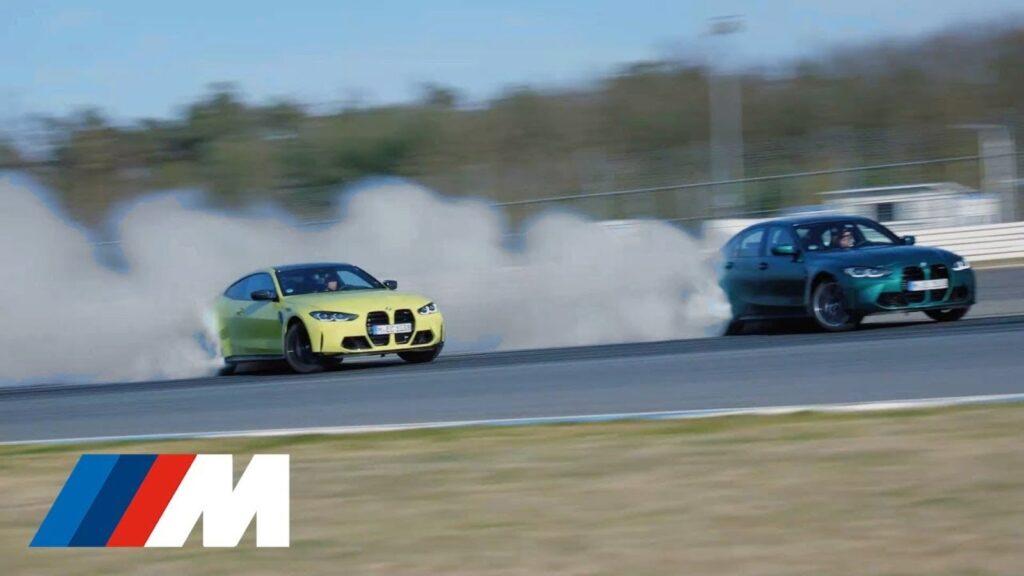
BMW has never been shy about letting its performance cars play at the edge of grip, but its latest patent idea takes a different route to sideways driving.
Rather than relying only on engine torque, differential behaviour or traction control mapping, the concept uses the suspension itself to help a car rotate into a drift.
It’s an intriguing look at how future performance software could move beyond the drivetrain and treat the chassis as an active part of the driving trick.

At a glance
- BMW has patented a system that could help initiate a drift by briefly reducing load on the rear tyres.
- The concept uses adaptive suspension or active roll-stabilisation hardware to move suspension components rapidly.
- There’s no confirmation that the technology will reach production, but it points to a new chassis-led approach to drift assistance.
A chassis-led way to start a slide
The patent describes a system that recognises when the driver is trying to get the car sideways, then reacts by briefly changing how much weight is acting on the rear axle.
By commanding part of the suspension to move upward very quickly, the system can momentarily reduce the load pressing the rear tyres into the road.
With less vertical load, the tyres need less torque to break traction, making the initial phase of a drift easier to trigger.
That’s the key distinction here.
Modern drift modes usually lean on power delivery, stability-control thresholds and electronically controlled differentials, while this idea uses body and suspension movement as the first nudge.
How the system would know when to intervene
The concept relies on sensors to identify the driver’s intention before the suspension actuation takes place.
BMW’s patent describes monitoring parameters such as vehicle speed and trajectory, with steering angle also potentially used to decide whether the function should be allowed to operate.
That matters because a system like this would need to be tightly controlled.
Reducing rear tyre load at the wrong moment could make a car feel unpredictable, so the operating window would likely be defined by very specific driving conditions.
In practice, that could mean the feature only activates when the car is already being driven in a manner consistent with drift initiation.
Why this is different from a conventional drift mode
BMW M cars already offer serious driver-adjustable performance systems, and models such as the M2 and M3 have made oversteer a familiar part of the brand’s modern identity.
This idea is more unusual because it doesn’t just permit slip or send more power rearward.
It changes the mechanical loading of the tyre contact patch for a split second, effectively making the rear axle easier to unstick.
For experienced drivers, that could make drift initiation feel more immediate and repeatable.
For engineers, it suggests another layer of performance tuning, where suspension, stability logic and powertrain behaviour all work together rather than in separate silos.
Patent promise and production reality
A patent doesn’t mean the feature is destined for the next BMW M car.
Automakers regularly protect engineering ideas that never make it to a showroom, especially when the concept depends on cost, calibration, durability and safety validation.
Still, the thinking is notable.
As performance cars become more software-defined, the most interesting developments may not always be bigger power figures or faster gearshifts.
Sometimes, the cleverest change is hidden in how a car moves its weight.
If BMW does develop this technology for production, it could give future M models a drift aid that feels less like an electronic safety net being loosened and more like the chassis actively helping the driver set the car at an angle.