Urban Jürgensen is one of those names that carries weight well before a new watch is placed on the table.
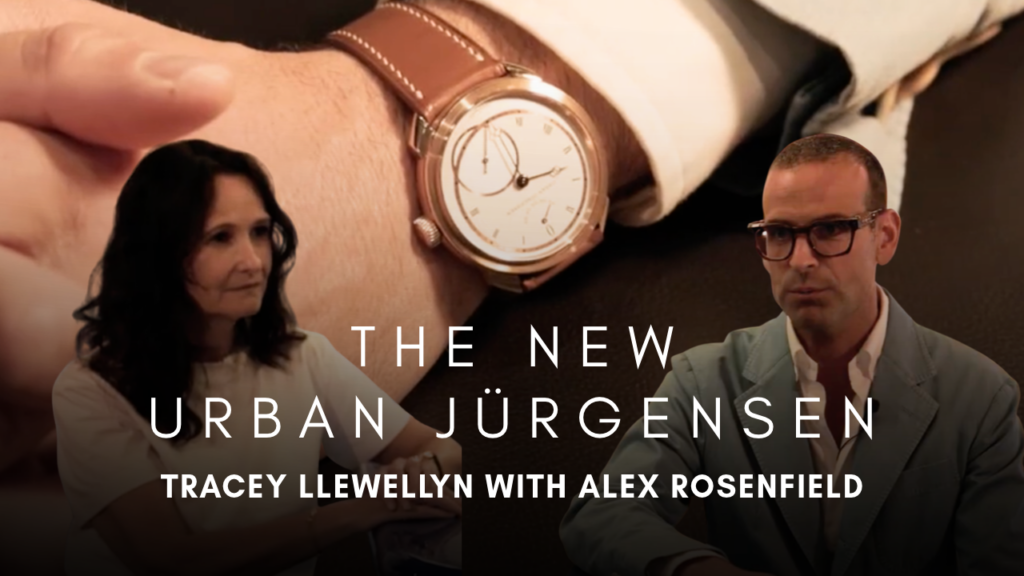
In a New York conversation with Tracey Llewellyn, CEO Alex Rosenfield lays out how the historic maison is being reshaped under new stewardship, and why the UJ2 has become an important signal of intent.
It’s less a story of nostalgia than one of calibration, with the brand weighing inherited craft against the demands of building a contemporary watch house.
At a glance
- Urban Jürgensen CEO Alex Rosenfield discusses the revived maison and the collector family now guiding one of watchmaking’s oldest names.
- The UJ2 sits at the heart of the new collection, presenting a restrained expression of the brand’s renewed direction.
- The conversation frames Urban Jürgensen’s next chapter around preservation, change, traditional craft and modern watchmaking.
A historic name enters new stewardship
Urban Jürgensen’s appeal has long rested on more than a logo or a lineage.
For Llewellyn, the fascination reaches back almost two decades, especially to the period associated with Peter Baumberger, Derek Pratt and Kari Voutilainen.
That era still matters because it helped shape how many serious collectors understand the maison today, as a house linked to careful handcraft, considered design and a particular strain of independent-minded horology.
Rosenfield’s role now is to explain what happens when that history is placed in the hands of a family of collectors rather than treated as a static archive.
The premise is delicate, because Urban Jürgensen has enough past to inspire reverence, but a revived maison also needs a living point of view.
The UJ2 and the value of restraint
The UJ2 is described as deceptively restrained, which may be the most revealing detail about the watch’s place in the new collection.
Rather than relying on obvious theatrics, it appears to function as a statement about control, proportion and confidence.
That matters for Urban Jürgensen because restraint is not the same as simplicity.
In fine watchmaking, a quiet watch can carry greater risk than an assertive one, since every choice has fewer distractions to hide behind.
The UJ2’s significance, as presented in the conversation, is not simply that it exists, but that it sits at the centre of how the maison wants to be understood now.
Craft, modernity and what should remain
The most interesting tension around Urban Jürgensen is not whether the past should be respected.
It clearly should be, and Rosenfield’s discussion with Llewellyn centres on what deserves preservation as the house moves forward.
The harder question is what must change.
A maison being rebuilt today can’t behave exactly as it did in an earlier generation, even when its identity depends on continuity.
That creates a useful editorial lens for the revived Urban Jürgensen, where traditional craft and modern watchmaking are not treated as opposing forces but as elements that must be brought into balance.
A different way to build a maison
Rosenfield’s perspective is shaped by the fact that Urban Jürgensen’s current chapter is being led by collectors who have become stewards.
That distinction matters because collectors often approach a watch house from the outside in, with an instinct for what enthusiasts notice, remember and question.
It can also sharpen expectations.
When a historically important name returns with a new collection, the audience is likely to include people who know the references, the personalities and the design codes already.
For that reader or collector, the UJ2 is interesting because it doesn’t appear to chase novelty for its own sake.
Its role is more measured, offering a way to read the maison’s priorities before the broader future fully comes into view.
Urban Jürgensen’s next chapter will be judged by how well it keeps faith with the qualities that made the name matter, while giving the house enough momentum to exist beyond memory.