Zenith’s Calibre 135 has always carried a particular kind of authority among movement enthusiasts.
With the G.F.J. Calibre 135 Double Signed with Naoya Hida & Co., that legacy returns in a highly focused ten-piece edition that treats precision, proportion and handwork as the main event.
It also marks the first creation in Zenith’s Double Signed Program, pairing the Le Locle manufacture with Japanese watchmaker Naoya Hida for a watch that feels deliberately restrained rather than nostalgic for its own sake.
At a glance
- Zenith has created a ten-piece G.F.J. Calibre 135 Double Signed edition with Naoya Hida & Co.
- The watch combines a 39.15 mm platinum case, a solid silver dial, hand engraving and blue Urushi lacquer accents.
- It uses a hand-wound COSC-certified Calibre 135 with a 72-hour power reserve and comes with three exclusive Japanese-made straps.
A restrained platinum case shaped by Naoya Hida’s eye
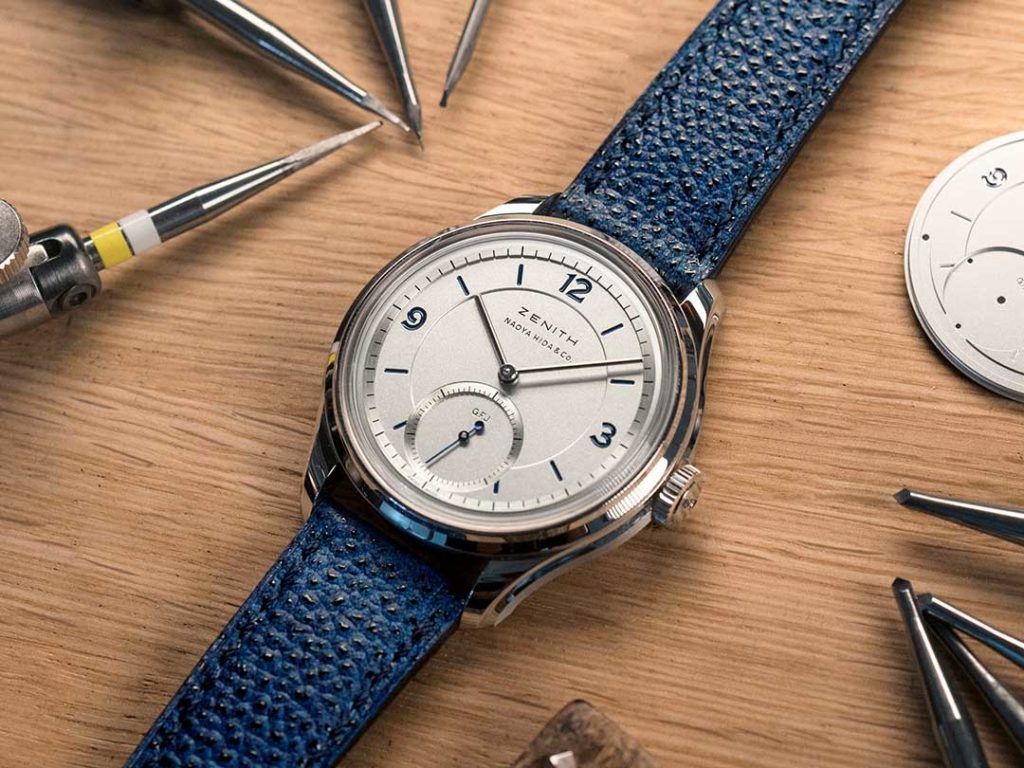
The watch is housed in a 39.15 mm platinum case, a size that gives the design presence without pushing it into contemporary excess.
Its proportions take cues from Naoya Hida’s NH Type 2A, a model known for its crisp geometry and quiet formality.
That influence suits Zenith’s Calibre 135 story particularly well, because this isn’t a watch trying to modernise a classic with volume or spectacle.
Instead, it leans into balance, surface quality and the sort of details that reward close inspection.
Silver, engraving and blue Urushi on the dial
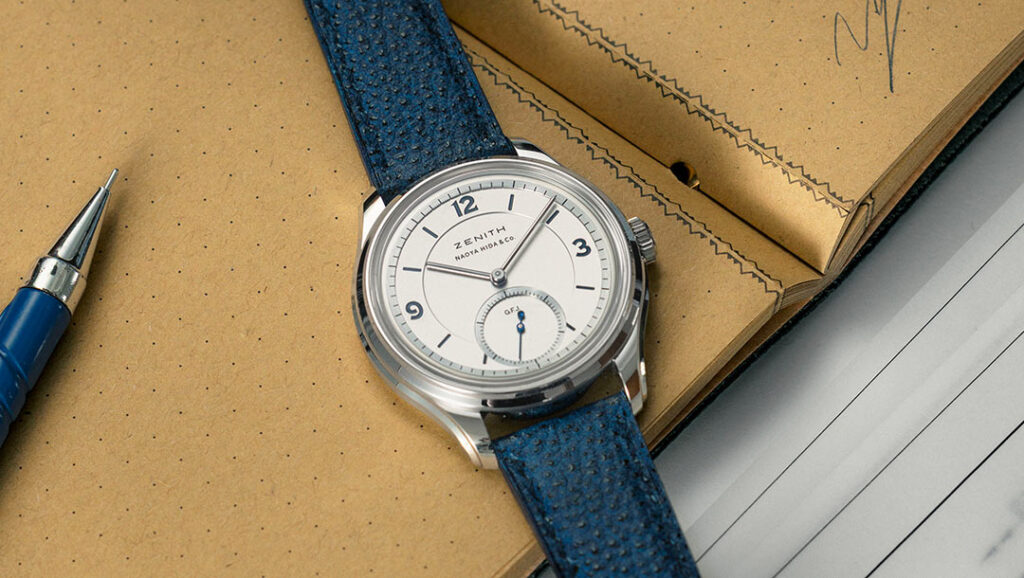
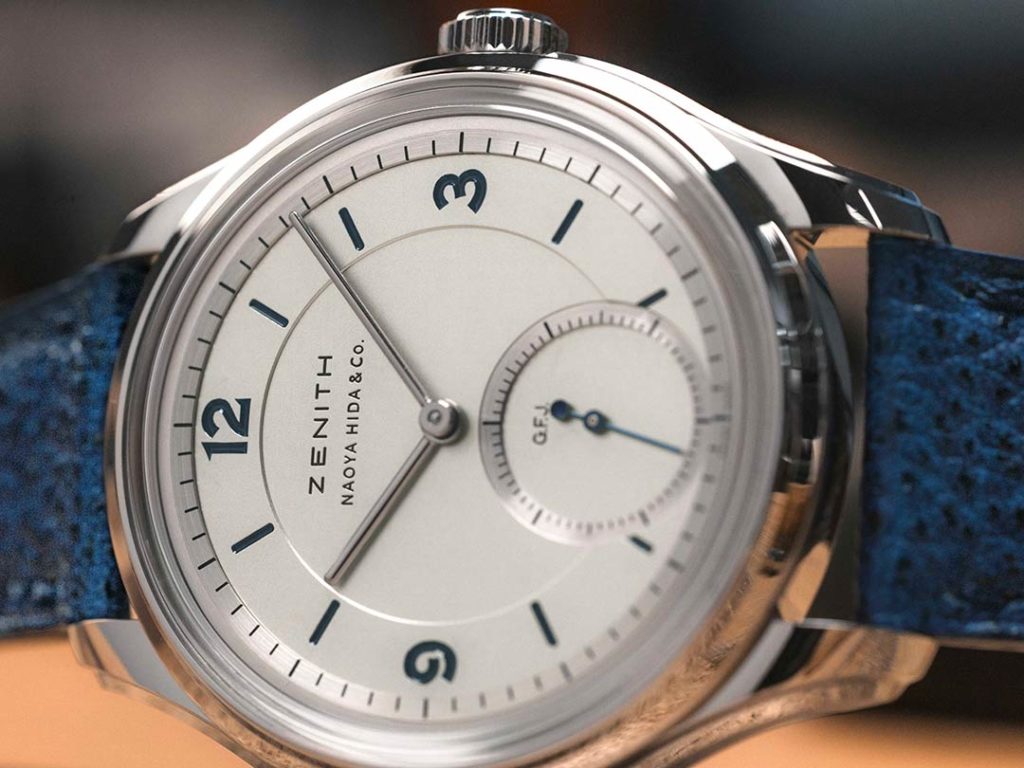
The solid silver dial is the clearest link to mid-century watchmaking, but the execution is distinctly contemporary in its precision.
Each hour marker and the double signature are hand-engraved by master engraver Keisuke Kano, then filled with blue Urushi lacquer.
That choice gives the dial depth without disturbing its restraint, especially against the cool tone of the silver base.
The hour and minute hands are made from hand-polished solid gold, while the small seconds hand at 6 o’clock is rendered in blued steel.
It’s a subtle mix of precious metal, craft technique and colour, with nothing on the dial fighting for attention.
The Calibre 135 returns as the centrepiece
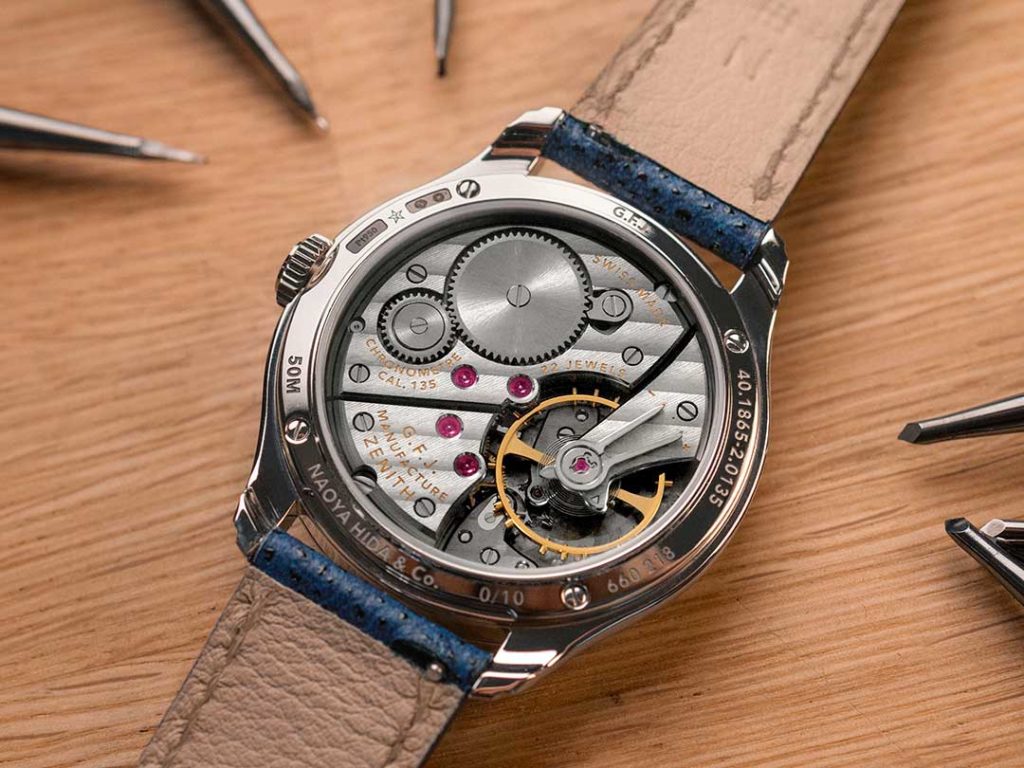
The hand-wound Calibre 135 is visible through the sapphire case back, which is important because the movement is more than a name printed on a dial.
Historically, Calibre 135 is remembered as one of the great competition movements of its era, and this edition keeps the emphasis on chronometric seriousness.
The movement is COSC-certified and beats at 2.5 Hz, with a large variable-inertia balance wheel, a Breguet balance spring and a stop-seconds mechanism.
Its 72-hour power reserve gives the watch practical range while preserving the charm of a manually wound calibre.
Finishing includes Côtes de Genève, a dark ruthenium treatment and gold accents, giving the movement architecture a more dramatic tone through the display back.
Details & Specifications
| Brand | Zenith |
|---|---|
| Model | G.F.J. Calibre 135 Double Signed with Naoya Hida & Co. |
| Edition | Limited to 10 pieces |
| Case size | 39.15 mm |
| Case material | Platinum |
| Dial | Solid silver with hand-engraved details and blue Urushi lacquer accents |
| Movement | Hand-wound Calibre 135 |
| Certification | COSC-certified |
| Frequency | 2.5 Hz |
| Power reserve | 72 hours |
| Key movement features | Variable-inertia balance wheel, Breguet balance spring, stop-seconds mechanism |
| Case back | Sapphire display back |
| Straps | Himeji Kurozan leather, Kyoto-crafted Wagyu leather and Japanese Kaihara denim |
| Buckle | Platinum pin buckle engraved with G.F.J. initials |
The three supplied straps add another layer to the collaboration, moving from Himeji Kurozan leather to Kyoto-crafted Wagyu leather and Japanese Kaihara denim.
Each is paired with a platinum pin buckle engraved with the G.F.J. initials, keeping the finishing language consistent even beyond the case and dial.
For collectors, the appeal is clear.
This is not simply a commemorative Zenith or a co-signed dial for its own sake, but a compact, carefully judged expression of one of the brand’s most important movements through the lens of Naoya Hida’s design discipline.