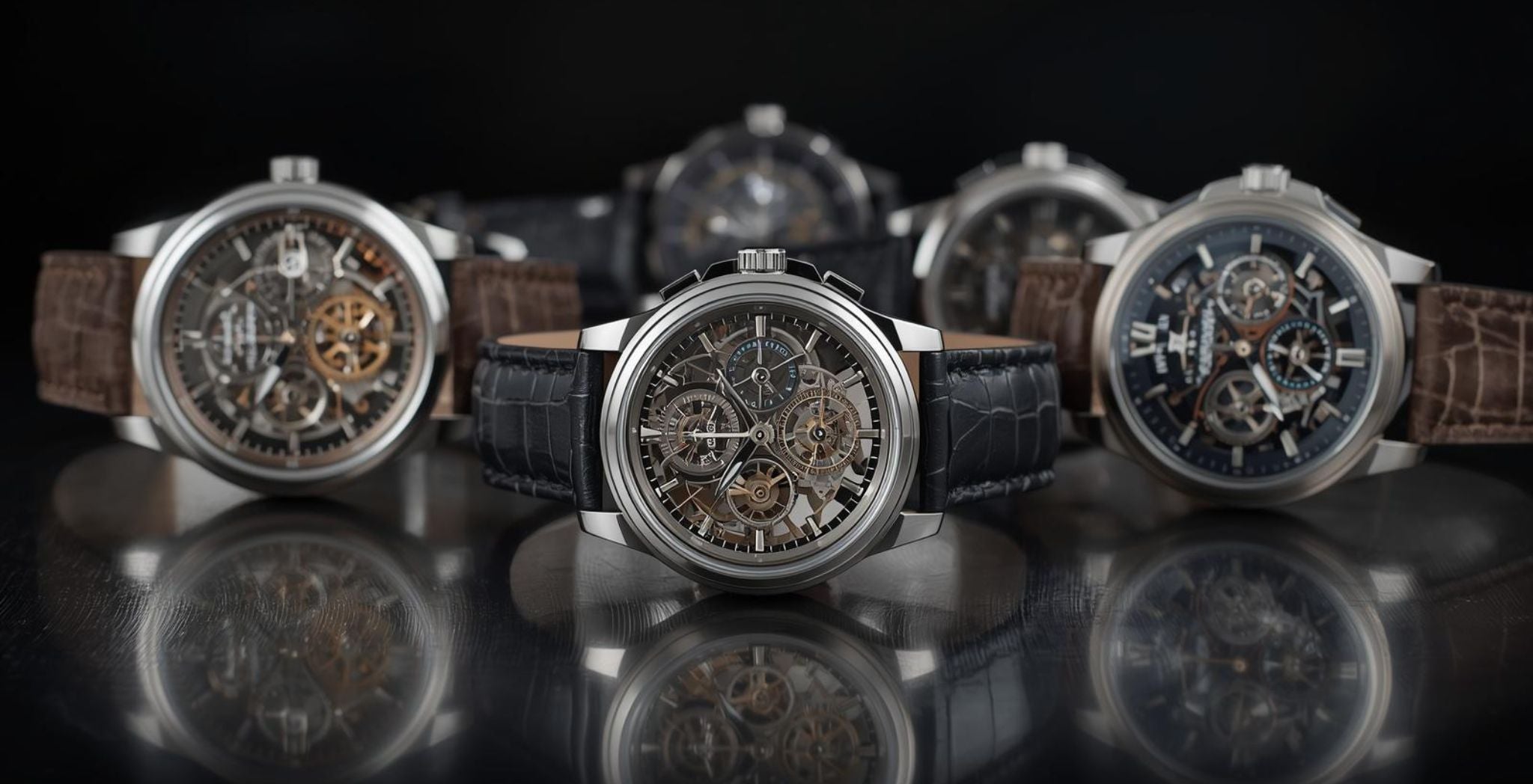
Rotary’s skeleton watches are built around a simple but enduring idea: the movement should be part of the design, not hidden beneath it. Across its men’s and women’s skeleton models, the brand uses open-worked dials to reveal the working mechanics below, turning a traditional dress watch into something more animated and more tactile.
A Long-Running Brand With the Right Backstory
Rotary was founded in 1895 in La Chaux-de-Fonds, Switzerland, and later became closely tied to the British watch market. That dual identity matters here. The brand’s skeleton watches are not trying to be avant-garde statement pieces; they sit closer to classic European dress-watch territory, with visible mechanics used as the point of interest rather than as an excuse for oversized or overcomplicated design.

That makes the Rotary skeleton formula appealing for buyers who want a mechanical watch with character, but without moving into high-luxury pricing or highly specialised collector territory. The attraction is immediate: look through the dial and you can see the balance, gear train and other working components doing their job in real time.
Open Dials, Wearable Cases
The men’s Rotary skeleton watches commonly use round stainless steel cases in the 40mm to 42mm range, a practical size for a modern mechanical watch. Many models pair brushed and polished finishing for contrast, while a domed mineral crystal adds depth to the open dial. The better examples work because they balance visual complexity with familiar proportions: there is enough exposed architecture to satisfy the mechanically curious, but the watch still reads as a proper timepiece rather than a display object.

Automatic versions add another layer of interest, especially when fitted with an exhibition caseback. Seeing the rotor move is one of those small pleasures that keeps mechanical-watch ownership engaging long after the novelty of the dial has worn off. Dress-oriented variants tend to be more restrained, often paired with black or brown leather straps, including alligator-pattern styles, for a more traditional formal look.
Women’s Skeleton Watches With Mechanical Substance
Rotary’s women’s skeleton watches take a different route from the common “shrink it and decorate it” approach. Case sizes typically sit between 30mm and 36mm, with silver and rose-gold-tone finishes used to soften the mechanical architecture visible beneath the crystal. The open-worked layout can give the dial an almost lace-like quality, but the appeal remains horological rather than purely decorative.

That is an important distinction. Women’s mechanical watches are still too often treated as a niche within a niche, yet a smaller skeleton watch can be one of the most interesting ways to wear a visible movement. On a cream leather strap, a Rotary skeleton can lean elegant and light; on a more classic dark strap, it becomes a compact dress watch with far more personality than a standard closed-dial design.
Who a Rotary Skeleton Watch Suits
A Rotary skeleton watch is best suited to someone who wants the charm of a visible mechanical movement in a watch that remains easy to wear. It is a natural fit for business-casual dressing, formal occasions and anyone buying a first mechanical watch who wants to understand what is happening under the dial. It also works for collectors who already own conventional three-handers and want something more visually engaging without stepping into an aggressively modern design language.

The key is choosing the right level of openness. A fully exposed dial delivers the most mechanical theatre, while a more structured skeleton layout preserves legibility and restraint. Case size and strap choice matter just as much: steel and leather keep the watch classic, while smaller case diameters make the design feel more refined.
Rotary’s skeleton watches succeed because they do not overcomplicate the proposition. They show the movement, keep the shapes familiar and make mechanical watchmaking feel approachable. For anyone drawn to the idea of seeing every second at work, they offer a straightforward and satisfying entry point into open-dial watch design.