Rolls-Royce has unveiled four new Bespoke craft techniques at London Craft Week 2026, presenting them through two Phantom Gallery artworks that turn the dashboard space of the Phantom into a miniature exhibition of handwork, material experimentation and engineering control.
The techniques include 3D leather hand-sculpting, beadwork at Gallery scale, 3D metal hand-sculpting and layered 3D veneer with integrated brass elements.
The Phantom Gallery as a space for fine craft
The Phantom Gallery is one of the most unusual canvases in contemporary luxury carmaking, a glass-enclosed section of the dashboard designed to hold commissioned work inside the cabin.
For Rolls-Royce, it has become a laboratory for the Bespoke Collective at Goodwood, where designers, engineers and craftspeople test how far traditional decorative disciplines can be pushed inside a motor car.
The wider Bespoke operation is supported by more than 2,500 people at the Home of Rolls-Royce in West Sussex, the only site where the marque designs, engineers and hand-builds every car.
Hand-sculpted leather flowers and bead-set fruit
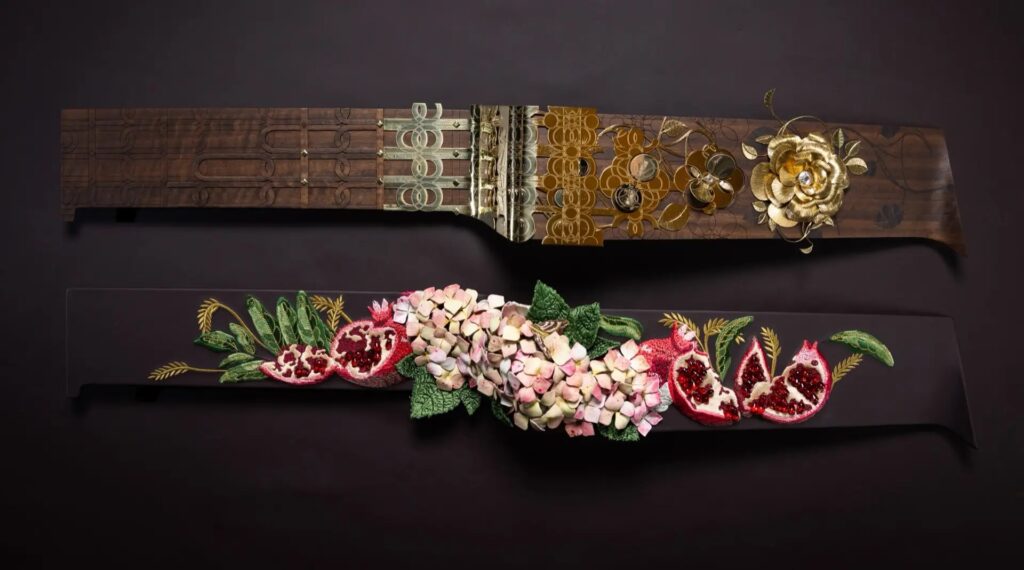
The first artwork, named Legacy Craft Inspired by Still Life, draws on Dutch Golden Age still-life painting and the embroidery traditions associated with the Arts and Crafts movement.
Its most striking elements are 50 hydrangea flowers, each individually sculpted from leather, then painted by hand so the pink tones deepen gradually toward the centre of each bloom.
The flowers are fixed to the Gallery surface with floral twine, while the leaves are made entirely from thread using a new Rolls-Royce technique called Sphinx Moth 3D embroidery.
The composition also includes embroidered pomegranates, each worked with alternate stitching and finished with 76 hand-sewn beads to evoke the translucent red quality of real seeds.
More than 250 hours of handwork went into the piece, with the layering and surface richness informed by late-19th-century haute couture embroidery.
Smoked eucalyptus, brass and a flower built like jewellery
The second artwork, Legacy Craft Inspired by The Draught, shifts from textile depth to architectural structure.
Its design begins with laser-etched patterns on smoked eucalyptus veneer, representing the draughtsman’s plan before the surface develops into layered 3D marquetry.
Multiple levels of laser-cut wood create a faceted relief, while brass inserts and a fine lattice take cues from Elizabethan and Jacobean strapwork as well as the iron grids used to support stained glass.
At the centre is a flower formed from five layers of brass, each petal cut by waterjet and then engraved by hand with more than 50 lines measuring just 0.2 mm wide.
That single brass detail required more than 45 hours to complete and uses modified tools developed by Rolls-Royce craftspeople for the task.
Where machine precision gives way to the hand
What makes these works compelling is not a rejection of technology, but the way digital and mechanical processes create a foundation for slower human finishing.
Laser cutting, waterjet shaping and digital patterning establish the geometry, while painting, engraving, embroidery and sculpting introduce the small variations that make each surface feel alive.
The two Phantom Gallery works are on public display at Rolls-Royce Motor Cars London on Berkeley Street in Mayfair from 11 to 17 May 2026 as part of London Craft Week.
For clients and collectors interested in contemporary craft, the message is clear enough: the future of automotive Bespoke work will be measured not only in materials, but in the invention of entirely new ways to work them.