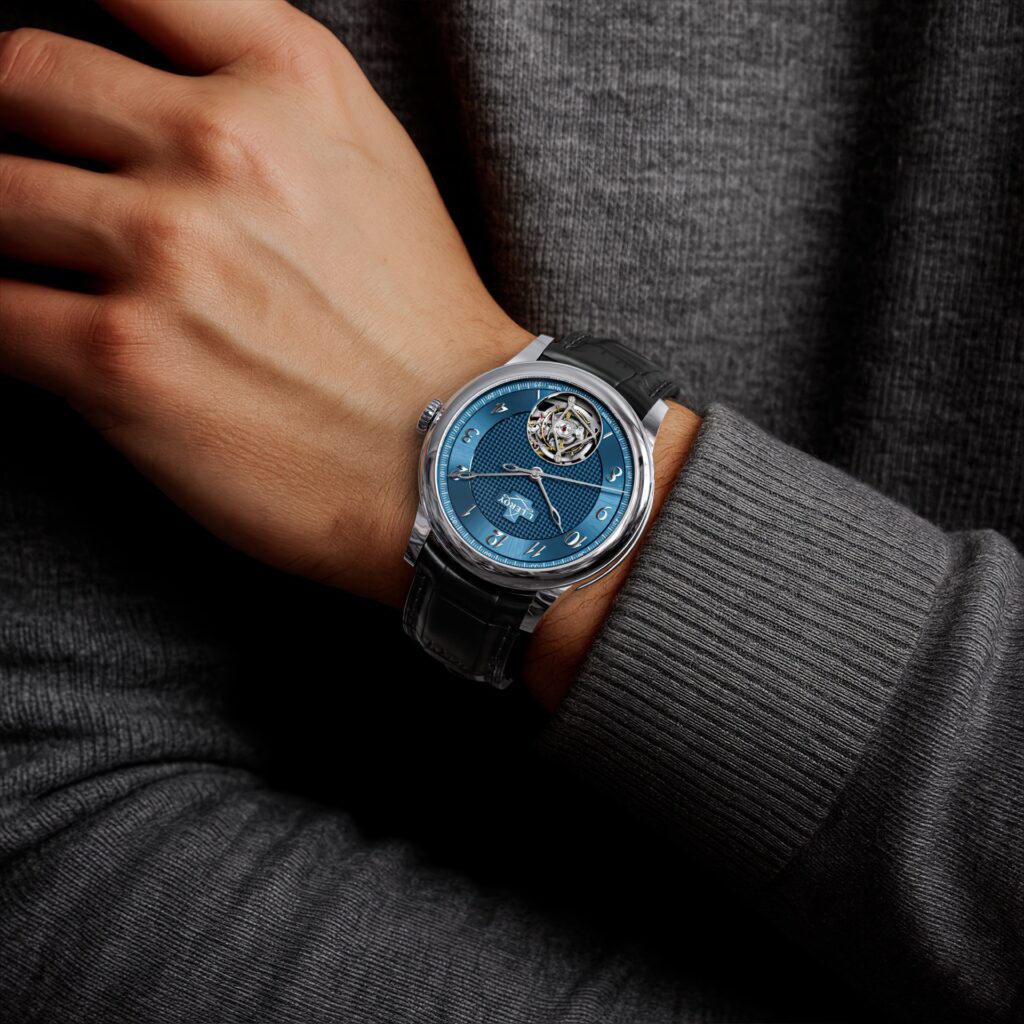
L.Leroy has introduced the ELYOR, a new flying tourbillon for the Osmior collection, shown during Geneva Watch Week 2026 in three case metals and three distinct dial executions.
It is a watch that leans on the Maison’s long chronometric memory without becoming a museum piece, using an old hidden signature as the name for one of its most technically ambitious modern models.
The ELYOR name returns with historic weight
L.Leroy was founded in 1785, and the ELYOR name reaches back to Charles Leroy, who used the anagram during the Reign of Terror to distance his work from royal associations.

That quiet historical detail now sits on a contemporary tourbillon that joins a brand lineage known for precision competitions, including 384 gold medals in chronometry.
The watch also fits the more formal side of L.Leroy’s catalogue, using the tambour case shape reserved for its classically inclined pieces.
Three metals and three dial personalities
The grade 5 titanium version uses a rhodium-plated silver hour track with a sunray finish, rhodium-treated applied Arabic numerals and a blue ALD-treated seconds hand as its only strong colour accent.
The platinum model gives the ALD treatment a larger role, applying it across the hour track for a sky-blue tone paired with rhodium-treated numerals.
The 18k 5N red gold version is warmer and moodier, with an anthracite sunray hour track, 5N gold-plated Arabic numerals and a matching gold-plated hour hand.
All three share a central Clous de Paris hobnail section, giving the dial a raised geometric texture that changes noticeably as light moves across it.
At 6 o’clock, the flying tourbillon is framed by a polished circlet, while its mirror-polished titanium bridge is shaped around L.Leroy’s interlaced double L monogram.
Calibre L600 keeps the tourbillon slim and visible
Inside the ELYOR is the proprietary self-winding calibre L600, a Geneva-developed movement made from 288 components and 34 jewels.
It runs at 21,600 vibrations per hour and uses a variable-inertia balance regulated by gold screws, with a Swiss lever escapement and a single barrel delivering 60 hours of power reserve.
The choice of a micro-rotor is central to the architecture, keeping the movement to 5.10 mm thick while leaving more of the finishing visible through the sapphire case back.
The rotor is made from gilded Inermet, a dense tungsten alloy that allows efficient winding despite its compact size, and it is finished with satin surfaces, sandblasted recesses and a raised polished logo.
The movement decoration is restrained but serious, with rhodium-plated frosted bridges, hand-polished bevels, circular perlage on the main plate and mirror-polished screw heads.
The tourbillon cage measures 13.60 mm, contains 78 components and completes one rotation every minute.
A dress tourbillon with measured proportions
The ELYOR case measures 42 mm across and 11.88 mm thick including the domed sapphire crystal, or 9.90 mm without it.
Those are controlled dimensions for an automatic flying tourbillon, especially one using a display-back micro-rotor calibre rather than hiding the winding system beneath a full rotor.
The case is finished with a polished domed bezel, a fluted crown engraved with the brand logo over a sandblasted surface, and a case back ring combining frosted sections, polished profiles and relief engraving.
Both front and rear crystals are sapphire with anti-reflective treatment, and water resistance is rated to 3 ATM.
Each watch is supplied on a black alligator strap with a large-scale upper and small-scale lining, closed by an open-worked deployant clasp in the matching case metal.
No official retail price has been announced, and production is expected to be limited across the titanium, platinum and red gold versions.
For collectors drawn to historically literate independent watchmaking, the ELYOR is most compelling as a complete proposition rather than a single-spec tourbillon, combining a meaningful name, a slim automatic calibre and three dial treatments that genuinely change the character of the watch.