Rado’s high-tech ceramic is now 40 years old, marking four decades since the 1986 launch of the Integral, the first serially produced watch to use the material for both its case and bracelet. What began as a pursuit of scratch resistance has become one of Rado’s most recognizable technical and design signatures.
From Sapphire Crystal to a Ceramic Watch
Rado’s path toward high-tech ceramic did not begin with a ceramic case. It started with the brand’s early use of sapphire crystal, a harder and more scratch-resistant alternative to acrylic and other weaker materials then used in watches.
The brand developed a patented sliding, water-sealed construction that tension-fit a thick, faceted sapphire crystal into an oval hard metal case using a specialized gasket. The success of that approach raised a broader question: could similar scratch resistance and toughness be extended beyond the crystal to more of the watch itself?
That question led Rado toward high-tech ceramic, a material that would become central to its identity.
The 1986 Integral Set the Template
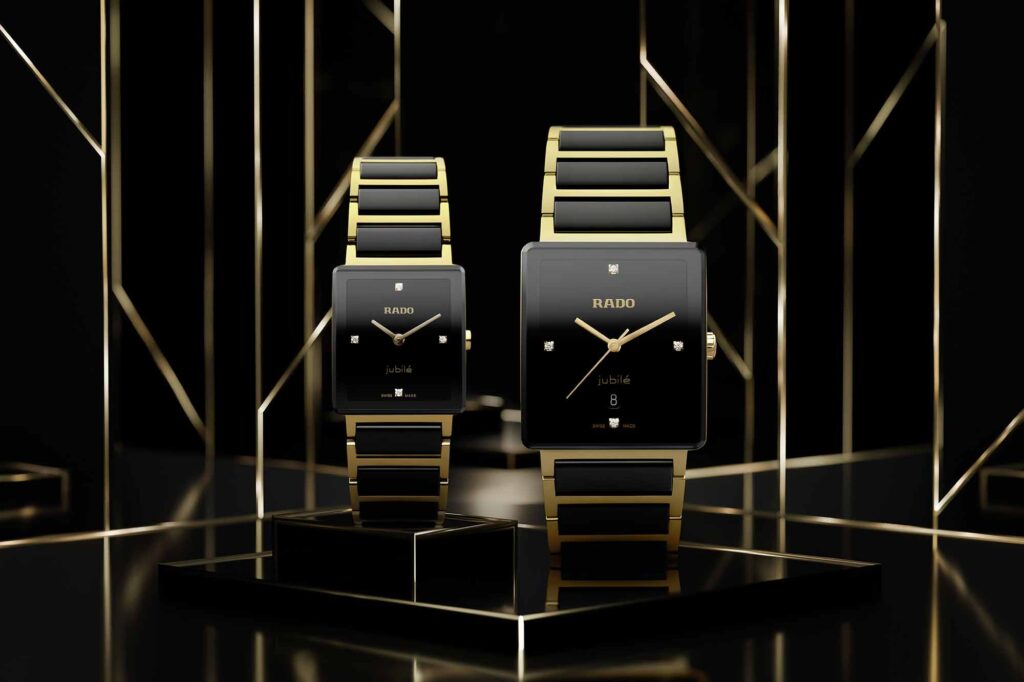
In 1986, Rado introduced the Integral. Its importance lies in how it used high-tech ceramic not as a decorative accent, but as a major structural and visual element across the case and bracelet.
The model established a direction the brand would continue to develop over the following decades. In 1992, Rado began introducing colored versions of high-tech ceramic. Later, the company refined injection molding techniques that allowed the material to be formed into more complex shapes.
By 2011, Rado had added another variation: plasma high-tech ceramic, a process that gives ceramic a metallic appearance without applying a metal coating.
How Rado’s High-Tech Ceramic Is Made
The process begins with high-purity zirconium oxide powder. Color is introduced early, so pigments are integrated into the material rather than applied to the finished component as a surface coating.
The zirconium oxide powder, pigment, and binder are mixed together. The material is then combined with a polymer binding agent, compressed into a solid form, and crushed back into granules. This creates a consistent feedstock suitable for molding.
Reducing porosity is a key goal. Once the feedstock is ready, it is heated until liquified and injected into molds under high pressure. Because the material shrinks during later stages, the molds are made roughly 25 percent larger than the intended final dimensions.
After cooling and removal from the molds, the components are placed in a chemical bath and then heated in an oven over two to three days. This dissolves the polymer binder and leaves a pure ceramic part at the correct size.
Finishing Ceramic With Ceramic
Once the components have reached their final size, they can be machined and polished. Rado’s finishing process uses ceramic against ceramic: the parts are placed in a vat with neutral-colored ceramic chips in various shapes and sizes, along with a water-based substance and abrasive material.
As the contents are agitated, the ceramic components are polished by contact with the ceramic chips. The result is a finished part without relying on a conventional metal-polishing process.
Plasma Ceramic and the Metallic Look Without Metal
One of Rado’s most notable ceramic developments is plasma high-tech ceramic. According to the account of the process, it emerged unexpectedly while the brand was experimenting with ways to make ceramic even harder by applying diamond to the surface at temperatures of 20,000°C.
At that extreme temperature, a reaction occurs within the ceramic structure, changing its composition and producing a metallic grey appearance. The key point is that the effect is not a coating and does not use actual metal to create the look.
A 40th Anniversary Return for the Integral
For the material’s 40th anniversary, Rado returned to the model that introduced high-tech ceramic to serial production: the Integral. The anniversary version closely follows the 1986 original while making measured updates.
Changes include a newer movement, a cleaner bezel design, a more tapered bracelet, and slightly larger proportions. The overall intent is less reinvention than revival, keeping the original Integral’s character intact while bringing it into the present.
Why the Material Still Matters
High-tech ceramic gave Rado a way to link technical performance with a distinct visual language. Its scratch resistance, integrated color, molded shapes, and later plasma finish all contributed to a design vocabulary that is difficult to separate from the brand.
Forty years after the Integral, the material remains a useful example of how watchmaking innovation can come not only from movements, but also from the case, bracelet, and the manufacturing methods behind them.