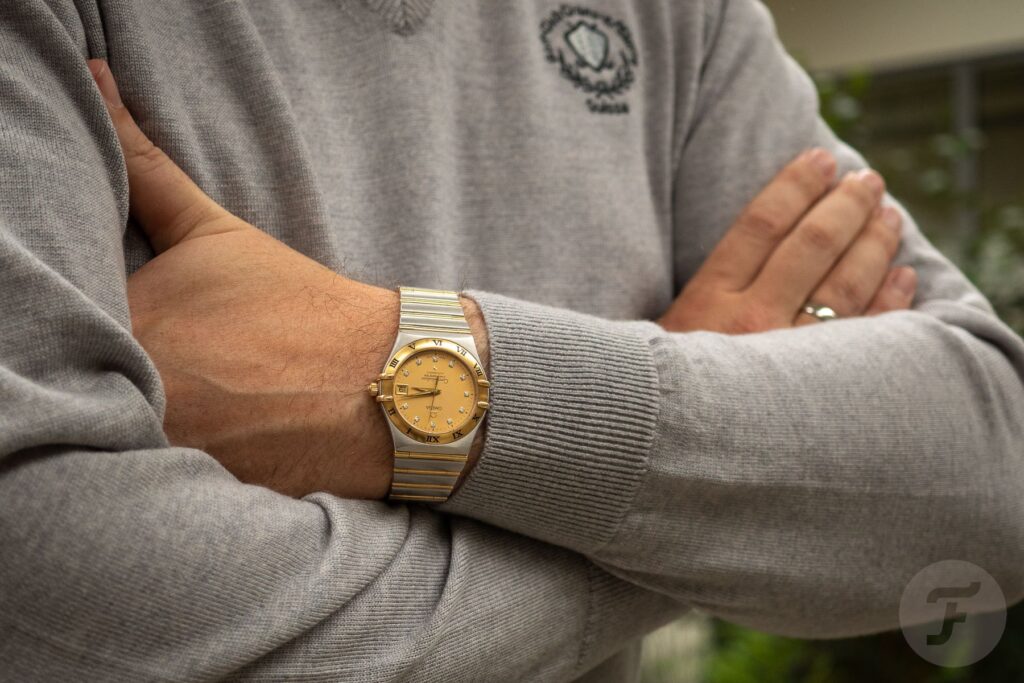
The Omega Constellation ’95 is a discontinued neo-vintage model that deserves attention from buyers looking for a thinner, dressier Omega at a relatively approachable price. Produced in several quartz and automatic versions, it combines modest dimensions with a recognizable 1980s-derived design, and many examples now trade well below the price of modern Omega models.
A compact Omega with a larger wrist presence
The Constellation ’95 arrived in 1995 as an evolution of the Constellation Manhattan design that Omega introduced in 1982. That means the watch is not purely a 1990s design; it is more accurately a refined version of an established integrated-bracelet Constellation formula.
For men’s models, the key sizes are 33.5mm for quartz versions and 35.5mm for automatic versions. Those numbers sound small by modern standards, but the tonneau-shaped case and integrated bracelet help the watch wear larger than the diameter suggests.
The automatic model measures about 38mm lug to lug and 9.5mm thick. It is not ultra-thin in the manner of high-end traditional dress watches, but it remains slim and comfortable, especially compared with many contemporary sports watches.
Quartz and automatic options
Omega offered both quartz and self-winding Constellation ’95 models. The automatic versions used Omega caliber 1120, an ETA 2892-A2-based movement with Côtes de Genève decoration and an Omega-signed rotor. The same base movement family also appeared in other Omega watches of the period, including the Seamaster 300M.
The quartz models are smaller and thinner, which makes them especially relevant for buyers who want a low-profile watch for formal wear or daily use. The automatic models add mechanical appeal while still keeping the overall package compact.
Why the Constellation ’95 matters now
Interest in smaller, thinner and more affordable watches has been growing among enthusiasts. The Constellation ’95 fits that shift well. It is dressier than many modern Omegas, yet still distinctive thanks to the integrated bracelet, Roman-numeral bezel details and decorative “claws” inherited from the Manhattan line.
The model also had a notable public profile in its day. After its 1995 launch, it was worn and promoted by prominent Omega ambassadors, including Cindy Crawford and Pierce Brosnan. Golfers such as Ernie Els and Bernhard Langer were also associated with the line. In 2001, Omega made a 1,500-piece Ernie Els limited edition, reference 1506.40, with a golf-ball motif on the dial.
Production span and later versions
The Constellation ’95 ran for many years. Omega introduced the Constellation Double Eagle in 2003, but the ’95-style line continued beyond that point. The final Constellation ’95 appeared in 2008, using the Co-Axial caliber 2500 to mark Omega’s 160th anniversary.
That long production window means there are many variations on the pre-owned market. Buyers will find steel, two-tone and quartz examples, as well as automatic references and special editions.
Current market pricing
The Constellation ’95 remains relatively affordable compared with many other Omega models. A steel automatic blue-dial reference 1502.40 can be found for less than €2,000, and the same applies to the white-dial reference 1502.30. Prices may be lower when sourcing from Japan.
Quartz models can cost substantially less. A blue-dial quartz reference 1512.40 can be found below €1,000. Two-tone automatic full-bar models currently tend to sell between €2,000 and €2,500.
For context, a two-tone quartz Constellation ’95 reference 1212.10 retailed for 4,000 Dutch guilders in 1998, roughly €1,815 before inflation adjustment. The automatic version cost 1,000 Dutch guilders more at the time.
Two-tone bracelets: full-bar versus half-bar
Two-tone Constellation ’95 models require extra attention because Omega made bracelet variations with either full-bar or half-bar gold links. The full-bar bracelet contains more gold, while the half-bar version uses less.
Useful references include the full-bar two-tone reference 1202.10 with a champagne dial and reference 1202.30 with a white dial. Half-bar versions include reference 1302.10 with a champagne dial and reference 1302.30 with a white dial.
Listings are not always accurate. Some sellers mix up full-bar and half-bar reference numbers, often by mistake. Buyers should compare the bracelet itself with the stated reference rather than relying only on the listing title.
What to check before buying
Reference accuracy is important. Some watches are listed under the wrong number, and some pre-1995 Constellation models may be described as Constellation ’95 pieces even though they lack the later dauphine hands, dial motif or correct movement. Earlier watches may use older calibers such as Omega caliber 1109.
Omega’s online catalog can help verify reference numbers. It is also worth checking bracelet condition carefully. A complete bracelet should have 23 links including the clasp links, and the bracelet should look fluid rather than stretched or bent. Excessive gaps between links can indicate problems.
Original box and papers are not unusual for this era, so it is reasonable to look for a complete set. However, Omega boxes from the 1990s often deteriorate, so a worn box is common and not automatically a warning sign.
Is the Omega Constellation ’95 worth considering?
For buyers who like the design, the Constellation ’95 offers a strong combination of comfort, reliability and value. The quartz models are especially thin and affordable, while the automatic versions provide a compact mechanical Omega with a proven ETA-based movement.
The styling will not suit everyone, particularly the decorative claws and integrated bracelet, but that is also what gives the watch its character. As interest in 1980s and 1990s watches continues to grow, the Constellation ’95 stands out as an overlooked neo-vintage Omega that can still be bought at sensible prices.