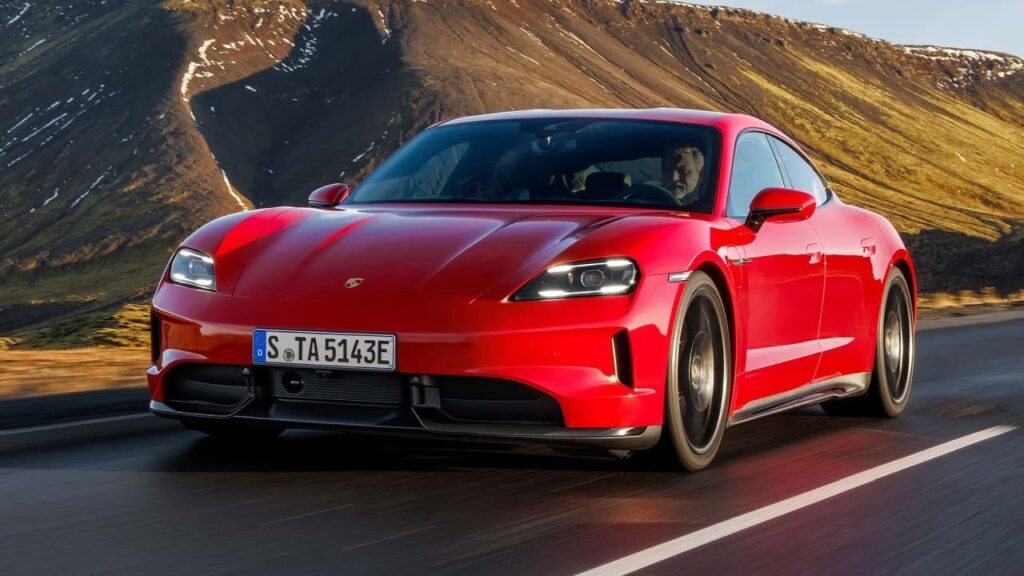
The Porsche Taycan helped make the electric performance sedan feel credible, desirable and very Porsche.
Now its long-term future appears less certain, with Porsche understood to be preparing to end Taycan production by 2030 rather than move assembly to Leipzig.
The timing matters because the Taycan was never a fringe experiment for the brand. It was Porsche’s first serious electric statement, and for a few years, it looked like the shape of its next era.

At a glance
- Porsche is understood to be planning to phase out the Taycan EV by 2030 at the latest.
- The plan would keep the model from moving from Stuttgart-Zuffenhausen to Leipzig, despite earlier relocation expectations.
- Taycan deliveries have fallen sharply, while Porsche EV buyers increasingly favour the newer Macan Electric.
The Taycan’s role inside Porsche is changing
The Taycan arrived as the car that had to prove Porsche could build a proper driver’s EV without simply leaning on acceleration numbers.
It did that with unusual conviction, combining a low-slung four-door shape with a cabin and road feel that stayed close to the brand’s sports-car language.
Its position now looks more complicated.
Porsche management and the company’s works council are understood to have reached an in-principle agreement to phase out the Taycan rather than continue with a previous plan to shift production from Stuttgart-Zuffenhausen to Leipzig.
Porsche hasn’t publicly confirmed the move, so the final timeline remains subject to the company’s formal product planning.
Demand has moved away from the electric sports sedan
The business case around the Taycan has become harder to defend as demand has cooled.
Global deliveries were roughly 41,000 units in 2023, before dropping to around 16,000 in 2025.
The first half of 2026 brought another stark number, with about 6,000 units delivered worldwide.
That decline doesn’t make the Taycan irrelevant, but it does show how quickly the premium EV market has changed.
Luxury buyers have continued drifting toward higher-riding vehicles, and Porsche’s own electric portfolio now gives them an obvious alternative in the Macan Electric.
For many customers, the SUV format simply makes more daily sense, especially when it carries the same badge and a newer product cycle.
What this says about Porsche’s EV strategy
If the Taycan does leave the line by 2030, it won’t necessarily signal a retreat from electric cars.
It would be a more specific correction around body style, customer demand and where Porsche chooses to place its investment.
The Macan Electric is better aligned with the broader luxury market, where SUVs continue to dominate purchase decisions across combustion, hybrid and electric segments.
The Taycan, by contrast, sits in a narrower lane as a performance-focused electric sedan with a more specialised audience.
That audience still exists, but the numbers suggest it may not be large enough to justify the model’s earlier industrial roadmap.
Details & Specifications
| Brand | Porsche |
|---|---|
| Model | Taycan |
| Vehicle type | Electric performance sedan |
| Current production location | Stuttgart-Zuffenhausen |
| Earlier production plan | Relocation to Leipzig had been considered |
| Potential production end | By 2030 at the latest |
| Global deliveries in 2023 | Approximately 41,000 units |
| Global deliveries in 2025 | Approximately 16,000 units |
| Deliveries in first half of 2026 | Approximately 6,000 units |
The Taycan’s possible exit would mark the end of an important chapter rather than a quiet failure.
It gave Porsche an electric flagship with genuine identity, but the market is now rewarding practicality and height as much as speed and engineering polish.
For collectors and enthusiasts, that may eventually make the Taycan more interesting, not less.