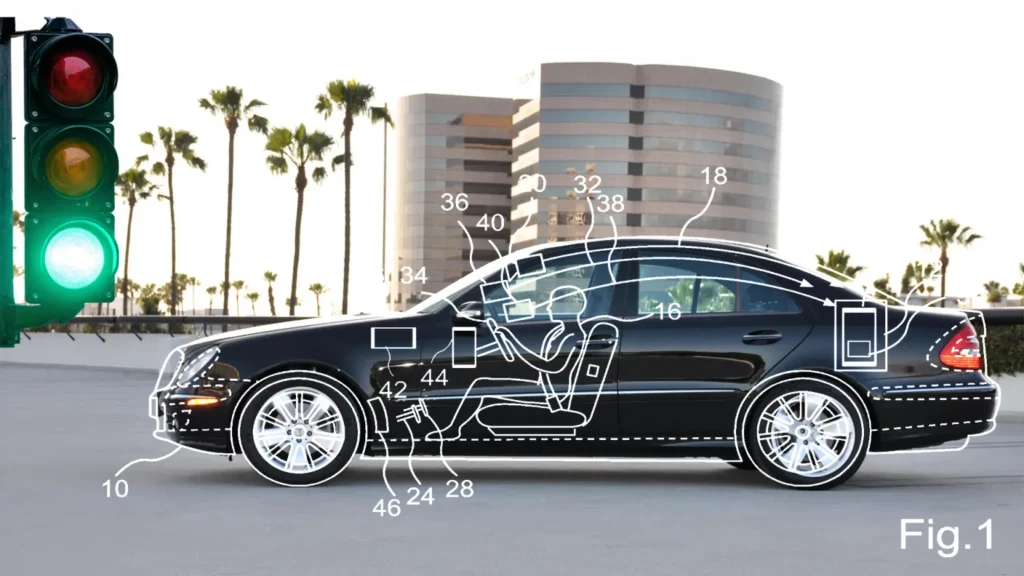
Mercedes-Benz has put a fresh spin on launch control, and it has little to do with a race track start line.
A newly published patent application describes a system that could watch traffic lights, recognise the switch from red to green, and then accelerate the car without waiting for the driver’s reaction.
It’s only a patent application for now, not a confirmed production feature, but it gives a useful glimpse at how performance software could start overlapping with driver-assistance technology.
At a glance
- Mercedes-Benz has published a patent application for launch control that can detect when a traffic light turns green.
- The concept uses cameras and machine learning, with an algorithm intended to manage smooth acceleration and vehicle stability.
- The patent describes examples including a launch to around 40 mph and acceleration up to 70 mph when joining a motorway, but production plans aren’t confirmed.
A launch system built around reaction time
Traditional launch control can prepare the car, manage traction and optimise acceleration, but it still depends on the driver choosing the exact moment to go.
Mercedes-Benz’s patent application frames that human reaction time as a limiting factor.
The proposed system would instead monitor traffic signals and identify the change from red to green, allowing the vehicle to begin accelerating automatically from a standstill.
That turns launch control from a driver-triggered performance tool into something closer to a situational response system.
Cameras, machine learning and smoother acceleration
The application describes the use of cameras and machine learning to recognise traffic light status.
Once the system detects the relevant change, an algorithm would manage acceleration with the aim of keeping the vehicle stable and making the launch feel controlled rather than abrupt.
The examples in the patent are not limited to a standing start at an intersection.
Mercedes-Benz also describes acceleration to around 40 mph from rest, as well as reaching speeds of up to 70 mph when joining a motorway from an entrance ramp.
That second scenario is notable because it points beyond novelty performance and toward a possible use case in merging traffic, where timing and consistent acceleration matter.
The production question remains open
A patent application doesn’t mean the technology is heading to a showroom.
Automakers routinely protect ideas that may never become production equipment, and Mercedes-Benz has not confirmed plans to offer this traffic-light-detecting launch control on a customer vehicle.
There is also a broader context here.
General Motors has also patented an automatic launch control system able to detect green lights, though its concept is aimed at a drag strip setting rather than everyday traffic lights.
That makes Mercedes-Benz’s application especially interesting, because it imagines launch control operating in a more ordinary driving environment.
Details & Specifications
| Brand | Mercedes-Benz |
|---|---|
| Subject | Patent application for traffic-light-detecting launch control |
| Detection method | Cameras and machine learning |
| Core function | Detects a red-to-green traffic light change and can automatically accelerate the vehicle from a standstill |
| Control focus | Smooth acceleration and vehicle stability |
| Example acceleration | Around 40 mph from a standstill |
| Additional example | Up to 70 mph when joining a motorway from an entrance ramp |
| Production status | No confirmed production plans |
If it ever reaches production, the appeal won’t just be quicker getaways from a stoplight.
The more compelling idea is a car that can judge the moment more precisely than its driver, then apply performance hardware with a level of consistency that feels less like showing off and more like software quietly doing its job.