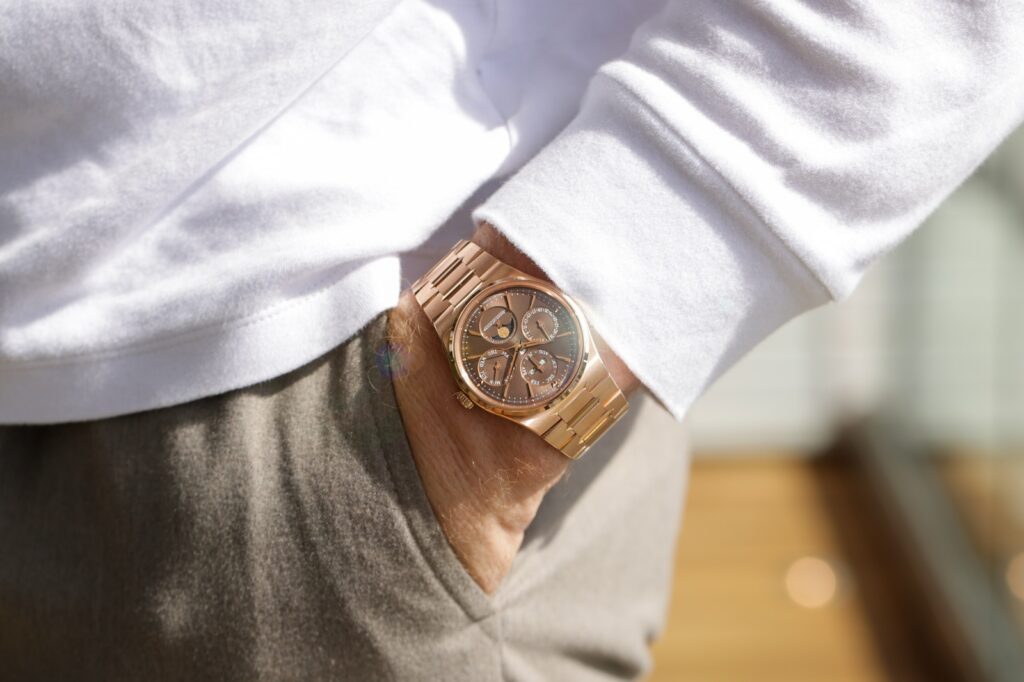
Jaeger-LeCoultre has always been closely tied to Le Sentier, but its latest certification makes that relationship feel newly relevant.
The High Precision Guarantee, known as HPG, is the manufacture’s in-house seal for finished watches, introduced with the Master Control Chronometre collection at Watches and Wonders.
It matters because it looks beyond the movement on a test bench and asks how the watch performs once it’s cased, finished and ready to live on a wrist.

At a glance
- Jaeger-LeCoultre’s HPG seal is an in-house certification for finished watches, currently used on the Master Control Chronometre models.
- The three-day test simulates wear through position changes, shocks, temperature shifts and altitude checks, while also requiring traditional movement finishing.
- The Master Control Chronometre Date starts at £12,700 in steel, with wider use of the HPG seal planned across collections from 2027.
Le Sentier remains the centre of gravity
Jaeger-LeCoultre’s manufacture sits in the Vallée de Joux, the high Swiss valley in the Jura that has been central to the brand since 1833.
The setting is more than scenic context.
At just over 1,000 metres above sea level, the valley’s isolation helped shape a culture of winter craft, even if the region’s horological roots also grew from earlier traditions in ironworking and gem cutting.

Today, the Le Sentier site contains 82 workshops, 180 different crafts and more than 800 people working on production alone.
That scale helps explain the ambition behind HPG.
This isn’t a small finishing flourish or a romantic stamp on the caseback, but a system intended to fold testing, regulation and finishing back into the same manufacture that builds the watch.

What the HPG seal actually checks
HPG stands for High Precision Guarantee, a name Jaeger-LeCoultre first used on a dial in 1970 with the Polaris II and has now revived as a certification seal.
In its current form, the seal applies to the finished watch rather than only to the uncased movement.
Each HPG watch is tested individually, and the emblem is engraved on the caseback once the watch has completed the process.
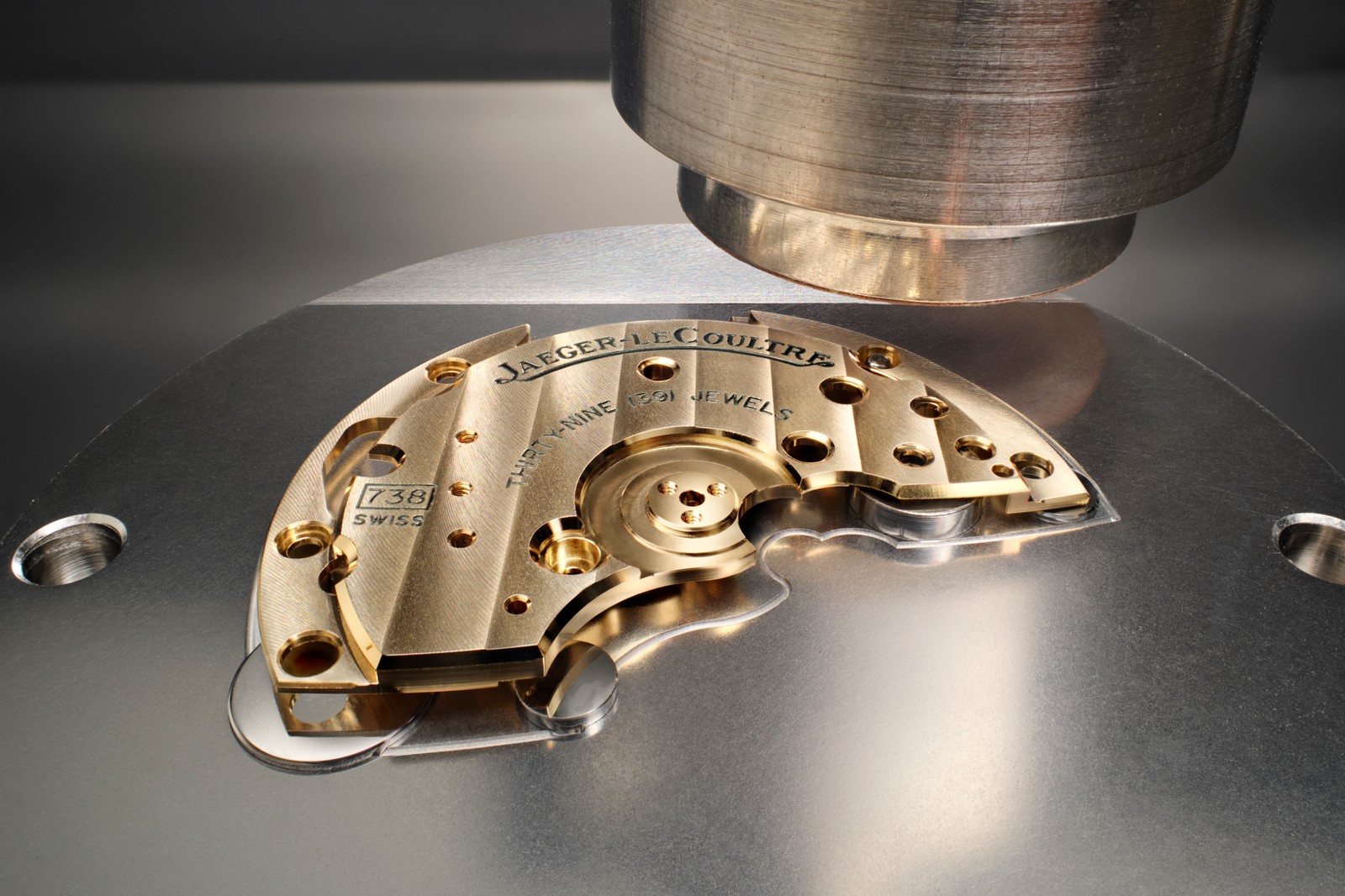
The distinction matters because the long-established COSC chronometer test, introduced in 1973, certifies movements before casing.
Standard COSC testing runs for 15 days across five positions and three temperatures, making it a serious benchmark for the calibre, but not a full assessment of the assembled watch.
Jaeger-LeCoultre has a longer history with whole-watch testing than many realise.

Its 1,000 Hours Control programme arrived with the original Master Control in 1992, more than two decades before METAS began certifying cased watches for Omega in 2015.
METAS has also certified cased Tudor watches since 2021, while COSC has added an Excellence Chronometer tier that tests finished watches under simulated wear to a published -2/+4 seconds per day tolerance.
HPG sits in that same wider conversation, though it remains Jaeger-LeCoultre’s own standard rather than an independent certification.
For the Master Control Chronometre, that distinction is softened by the fact that each movement first passes COSC before the cased watch goes through HPG.
Real-world simulation, with one notable caveat
The HPG test runs over three days on a machine developed by Jaeger-LeCoultre, which the brand describes as patent pending.
Altitude is tested on the calibre alone from sea level to 1,004 metres, a figure that mirrors the elevation of the manufacture itself.
The rest of the process takes place after casing.
For the first two days, the watch is moved through different positions, including dial up and crown down, while receiving shocks between 25G and 50G.
The active phases are held at 35°C, while rest periods drop to 18°C.
The third day is effectively a standstill test, leaving the watch at rest rather than in motion.
The temperature range is the part collectors will notice most.
An 18°C low is less demanding than a cold day in many parts of Europe, and it is narrower than standard COSC temperature testing, which includes 8°C and 38°C.
That doesn’t make HPG insignificant, but it does explain why the combination of COSC and HPG is more convincing than HPG alone.
Details & Specifications
| Brand | Jaeger-LeCoultre |
|---|---|
| Seal | High Precision Guarantee, or HPG |
| Current collection | Master Control Chronometre |
| Current HPG models | Master Control Chronometre Date, Date Power Reserve and Perpetual Calendar |
| Test duration | Three days |
| Testing scope | Finished cased watch for most checks; altitude tested on the calibre alone |
| Altitude test | Sea level to 1,004 metres |
| Shock testing | 25G to 50G |
| Temperature profile | 35°C during active phases and 18°C during rest phases |
| Finishing requirement | At least six of eight traditional finishing techniques |
| Known UK prices | Date from £12,700 in steel; Date Power Reserve £15,300; Perpetual Calendar £41,000 in steel |
| Planned expansion | Jaeger-LeCoultre plans to extend the seal through its collections from 2027 |
Finishing becomes part of precision
HPG doesn’t only measure rate stability.
To qualify, a movement must display at least six of eight traditional finishing techniques, drawn from bevelling, burnishing, circular smoothing, linear smoothing, countersunk jewels, Côtes de Genève, perlage and polished screw heads.
Jaeger-LeCoultre does not state that these techniques must be executed by hand.
That leaves room for purists to argue over romance versus reality, but the more interesting point is the brand’s decision to connect finishing with performance.
Jaeger-LeCoultre’s position is that finishing isn’t purely decorative.
Polishing can reduce friction, Côtes de Genève are said by the manufacture to trap dust, and cleanly finished edges reduce the risk of burrs or particles finding their way into the movement.
It’s a pragmatic view of decoration, and one that suits a manufacture known as much for depth of craft as for volume of calibres.
MasterCare adds a new ownership layer
The other new piece in Jaeger-LeCoultre’s ecosystem is MasterCare, a storage and care service launching from 16 November 2026.
Owners can deposit eligible watches in a secure facility inside the Le Sentier manufacture, where Jaeger-LeCoultre will wind them, check timing across the full power reserve and test every complication.
Each watch receives a quarterly report, and the manufacture contacts the owner before carrying out any required work.
Access is by application and subject to a fee, with eligibility based on ownership history with the brand and proof of ownership.
Each watch must already have been serviced by Jaeger-LeCoultre, and vintage pieces are not eligible.
Collection is deliberately personal rather than logistical.
Owners bring watches in and collect them themselves, with 48 hours’ notice required for pickup, while visits include private tours, workshops and lunch.
It won’t appeal to every collector, but it reflects where serious watch ownership has been heading.
For Jaeger-LeCoultre, HPG certifies the watch at the point of creation, restoration brings older pieces back to standard, and MasterCare offers a way to look after them in between.
That makes the new seal more than a caseback engraving.
It is Jaeger-LeCoultre turning its manufacture into a longer-term point of trust, from the first test of a finished watch to the years that follow.